


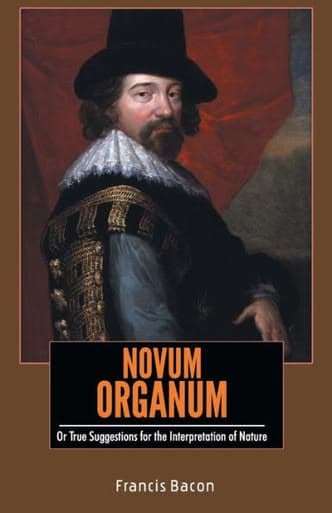
Novum Organum, or True Directions Concerning the Interpretation of Nature

Bacon's Novum Organum argues that the human understanding must be purged of its natural and acquired distortions—the 'idols'—before a new method of induction can yield genuine knowledge of nature. The work's distinctive mechanism is the inductive ascent from particulars to axioms by way of tables of presence, absence, and degree, replacing the syllogism of the schools. Its central claim is that knowledge should be pursued for power over nature and the relief of humanity's estate, and that the anticipations of the mind must give way to the slow, disciplined interpretation of nature.
Key Insights
✦What are the four idols of the mind, and how do they function in Bacon's argument?
The four idols are the sources of error that distort human understanding. The idols of the tribe are rooted in human nature itself—the tendency to see order where there is none, to generalise from limited experience. The idols of the cave are peculiar to the individual, arising from temperament, education, and habit. The idols of the marketplace arise from language and social interaction, where words are mistaken for things. The idols of the theatre are derived from received philosophical systems, which Bacon compares to stage plays that create imaginary worlds. The doctrine is diagnostic: it explains why learning has failed to advance despite the efforts of countless scholars. The new method of induction is designed to overcome these errors by proceeding carefully from particulars to axioms, avoiding the premature generalisation that the idols encourage.
✦What is the method of induction that Bacon proposes, and how does it work in practice?
Bacon's method of induction proceeds by compiling 'tables' of particulars: a table of presence (instances where the phenomenon appears), a table of absence (instances where it is absent but similar in other respects), and a table of degree (instances where the phenomenon varies in intensity). By comparing these tables, the investigator can identify the 'form' of the phenomenon—its underlying nature or cause. Bacon calls this process 'interpretation of nature,' as opposed to the 'anticipations of the mind,' which leap to general conclusions from insufficient evidence. The method is slow and laborious, requiring the collection of vast numbers of observations. Bacon acknowledges that it is not yet fully exemplified in the Novum Organum; the work presents the method rather than a complete demonstration of it.
✦How does the Novum Organum relate to the Great Instauration, and what is its place in Bacon's larger project?
The Novum Organum is the second part of the Great Instauration, Bacon's six-part plan for the reform of learning. The title is a deliberate contrast with Aristotle's Organon, the collection of logical treatises that dominated medieval and Renaissance education. The Novum Organum is both destructive and constructive: it begins with the doctrine of the idols, which diagnoses the sources of error, and then presents the new method of induction. It is the philosophical heart of the Great Instauration, the part that provides the instrument for the advancement of knowledge. The other parts of the plan—the survey of existing sciences, the natural history, the ladder of intellect, the anticipations, and the new philosophy—were never completed, making the Novum Organum the most substantial surviving part of Bacon's project.
✦How was the Novum Organum received in the seventeenth century, and what was its influence on the development of science?
The Novum Organum was widely read and admired, though its method of induction was not adopted in the exact form Bacon proposed. Its influence on the ideology of the new science was enormous. The Royal Society, founded in 1660, looked to Bacon as a guiding spirit, and his vision of collaborative, methodical inquiry informed its early programs. The work's emphasis on the practical benefits of knowledge—the relief of humanity's estate—became a central justification for scientific research. Historians of science note that the Novum Organum and The Advancement of Learning together constituted a manifesto for a new kind of learning, one oriented toward power over nature rather than contemplation of ancient texts. Its influence has been enduring, even if its specific method has been modified by later scientists and philosophers.
✦What was the 'first English edition' of the Novum Organum, and how was it translated?
The Novum Organum was first published in Latin in 1620. English translations circulated in manuscript before the first printed English edition, which appeared in the collected Works of 1676. The translation was not by Bacon himself; like many of his Latin works, it was rendered into English by others. The standard modern English translation is by Peter Urbach and John Gibson, published in 1994, which aims to be both accurate and readable. Earlier translations, such as those by James Spedding, Robert Leslie Ellis, and Douglas Denon Heath in the nineteenth century, remain valuable for their scholarly apparatus. Readers should be aware that the Latin original is the authoritative text, and that translations differ in their rendering of Bacon's technical vocabulary.
✦What is the most common misunderstanding of Bacon's inductive method?
The most common misunderstanding is that Bacon advocated a simple enumeration of instances—collecting observations and generalising from them without the use of hypotheses. In fact, Bacon's method is more complex. He insists on the importance of negative instances, of experiments that vary conditions, and of a process of elimination that he calls 'exclusion.' He also recognises that the mind cannot proceed without some direction, though he is wary of the premature hypotheses that the idols encourage. The method is not a mechanical algorithm but a disciplined practice of inquiry. Reading the Novum Organum as a defence of naive empiricism misses the sophistication of Bacon's account of how the mind should be purged and directed in the interpretation of nature.
Wealthy Psyche is an intellectual archive. We do not host, distribute, or sell book copies — physical or digital. We provide structured knowledge to help you think better, faster.