


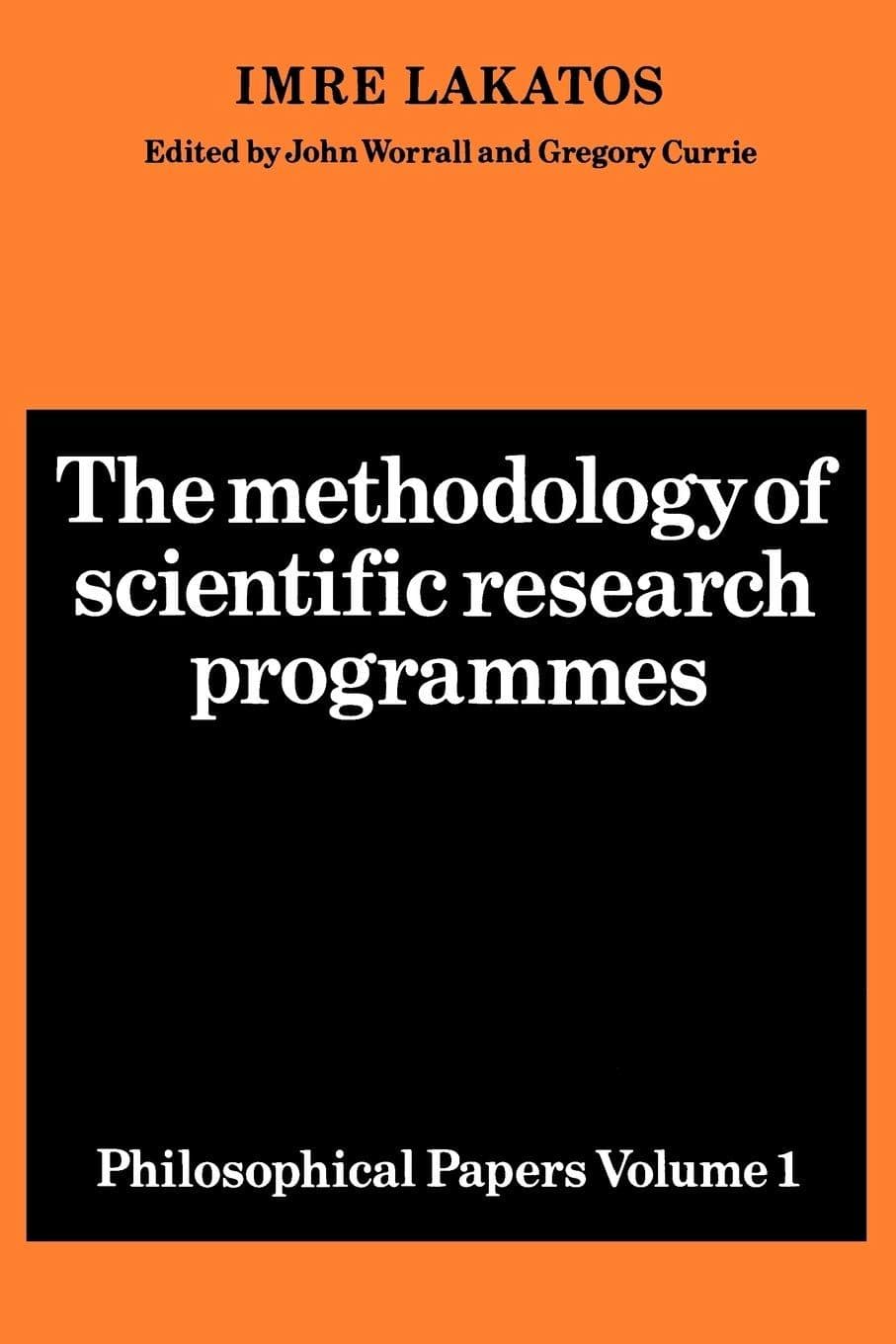
The Methodology of Scientific Research Programmes: Philosophical Papers, Volume 1
Lakatos's central argument is that science should be understood not as a sequence of isolated theories to be falsified, but as competing research programmes, each with a protected 'hard core' of assumptions and a 'protective belt' of auxiliary hypotheses that can be revised. The distinctive mechanism is the distinction between progressive and degenerating programmes: a programme is progressive if its theoretical growth anticipates novel facts, degenerating if it only patches up anomalies after the fact. Lakatos thus offers a rational reconstruction of scientific growth that avoids both Popper's naive falsificationism and Kuhn's paradigm-conversion.
Key Insights
✦What is a scientific research programme, and how does it differ from a Popperian theory or a Kuhnian paradigm?
A research programme is a series of theories that share a common 'hard core'—a set of assumptions treated as irrefutable by methodological decision—and a 'protective belt' of auxiliary hypotheses that can be revised in response to anomalies. It differs from a Popperian theory in that it is not rejected as soon as it fails a test; the hard core is protected, and the belt is modified. It differs from a Kuhnian paradigm in that research programmes can coexist and compete, whereas Kuhn's paradigms succeed one another in revolutionary ruptures. Lakatos presents the methodology of research programmes as a rational reconstruction of scientific growth that is neither as naive as Popper's falsificationism nor as irrationalist as Kuhn's paradigm-conversion, which he called a matter of 'mob psychology.'
✦What is the distinction between progressive and degenerating research programmes, and how is it applied?
A progressive research programme is one whose theoretical growth anticipates novel facts that are subsequently confirmed by experiment. The programme 'predicts' new phenomena and thereby demonstrates its empirical fertility. A degenerating programme, by contrast, only patches up anomalies after the fact: its auxiliary hypotheses are ad hoc adjustments that do not lead to new predictions. The distinction is not a rigid classification but a matter of degree and historical judgment. A programme can be progressive in one period and degenerating in another. The methodology is a heuristic for evaluating scientific change, not a mechanical algorithm for theory choice. Critics have noted that the distinction is often applied retrospectively and that the criteria for 'novel facts' are not as clear as Lakatos suggests, but the framework remains influential.
✦How does the methodology of research programmes relate to Lakatos's earlier work on mathematics and to his later editing of Criticism and the Growth of Knowledge?
The methodology of research programmes is the mature statement of a position that Lakatos had been developing throughout his career. Its roots lie in his philosophy of mathematics, particularly the method of proofs and refutations, which shows how mathematical knowledge grows through the critical revision of concepts. The methodology of research programmes applies this dialectical model to empirical science. The essay was first presented at the 1965 London conference and published in Criticism and the Growth of Knowledge (1970), before being included as the lead essay in this volume. The volume also includes his critique of Popperian historiography, his rejoinder to Grünbaum on crucial experiments, and his essay 'History of Science and its Rational Reconstructions,' which argues that the history of science is best understood as a history of research programmes.
✦How was the volume assembled and published, and what does its editorial history reveal?
The volume was edited by John Worrall and Gregory Currie and published posthumously by Cambridge University Press in 1978, four years after Lakatos's death. It collects essays written over a decade, including the title essay, which was first published in Criticism and the Growth of Knowledge (1970), and 'History of Science and its Rational Reconstructions,' which appeared in the Boston Studies in the Philosophy of Science (1971). The editors note that Lakatos had been planning a book of his own but had not completed it; the collection is a reconstruction from published papers and unpublished manuscripts. The volume is the first of two Philosophical Papers; Volume II is Mathematics, Science and Epistemology. A paperback edition appeared in 1980.
✦What were the main criticisms of Lakatos's methodology, and how has it held up since publication?
The main criticism is that the distinction between progressive and degenerating programmes is too vague to provide a decisive criterion for theory choice. Critics, including Kuhn and Feyerabend, argued that the methodology is a rationalisation after the fact: it tells us which programmes were progressive, but it does not provide guidance in real time. Other critics have noted that the hard core/protective belt distinction is not as clear as Lakatos suggests, since it is often difficult to identify what counts as 'hard core' and what counts as 'auxiliary hypothesis.' Despite these criticisms, the methodology has been influential in the history and philosophy of science. It offers a more realistic picture of scientific practice than Popper's falsificationism and a more rational picture than Kuhn's paradigm-conversion.
✦What is the most common misunderstanding of the methodology of research programmes?
The most common misunderstanding is that Lakatos is simply splitting the difference between Popper and Kuhn, or that he is offering a new algorithm for scientific method. In fact, he is doing something more ambitious: he is offering a rational reconstruction of scientific growth that is neither Popperian nor Kuhnian. He does not claim that the methodology provides a mechanical decision procedure for choosing between programmes; he claims that it provides a framework for understanding why some programmes are progressive and others degenerating. A related misunderstanding is that the methodology is merely descriptive. Lakatos intends it as a normative methodology: it tells us what scientists should do if they want to maximise the growth of knowledge. Reading the volume as a historical document misses its continuing importance as a contribution to the philosophy of science.
Wealthy Psyche is an intellectual archive. We do not host, distribute, or sell book copies — physical or digital. We provide structured knowledge to help you think better, faster.