


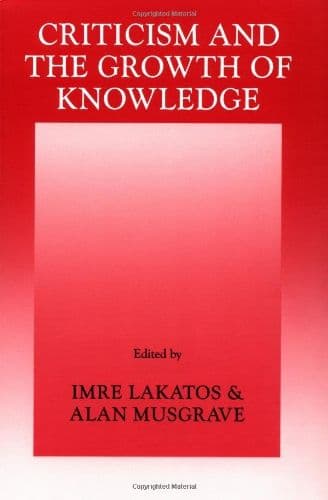
Criticism and the Growth of Knowledge
This edited volume collects the proceedings of a 1965 London conference that staged a confrontation between Thomas Kuhn and Karl Popper, with contributions from Lakatos, Feyerabend, Toulmin, and others. Its central claim, articulated by Lakatos in his own contribution, is that neither Popper's falsificationism nor Kuhn's normal science adequately describes how scientific knowledge grows: Popper underestimates the tenacity of research programmes, while Kuhn's 'normal science' risks making scientific change a matter of mob psychology. The volume is distinctive for showing the debate in motion rather than resolving it.
Key Insights
✦What was the 1965 London conference, and how did this volume come about?
The volume collects the proceedings of the International Colloquium in the Philosophy of Science, held at Bedford College, London, in July 1965. The conference was organised by Lakatos and Musgrave, and its centrepiece was a confrontation between Thomas Kuhn and Karl Popper, with Kuhn presenting the recently published Structure of Scientific Revolutions and Popper responding. The volume, published in 1970, includes revised versions of the papers, the transcripts of the discussion sessions, and Lakatos's own contribution, 'Falsification and the Methodology of Scientific Research Programmes,' which became one of his most influential essays. The book is unusual in preserving the cut and thrust of the debate, including the exchanges between Kuhn, Popper, and their critics. It is a document of a pivotal moment in twentieth-century philosophy of science.
✦What is the central argument of Lakatos's contribution, and how does it differ from both Popper and Kuhn?
Lakatos argues that neither Popper's falsificationism nor Kuhn's normal science adequately describes how scientific knowledge grows. Popper's account, he argues, is too naive: it assumes that a theory can be rejected as soon as it fails a test, but in practice scientists defend their theories against anomalies and only abandon them when a better alternative is available. Kuhn's account, by contrast, risks making scientific change a matter of mob psychology: if normal science is governed by a paradigm that cannot be criticised from within, then the transition to a new paradigm is a matter of conversion, not rational argument. Lakatos's alternative is the methodology of scientific research programmes, which allows for both tenacity and criticism: a research programme has a hard core that is protected from refutation and a protective belt of auxiliary hypotheses that can be revised. The growth of knowledge is the competition between progressive and degenerating research programmes.
✦How did Kuhn respond to Popper's criticisms in the volume, and what was the substance of their disagreement?
Kuhn's response, 'Logic of Discovery or Psychology of Research?', argues that Popper has misunderstood the nature of normal science. Popper had characterised normal science as a period of dogmatic adherence to a paradigm, which he regarded as a failure of critical rationality. Kuhn replies that normal science is not dogmatic but puzzle-solving: it is the activity through which a paradigm is articulated and its implications worked out. Popper's account of science as perpetual revolution, Kuhn argues, describes only the extraordinary episodes of paradigm change, not the ordinary work that makes science possible. The disagreement is thus about what science is: a critical, revolutionary activity (Popper) or a puzzle-solving, tradition-bound one (Kuhn). The volume preserves the exchange, including Popper's reply, allowing readers to follow the argument in detail.
✦What role do Feyerabend and Toulmin play in the volume, and how do their contributions relate to the Popper-Kuhn confrontation?
Feyerabend's contribution, 'Consolations for the Specialist,' is a critique of both Popper and Kuhn. He argues that neither account captures the actual complexity of scientific practice, and that the attempt to formulate a single methodology for science is misguided. His position anticipates the anarchism of Against Method. Toulmin's contribution, 'Does the Distinction between Normal and Revolutionary Science Hold Water?', questions Kuhn's dichotomy between normal and revolutionary science, arguing that scientific change is more continuous than Kuhn's model suggests. Both contributions serve to complicate the Popper-Kuhn opposition, showing that the debate is not a simple choice between two positions. The volume is thus not merely a record of a confrontation but a collective exploration of the limits of both accounts.
✦How was the volume received, and what has been its influence?
The volume was widely reviewed and became a standard reference in the philosophy of science. It is often cited as the text that introduced the Popper-Kuhn debate to a wider audience and that established Lakatos's methodology of scientific research programmes as a major alternative to both. The volume's preservation of the discussion sessions made it a valuable record of philosophical argument in action, and it has been used in courses on the philosophy of science for decades. Its influence has been enduring, although the debate it records has been superseded by later developments. The volume is still valuable for its clarity, its engagement with fundamental questions, and its demonstration of how philosophical positions are tested in argument.
✦What is the most common misunderstanding of the volume's argument?
The most common misunderstanding is to read the volume as a simple contest between Popper and Kuhn, with Lakatos as the referee or synthesiser. In fact, all three positions are distinct, and Lakatos's contribution is a critique of both. He does not simply split the difference between them; he argues that both are inadequate and that his own methodology of research programmes is the superior alternative. A related misunderstanding is to treat the volume as a historical document with no relevance to contemporary debates. The questions it raises—about the rationality of scientific change, the role of tradition and criticism, and the nature of scientific progress—remain central to the philosophy of science. Reading the volume as a historical curiosity misses its continuing importance.
Wealthy Psyche is an intellectual archive. We do not host, distribute, or sell book copies — physical or digital. We provide structured knowledge to help you think better, faster.