


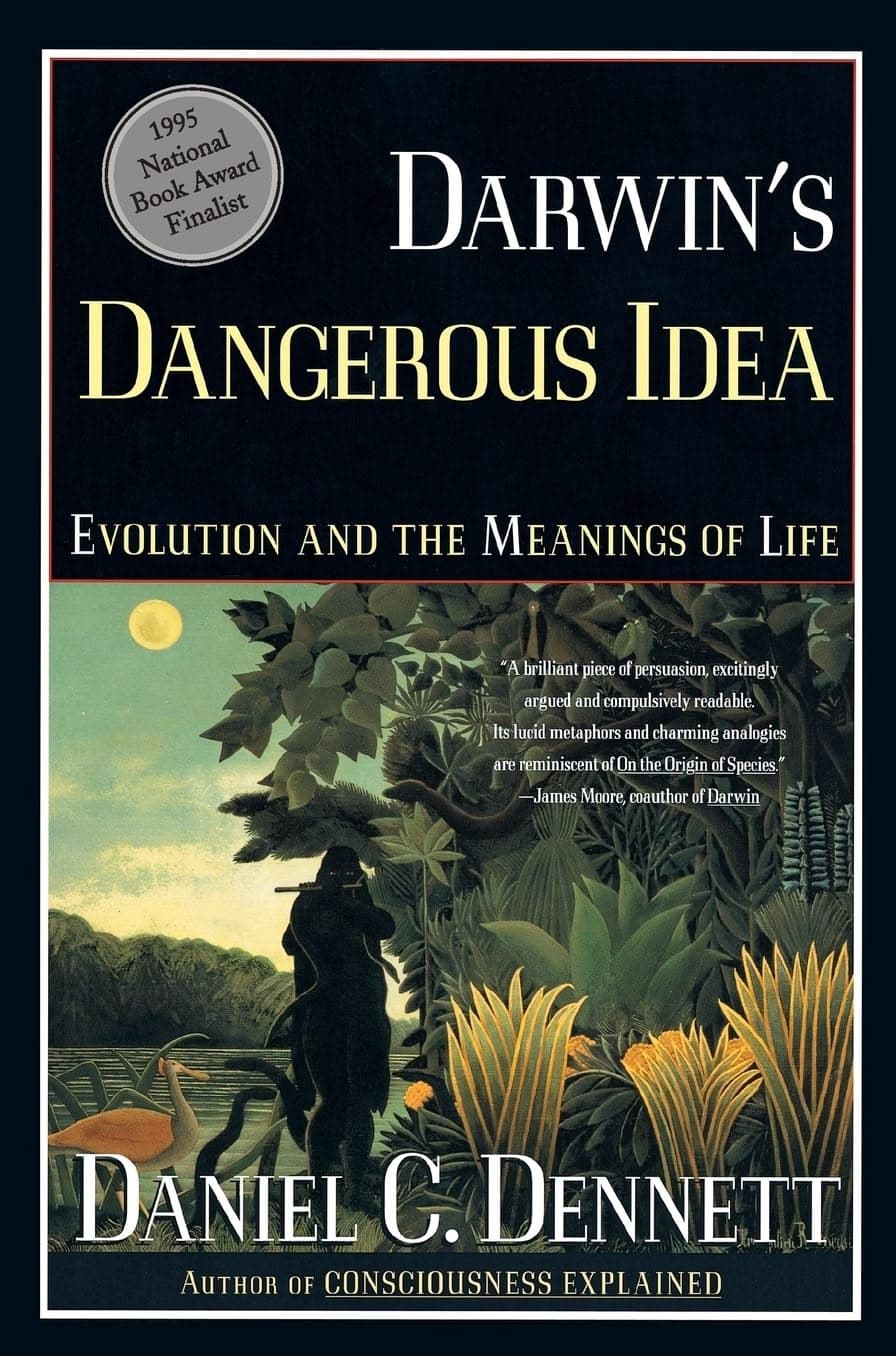
Darwin's Dangerous Idea: Evolution and the Meanings of Life

Darwin's Dangerous Idea argues that natural selection is a 'universal acid'—a corrosive idea that dissolves traditional explanations of purpose, meaning, and design wherever it touches them. Dennett's central mechanism is the distinction between 'cranes' (processes that lift complexity from below, like natural selection itself) and 'skyhooks' (miraculous explanations that lift from above, like divine intervention or Lamarckian inheritance). The book's distinctive claim is that everything from the bacterial flagellum to human culture and morality can be explained by cranes, and that resisting this conclusion is a form of intellectual dishonesty.
Key Insights
✦What is the central argument of Darwin's Dangerous Idea, and what does it reject?
The book's argument is that Darwin's theory of natural selection is a 'universal acid' that dissolves traditional explanations of purpose and design wherever it is applied . Dennett's central claim is that the appearance of intelligent design in nature—from the intricate machinery of cells to the human mind—can be fully explained by blind, algorithmic processes of selection operating over deep time. What Darwin's Dangerous Idea rejects is any appeal to 'skyhooks'—miraculous lifters that explain complexity by invoking something above nature, whether divine intervention, Lamarckian inheritance, or an irreducible life force. For Dennett, the only legitimate explanations are 'cranes': processes that lift complexity from below, using the materials already at hand. The book's task is to show that cranes are sufficient and skyhooks are not needed.
✦What are 'cranes' and 'skyhooks,' and why is the distinction central to the book?
The distinction is Dennett's most influential contribution to the philosophy of biology. A skyhook is an imaginary contrivance that lifts you aloft without any support from below—a miraculous explanation that solves a problem by positing something that itself requires no explanation . A crane, by contrast, is a real mechanism that lifts things up from the ground, using materials already available. Dennett argues that Darwinian natural selection is a crane: it builds complexity incrementally, without foresight or design. Lamarckian inheritance and Teilhard de Chardin's evolutionary utopianism are skyhooks: they promise to explain design by smuggling in a designing intelligence. The distinction matters because it gives Dennett a criterion for distinguishing legitimate evolutionary explanations from disguised creationism, and it allows him to argue that human culture and morality are themselves products of cranes, not skyhooks.
✦How does Dennett use the 'universal acid' metaphor, and what does it dissolve?
The universal acid is Dennett's metaphor for the corrosive power of Darwin's idea. He recalls childhood fantasies about a chemical so corrosive it would eat through anything, including the container designed to hold it . Darwinism, he argues, is that acid: it dissolves traditional beliefs about purpose, meaning, and morality by showing that they can be explained without a designer. The acid eats through the idea that human beings are special creations, that morality requires a divine lawgiver, and that the universe has an inherent purpose. But Dennett insists the acid is not destructive in a nihilistic sense. Once the traditional beliefs are dissolved, what remains is a naturalistic understanding of how meaning and value emerged from blind processes—an understanding that Dennett argues is more honest and more awe-inspiring than the skyhooks it replaces.
✦How was the book received, and what were the main criticisms?
Reception was polarized. Stephen Pinker called it 'essential and pleasurable for any thinking person,' and Richard Dawkins described it as 'a surpassingly brilliant book' . John Gribbin in the Sunday Times called it 'the best single-author overview of all the implications of evolution by natural selection available' . But critics were sharp. A review in Ecological Psychology argued that the book's real agenda is to legitimize artificial intelligence by locating the source of all agency and meaning in algorithms, and that this project rests on a 'paradigmatic dualism' that separates the psychological and physical into incommensurable parts . A review in a mathematical journal described the polemical sections as 'muddled' and accused Dennett of turning opponents into 'men of straw' . The deeper criticism, from religious and humanistic perspectives, is that Dennett's dismissiveness toward those who resist the acid is itself a kind of dogmatism.
✦What is the relationship between Darwin's Dangerous Idea and Dennett's later book, From Bacteria to Bach and Back?
From Bacteria to Bach is the sequel and application. Darwin's Dangerous Idea establishes the general framework: natural selection is a universal acid, cranes are sufficient, and skyhooks are unnecessary. From Bacteria to Bach takes up the specific question that the earlier book left open: how did human minds, with their capacity for language, culture, and reflective thought, emerge from the same blind processes? Dennett describes the later book as taking up 'where Darwin's Dangerous Idea left off,' extending the Darwinian account to cultural evolution and the human mind . The earlier book provides the philosophical foundation; the later book builds the evolutionary narrative that explains how the Gregorian level of the Tower of Generate and Test was constructed from the materials of genetic evolution.
✦How does the book's treatment of religion relate to its central argument?
Religion is the test case for the universal acid. Dennett argues that Darwinism dissolves the traditional argument from design—the claim that the complexity of the natural world requires a designer—and that this dissolution has profound implications for religious belief. He suggests that those who see no conflict between evolution and religion are either not looking closely or are reducing God to a 'merely ceremonial role' . His most controversial proposal is that religious traditions should be 'preserved in cultural zoos,' valued as cultural artifacts rather than as sources of truth . This stance drew sharp criticism from religious readers, but it is consistent with the book's logic: if natural selection explains design without a designer, then the God hypothesis is a skyhook, and skyhooks are what the acid dissolves. Dennett does not claim to prove atheism; he claims that Darwinism makes the design argument untenable.
Wealthy Psyche is an intellectual archive. We do not host, distribute, or sell book copies — physical or digital. We provide structured knowledge to help you think better, faster.