


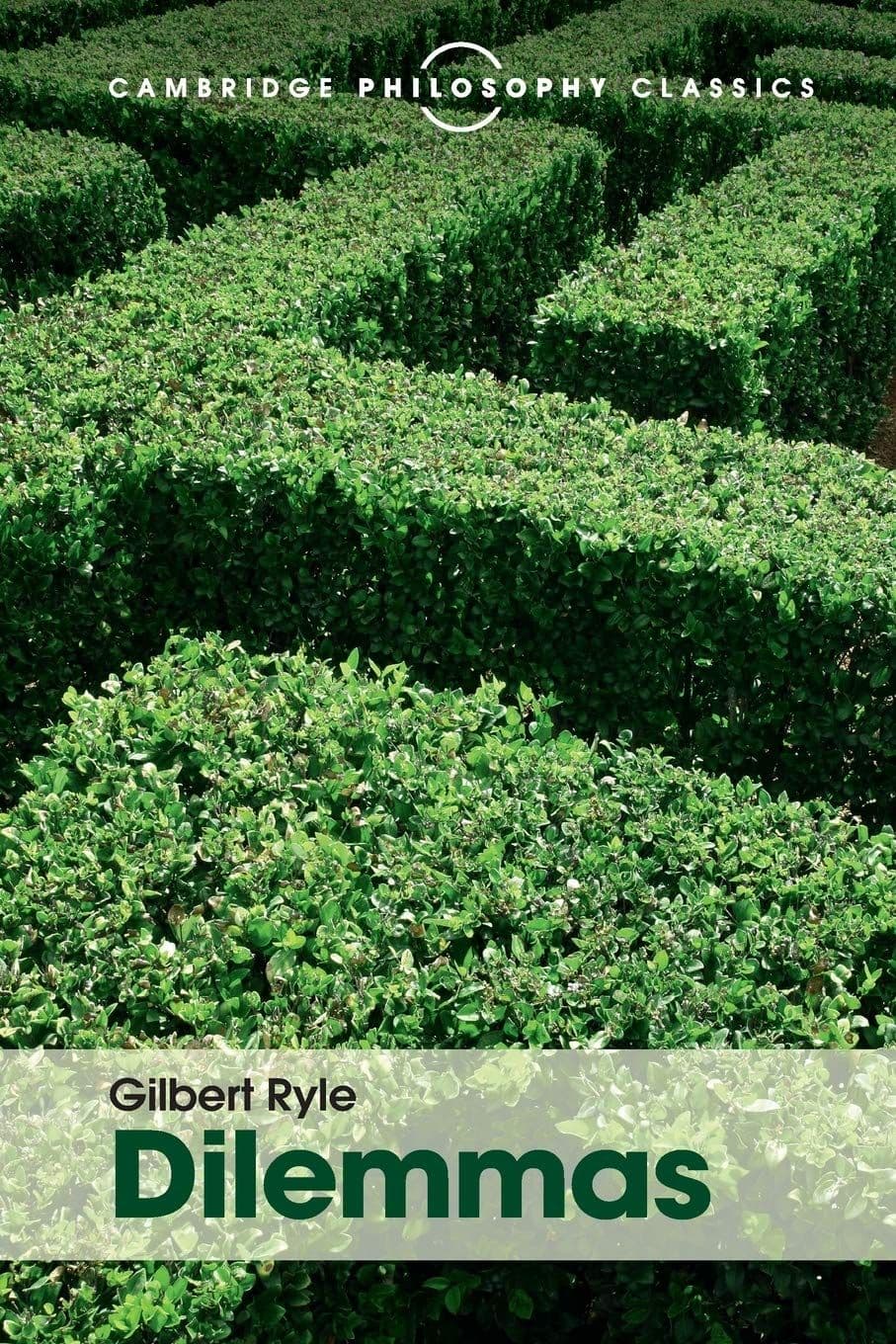
Dilemmas: The Tarner Lectures 1953
Ryle's Tarner Lectures diagnose a recurring pattern in philosophy: two accounts of the same subject seem to collide, forcing a choice between them, when in fact they answer different questions and belong to different logical categories. The neurophysiologist's question about perceptual mechanisms, the philosopher's question about the nature of perception, and the ordinary person's question about what is perceived are not rivals. Through case studies including fatalism, Zeno's paradox, pleasure, and the apparent conflict between science and everyday experience, Ryle demonstrates that the either/or is a false dilemma generated by misconstruing the logical type of the concepts involved.
Key Insights
✦What is the central diagnostic method of Dilemmas, and what kind of philosophical problem does it target?
Ryle targets dilemmas that arise when answers to different questions are mistakenly taken to be answers to the same question, and therefore in competition with one another . The solution is to demonstrate that the purported answers cannot be answers to one and the same question because they belong to different logical types or categories. His paradigm is perception: the neurophysiologist asks about mechanisms, the philosopher asks what perception is, and the ordinary person asks what is perceived. These are not rival accounts of a single phenomenon but responses to distinct questions, and treating them as competitors generates a false either/or . The method is a further application of the conceptual cartography developed in The Concept of Mind.
✦How does Ryle dissolve the fatalist's dilemma about future truth?
The fatalist argues that if it was true a thousand years ago that I would do something yesterday, then I could not have helped doing it. Ryle's response is that the fatalist misinterprets an innocuous proposition. The harmless reading is that for anything that happens, if anyone had guessed at any previous time that it would happen, the guess would have turned out correct. The fatalist transforms this into the claim that for whatever takes place, it was antecedently true that it was going to take place . The error lies in assigning 'true' to the category of property rather than the category of verdict. Once 'true' is understood as a verdict on a statement rather than a property inherent in a proposition awaiting discovery, the fatalist's inference loses its grip .
✦What does Ryle's treatment of Zeno's paradox reveal about his method?
The Achilles and the tortoise chapter is widely regarded as the strongest essay in the collection. A contemporary review in Philosophy noted that 'the analysis is developed with a sustained elegance, the analogies are close and really illuminating, the writing is firm, clear and unforced' . Ryle's strategy is not to refute Zeno with a new mathematical formalism but to expose the conceptual confusion that makes the paradox seem compelling. The paradox trades on treating the infinite divisibility of a distance as if it entailed the impossibility of traversing it, conflating a mathematical description of space with the practical activity of running. The resolution shows that the puzzle arises from misconstruing the logical grammar of 'infinite series' as it applies to motion, a diagnostic move characteristic of Ryle's approach throughout the book.
✦How does the book's treatment of perception relate to The Concept of Mind?
The perception chapter revisits and extends the parallel Ryle drew in The Concept of Mind between verbs like 'seeing' and 'hearing' and achievement words like 'winning' . He argues that perceiving is not a state or process but the scoring of an investigational success, and that the physiologist's anxiety about locating the 'actual seeing' as a final detectable item in a causal chain is misplaced. However, the contemporary reviewer in Philosophy judged this the least satisfactory essay in the book, arguing that Ryle 'exaggerates the distance' the parallel can travel: 'few of the objects of our seeing are things of our seeking, and most of our hearing is overhearing' . The chapter thus shows Ryle applying his method to a domain central to his earlier work, with results that were contested even by sympathetic readers.
✦What is the relationship between Dilemmas and the Tarner Lectures format?
Dilemmas is a slightly modified version of the Tarner Lectures Ryle delivered at Cambridge in the Lent Term of 1953 . The Tarner Lectures were a public lecture series, and the book retains that accessible, non-technical register: a contemporary review observed that it is 'not primarily designed for an audience of academic philosophers' but for those who recognize when discussion has become beset with philosophical difficulties without knowing how to extricate themselves . The Times Literary Supplement praised the book for grasping problems 'at that critical stage when they are just casting off their connexions with everyday life' . The lecture format shaped the book's brevity and its illustrative, case-study approach rather than systematic treatise.
✦How has Dilemmas been received compared to The Concept of Mind?
Dilemmas has generally been treated as a lesser companion to Ryle's 1949 masterpiece. The Routledge Encyclopedia of Philosophy describes the Tarner Lectures as 'less spectacular and on the whole less successful than in The Concept of Mind,' though it acknowledges them as 'a further display' of Ryle's view that philosophical problems can be solved by systematic restatement and the replacement of category-habits by category-disciplines . The book's brevity and its range of concrete puzzles have made it accessible to non-specialists, but it did not introduce a new framework comparable to the 'ghost in the machine' critique. Its value lies in showing Ryle's diagnostic method applied across logic, perception, pleasure, and the science-everyday world relation, rather than in advancing a single unifying thesis.
Wealthy Psyche is an intellectual archive. We do not host, distribute, or sell book copies — physical or digital. We provide structured knowledge to help you think better, faster.