


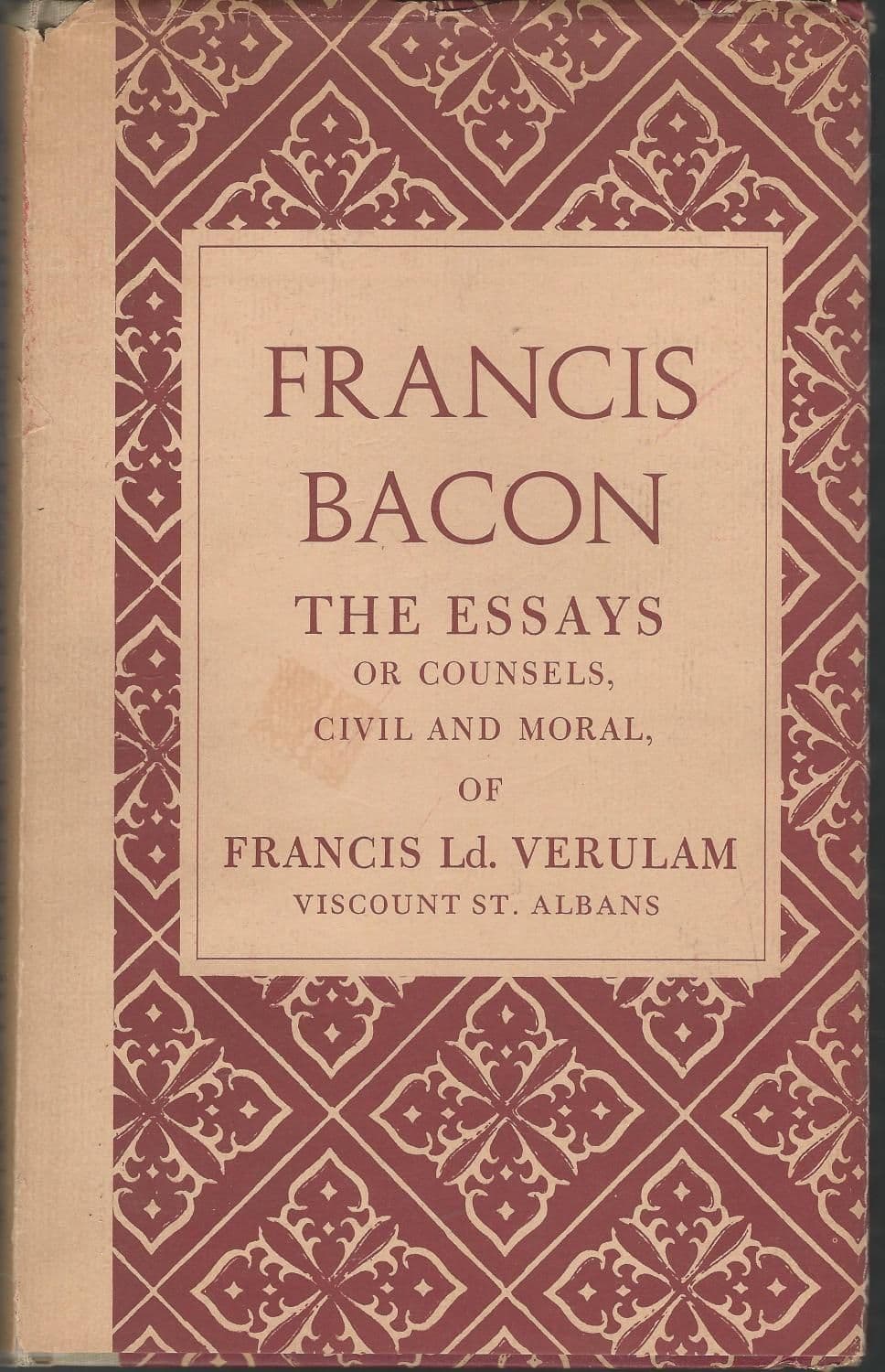
Essays, or Counsels, Civil and Moral

Bacon's Essays are not systematic philosophy but distilled observations on the conduct of life, arguing that practical wisdom is a matter of maxims tested by experience rather than rules derived from theory. The collection's central claim is that the advancement of knowledge serves the 'relief of man's estate,' and the essays apply this pragmatic orientation to subjects as varied as truth, death, envy, love, and empire. Bacon's distinctive mechanism is the aphorism: a compressed, often paradoxical formulation that captures the tensions of political and moral life without resolving them into a system.
Key Insights
✦What is the central claim of Bacon's Essays, and how does it relate to his scientific program?
The central claim is that practical wisdom is a matter of maxims tested by experience, not rules derived from abstract theory. The Essays apply Bacon's conviction that knowledge should serve the relief of man's estate to the conduct of civil and moral life. They are not systematic treatises but distilled observations—aphorisms—that capture the tensions of political and moral experience. The connection to Bacon's scientific program is the emphasis on observation and experience as the basis of knowledge. Just as the Novum Organum argues that natural philosophy must proceed from particulars to axioms, the Essays suggest that moral and political wisdom must be drawn from the observation of particular cases rather than from abstract principles. The Essays are, in effect, the practical complement to Bacon's theoretical reform of learning.
✦How did the Essays evolve across their editions, and what does that evolution reveal?
The Essays were first published in 1597 as a small volume of ten essays. A second edition in 1612 expanded the collection to thirty-eight essays and included a new essay, 'Of Religion.' The third edition, published in 1625, the year before Bacon's death, contained fifty-eight essays and represented the final, most complete version. The evolution is significant: the early essays are terse and aphoristic, often consisting of a few sentences, while the later essays are more expansive and meditative. The 1625 edition also includes the essay 'Of Masques and Triumphs,' which reflects Bacon's experience as a courtier. The changes reveal Bacon's development as a thinker and stylist, and they show that the Essays were not a single work but a series of revisions across nearly three decades.
✦What is the significance of Bacon's aphoristic style, and how does it differ from the essay form of Montaigne?
Bacon's aphorisms are compressed, often paradoxical formulations that aim to capture the tensions of political and moral life without resolving them into a system. This is a deliberate stylistic choice. Montaigne's essays are digressive and self-revelatory, following the movements of the author's mind; Bacon's essays are impersonal and authoritative, presenting maxims that the reader is invited to test against experience. Bacon believed that the aphorism was a superior form for practical wisdom because it does not pretend to be a complete system. As he writes in The Advancement of Learning, aphorisms are 'the pith and heart of sciences'—they present knowledge in its most concentrated and useful form. The style of the Essays is thus itself a philosophical statement about the nature of practical knowledge.
✦Which essays are most representative of Bacon's thought, and what do they reveal?
Several essays stand out. 'Of Truth' opens the collection and establishes its central theme: the pursuit of truth is the sovereign good of human nature, but a lie is a vain and false pleasure. 'Of Death' treats death not with religious consolation but with Stoic observation: it is as natural to die as to be born, and the fear of death is diminished by understanding it. 'Of Great Place' reflects Bacon's experience as a statesman, advising those in power to remember that they are servants of the state and must not be corrupted by ambition. 'Of Innovations' is characteristic of Bacon's reformist temper: innovations should be made quietly and gradually, not with violence. 'Of Studies' is perhaps the most famous, arguing that reading makes a full man, conference a ready man, and writing an exact man. These essays reveal Bacon's central concerns: the pursuit of truth, the management of power, and the discipline of the mind.
✦How were the Essays received in Bacon's time, and what has been their later reputation?
The Essays were well received and contributed to Bacon's reputation as a man of letters, but they were not his most important works in the eyes of his contemporaries, who valued him primarily as a lawyer and statesman. Their later reputation has been higher: they are regarded as a classic of English prose and a key text in the development of the essay form. Bacon's aphoristic style influenced later writers, including the seventeenth-century metaphysical poets and the eighteenth-century essayists. In the twentieth century, some critics saw the Essays as a kind of Machiavellian handbook, but others read them as a meditation on the ethical dilemmas of public life. Their enduring interest lies in their combination of worldly realism and philosophical reflection, a combination that reflects Bacon's own experience as a philosopher and a man of affairs.
✦Do the Essays contradict Bacon's scientific program by treating politics and morality as domains of opinion rather than knowledge?
There is a tension, but not a contradiction. Bacon's scientific program aims at the kind of knowledge that can be tested and verified, while his Essays treat politics and morality as domains of practical wisdom that cannot be reduced to rules. But Bacon did not believe that practical wisdom was mere opinion. The Essays are the product of experience, observation, and reflection, and they aim at maxims that are reliable, even if they cannot be demonstrated with the certainty of a mathematical proof. The tension between the two domains is characteristic of Bacon's thought: he was a reformer of knowledge who recognised that the conduct of life requires a different kind of wisdom from the investigation of nature. The Essays are the record of that recognition.
Wealthy Psyche is an intellectual archive. We do not host, distribute, or sell book copies — physical or digital. We provide structured knowledge to help you think better, faster.