


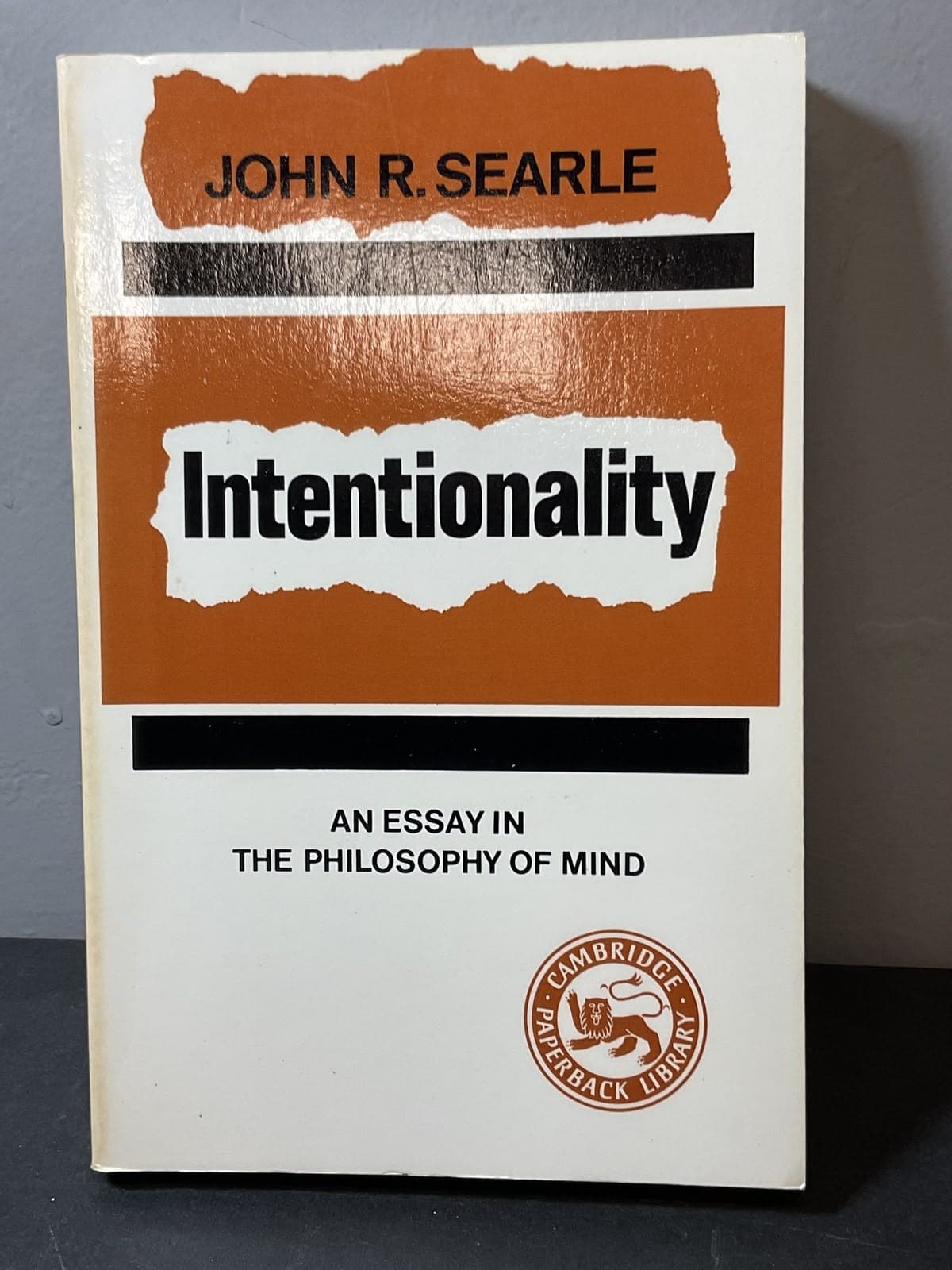
Intentionality: An Essay in the Philosophy of Mind
Searle's central move is to reverse the explanatory order between language and mind: the aboutness of speech acts is derived from the more basic intentionality of mental states, not the other way around. Intentional states—beliefs, desires, perceptions, intentions—are characterized by conditions of satisfaction and direction of fit, and they are intrinsically intentional in a way that utterances are not. The book develops this framework across perception, action, causation, and reference, arguing that the philosophy of language is ultimately a branch of the philosophy of mind and that intentionality is a biological phenomenon of the brain.
Key Insights
✦What is the central claim of Intentionality, and what does it reject?
Searle's central claim is that the intentionality of language is derived from and dependent on the intrinsic intentionality of the mind. Utterances have meaning only because they express mental states that already possess aboutness. The book rejects the converse view, implicit in much philosophy of language, that intentionality can be analyzed primarily through linguistic representation. It also rejects computational theories that treat the mind as a symbol-manipulating system. Intentional states are characterized by conditions of satisfaction and direction of fit: beliefs aim to fit the world, desires aim to make the world fit them, and both are satisfied or frustrated depending on how the world turns out. Searle argues that this framework provides the philosophical foundations for his earlier work on speech acts .
✦What role does the 'Background' play in Searle's theory?
The Background is Searle's term for the non-intentional capacities, dispositions, and skills that make intentional states possible without themselves being represented. Intentional states do not function in a vacuum; they require a network of other intentional states and a background of know-how that is not itself propositional. Searle uses the example of wanting to go to the refrigerator: the desire only makes sense against a background of knowing how to walk, open doors, and recognize food. The Background is not a set of rules or representations but a set of abilities. This element of the theory is significant because it introduces a non-representational dimension into an account that is otherwise focused on representational content, and it has been influential in later discussions of embodied cognition and skilled action .
✦How does Intentionality relate to Searle's earlier book Speech Acts?
Intentionality provides the theoretical foundation that Speech Acts (1969) presupposed but did not fully articulate. In the earlier book, Searle analyzed illocutionary acts in terms of their conditions of satisfaction—what must be the case for a promise, an assertion, or a command to succeed. Intentionality generalizes this analysis: all intentional states, not just speech acts, have conditions of satisfaction and direction of fit. The later book argues that speech acts are a derived form of intentionality, dependent on the mind's capacity to represent states of affairs. As one overview puts it, the philosophy of language is in the end a branch of the philosophy of mind, and Intentionality supplies the foundations for the earlier work . The book thus retroactively grounds the speech act theory in a general theory of mental representation.
✦What is the 'connection principle,' and why is it controversial?
The connection principle is Searle's claim that all genuinely mental states must be accessible in principle to consciousness. On this view, a state that is in no way accessible to conscious awareness is not a mental state at all but a neurophysiological state. The principle is controversial because it rules out the possibility of deeply unconscious intentional states of the kind posited by cognitive science and psychoanalysis. Critics have argued that Searle provides no convincing reason why consciousness must accompany all intentionality, and that the principle conflates the question of what makes a state mental with the question of what makes it accessible to a subject . Searle's defense of the principle is part of his broader resistance to computational and functionalist accounts of mind, but it remains one of the less widely accepted elements of his theory.
✦How has the book been received and evaluated by other philosophers?
Contemporary reviews were generally positive. The Philosophical Review praised the book's vigor and clarity, and Nous called its attempt to explain the philosophy of language as part of the philosophy of mind 'truly impressive' . The International Studies in Philosophy recommended it as a graduate seminar text, and Philosophy and Phenomenological Research judged a thorough study of Searle's approach essential to any serious work in philosophy of mind . Later assessments have been more mixed. Searle's internalism—the thesis that all intentional content is 'in the head'—has been challenged by externalists about content, including Hilary Putnam and Tyler Burge, whose arguments Searle engages with in the chapter 'Are Meanings in the Head?' The book remains a standard reference for the conditions-of-satisfaction framework, even among those who reject its internalist commitments .
✦What is a common misreading of Searle's internalism in this book?
A frequent misreading treats Searle's internalism as the claim that the objects of intentional states are inside the head. That is not his view. Searle holds that intentional content is constituted exclusively by what is internal to the thinker—representations, not the real-world objects those representations are about. The objects, events, and locations outside the thinker may figure in the truth conditions of the content, but they are not components of the content itself . This distinction is crucial: Searle is not denying that we think about external things; he is making a claim about what constitutes the content of those thoughts. The misreading often arises from conflating the vehicle of representation (internal) with its referent (often external), a distinction Searle insists on but which critics sometimes overlook.
Wealthy Psyche is an intellectual archive. We do not host, distribute, or sell book copies — physical or digital. We provide structured knowledge to help you think better, faster.