


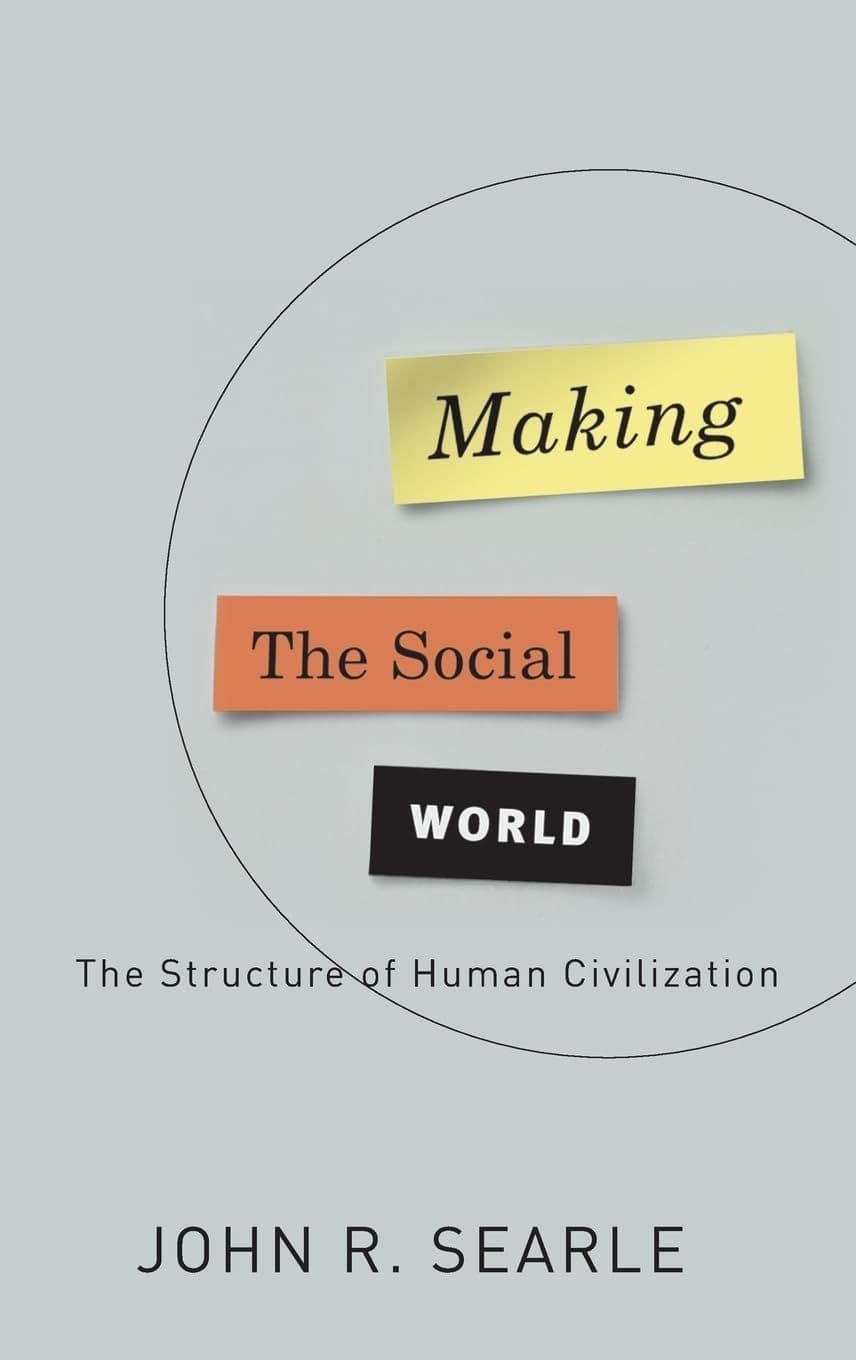
Making the Social World: The Structure of Human Civilization
Searle's central claim is that social reality—money, property, marriage, government—is created and maintained by a single linguistic operation repeated endlessly: the Status Function Declaration. By declaring 'X counts as Y in context C,' we impose functions on objects and people that they cannot perform by physical nature alone, thereby creating deontic powers (rights, duties, obligations) that structure human civilization. This 2010 book revises his earlier account in The Construction of Social Reality, replacing constitutive rules with declarations as the fundamental building block, and argues that language is not merely useful for social ontology but constitutive of it.
Key Insights
✦What is the central claim of Making the Social World, and what does it reject?
Searle argues that social reality is created and sustained by Status Function Declarations: speech acts of the form 'We (or I) make it the case by Declaration that X counts as Y in C.' These declarations impose functions on objects and people that they cannot perform by physical constitution alone—a piece of paper counts as money, a person counts as president—thereby creating deontic powers such as rights, duties, and obligations. The book rejects the idea that social facts can be reduced to brute physical facts or to individual psychological states. It also revises Searle's own earlier account: where The Construction of Social Reality treated constitutive rules ('X counts as Y in C') as the basic building block, Making the Social World elevates the Declaration as the fundamental operation, treating constitutive rules as a special case of the more general declarative structure .
✦How does this book revise the theory presented in The Construction of Social Reality?
The key revision concerns the logical form of social ontology's foundational operation. In the 1995 book, Searle treated constitutive rules of the form 'X counts as Y in C' as the principal representational vehicles for creating institutional facts. In Making the Social World, he argues that what lies at the foundation is the Status Function Declaration: 'We (or I) make it the case by Declaration that X counts as Y in C.' This shift elevates language from a useful tool for representing social facts to the constitutive mechanism that creates them. A critical notice in Dialogue explains that under the new dispensation, constitutive rules are treated as a special case of declarations rather than the reverse . The revision also generalizes the earlier theory, which Searle now presents as a special case of the more encompassing account developed in the 2010 book .
✦What role does language play in Searle's account of social reality?
Language is not merely instrumental for Searle; it is constitutive of institutional reality. He argues that the move from X to Y—imposing a function on something that cannot perform it by physical nature—is already linguistic in character, because the Y term symbolizes something beyond the X object. For an institutional fact to exist, it must be publicly understandable, and this requires symbolic devices that represent something beyond themselves by convention . Searle identifies three essential features of linguistic symbols: they symbolize beyond themselves, they do so by convention, and they are public. He concludes that the capacity to attach symbolic function to an object that lacks it intrinsically is the precondition of both language and institutional reality . This is why he denies there can be a 'state of nature' for language-using humans: the social world is language-dependent through and through.
✦What are deontic powers, and why are they central to the argument?
Deontic powers are the rights, duties, obligations, permissions, and authorizations created when a status function is imposed. When a piece of paper counts as currency, it confers on its holder the power to purchase; when a person counts as president, they acquire powers to command and obligations to serve. Searle treats deontic powers as the distinctive mark of institutional facts: they are what status functions create, and they explain how social structures motivate action without relying on physical coercion alone. These powers provide desire-independent reasons for action—reasons that do not originate in the agent's wants or preferences but in their recognition of institutional obligations . Searle argues that political power ultimately rests on collective acceptance of status functions, meaning that even governmental authority derives from the bottom up rather than from brute force .
✦How has the book been received by critics and reviewers?
Reception has been mixed but generally respectful. Colin McGinn, writing in the New York Review of Books, called it 'stimulating and vigorous' . The American Journal of Sociology praised it as 'wonderfully clear and wonderfully ambitious' . A more critical notice in Dialogue highlighted the significance of the theoretical shift from constitutive rules to Status Function Declarations, treating it as a substantive revision rather than a mere restatement . Some reviewers have questioned whether the account adequately handles cases of institutional facts created outside established institutions, and whether the emphasis on collective acceptance can bear the weight Searle places on it for explaining political power. The Notre Dame Philosophical Reviews recommended the book to newcomers as a lively introductory overview of Searle's current and past research themes .
✦What is a common misconception about this book's relationship to Searle's philosophy of mind?
A frequent misconception is that Making the Social World is a departure from Searle's philosophy of mind, a turn to a separate domain of social ontology. In fact, the book is continuous with his broader project. Searle's aim is to show how mind, language, and civilization are natural products of the basic facts described by physics, chemistry, and biology . The social world is not a separate ontological realm but an extension of the same naturalistic framework that grounds his accounts of intentionality and consciousness. The deontic powers created by status functions are real powers that motivate action, but they exist only because of collective intentionality—the same capacity for shared mental representation that Searle has analyzed throughout his career. The book thus applies his philosophy of mind to the structure of civilization rather than abandoning it.
Wealthy Psyche is an intellectual archive. We do not host, distribute, or sell book copies — physical or digital. We provide structured knowledge to help you think better, faster.