


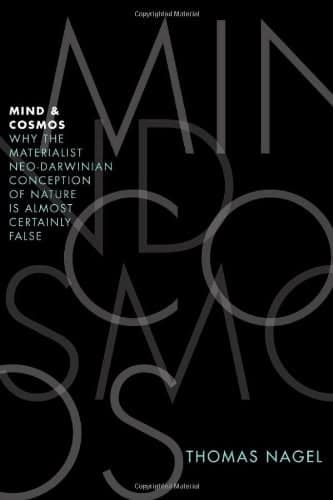
Mind and Cosmos: Why the Materialist Neo-Darwinian Conception of Nature Is Almost Certainly False

Nagel's central claim is that the materialist neo-Darwinian conception of nature is almost certainly false because it cannot account for consciousness, cognition, meaning, or value. Since minds are features of biological systems that evolved, a purely mechanistic evolutionary biology is fundamentally incomplete. Nagel does not argue for religious belief or intelligent design; he suggests that if materialism fails, principles of a different kind—teleological rather than mechanistic—may be at work in nature. The book is a challenge to the adequacy of reductive materialism, not a positive alternative system.
Key Insights
✦What is the central claim of Mind and Cosmos, and what does it reject?
Nagel's central claim is that the modern materialist neo-Darwinian conception of nature is almost certainly false because it conspicuously fails to explain consciousness, intentionality, meaning, and value . He rejects the view that a purely mechanistic account of evolution and cosmology can be complete. Nagel's skepticism is not based on religious belief or a commitment to intelligent design; he explicitly states that he is an atheist and does not endorse any definite alternative . What he suggests is that if the materialist account is wrong, then principles of a different kind—teleological rather than mechanistic—may also be at work in the history of nature, governing the growth of order .
✦How does the book's argument about consciousness relate to Nagel's earlier work?
The argument extends Nagel's long-standing critique of reductionism, most famously articulated in his 1974 essay 'What Is It Like to Be a Bat?' That essay argued that subjective experience cannot be captured by objective, third-person physical descriptions. Mind and Cosmos generalizes this point: if consciousness is a real feature of nature, then any conception of nature that cannot account for it is fundamentally incomplete . The book also draws on themes from The View from Nowhere, particularly the tension between the subjective and objective standpoints. What is new in Mind and Cosmos is the explicit extension of this critique to evolutionary biology and cosmology, arguing that the failure to explain mind threatens the entire naturalistic world picture .
✦What are teleological principles, and why does Nagel invoke them?
Teleological principles are principles of order directed toward an end or goal, rather than blind mechanical laws. Nagel suggests that if materialism cannot explain the appearance of conscious minds in the universe, then principles of a different logical form—teleological rather than mechanistic—may be at work in the history of nature . He does not specify what these principles are or how they operate; his claim is more modest: that recognizing the limits of the materialist account is the first step in being open to alternatives . Critics have noted that this is a gesture toward a possibility rather than a developed theory, and that Nagel does not provide a positive account of how teleological principles would work in practice.
✦How was Mind and Cosmos received when it was published?
Reception was sharply polarized. The book generated significant criticism from prominent scientists and philosophers, including Steven Pinker, Daniel Dennett, and Elliott Sober . Leon Wieseltier in The New Republic defended Nagel, arguing that he was denounced not for being wrong but for being heretical . The New York Review of Books published a critical review by H. Allen Orr, while The New York Times Book Review featured a positive assessment by E.L. Doctorow . Michael Chorost suggested that the book would have received less criticism had Nagel not endorsed criticisms raised by intelligent design proponents, despite Nagel not endorsing intelligent design as a solution . Nagel replied to his critics in The New York Times, but this drew further criticism .
✦What is a common misconception about the book's relationship to intelligent design?
A frequent misconception is that Nagel's critique of materialism is a covert defence of intelligent design or theism. Nagel explicitly denies this. He states that his skepticism is not based on religious belief, and he does not endorse intelligent design as an alternative . His objection to materialism is that it is an incomplete explanatory framework, not that it is false because it conflicts with scripture. However, the misconception has been fuelled by Nagel's acknowledgment that intelligent design proponents such as Michael Behe and Stephen Meyer do not deserve the scorn they receive from the scientific establishment, even though he does not accept their positive proposals . This has led some critics to conflate his critique with advocacy for their views.
✦What is the strongest criticism of the book's positive proposal?
The strongest criticism is that Nagel's positive proposal—that teleological principles may be at work in nature—is not developed into a testable or substantive theory. He suggests that principles of a different kind may be at work, but he does not specify what they are, how they operate, or how they could be investigated. A review in Evolution: Education and Outreach argues that Nagel's claim that natural selection cannot explain our capacity for objective reasoning is mistaken, pointing to evolutionary epistemology and the analogy between natural selection and the acquisition of knowledge . The book's value lies in its critical challenge to reductionism, not in its constructive alternative, which remains programmatic.
Wealthy Psyche is an intellectual archive. We do not host, distribute, or sell book copies — physical or digital. We provide structured knowledge to help you think better, faster.