


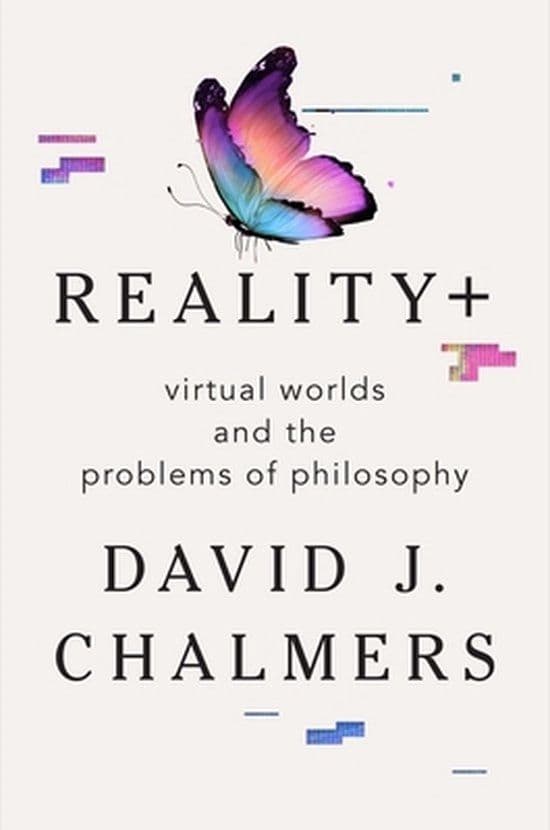
Reality+: Virtual Worlds and the Problems of Philosophy

Reality+ argues that virtual reality is genuine reality: objects and events in computer-generated worlds are real digital objects made of bits, not illusions or second-class simulations. Chalmers's central mechanism is 'technophilosophy,' using virtual worlds to reframe classic problems—knowledge, reality, mind, value—and to argue that a meaningful life is possible in VR. The book's distinctive claim is that if we are already in a simulation, that does not make our lives less real; it only changes what reality is made of, from quarks to bits.
Key Insights
✦What is the central argument of Reality+, and what does it reject?
The book's central thesis is that virtual reality is genuine reality. Chalmers argues that virtual worlds generated by computers are not second-class worlds, and that objects within them—tables, cities, avatars—are real digital objects made of bits, possessing existence, causal powers, and mind-independence . What Reality+ rejects is the widespread intuition, reinforced by science fiction, that virtual reality is inherently fake, illusory, or escapist. Chalmers argues that if we are living in a simulation, our lives are not thereby meaningless; the simulation hypothesis changes our understanding of what reality is made of, not whether it exists. The book extends the argument of his earlier essay 'The Matrix as Metaphysics' into a comprehensive treatment of knowledge, mind, value, and theology.
✦What is 'technophilosophy,' and how does Chalmers use it to approach traditional problems?
Technophilosophy is Chalmers's term for a two-way method: technology raises new philosophical questions, and philosophy illuminates technology. In Reality+, he uses virtual worlds as a lens for classic problems. The simulation hypothesis reframes Descartes's demon and Putnam's brain-in-a-vat; virtual reality raises questions about the nature of perception and the external world; digital minds force us to ask what consciousness requires; and the possibility of meaningful virtual lives tests our theories of value . Chalmers describes the book as a 'grand tour of philosophy' organized around virtual worlds, arguing that these new technologies do not merely apply old answers but transform the questions themselves. The method is distinctive because it treats virtual worlds as a serious metaphysical topic rather than a curiosity.
✦How does Chalmers respond to the objection that virtual objects are 'not real' because they are made of bits?
Chalmers argues that being made of bits is no more threatening to reality than being made of quarks. His 'virtual realism' holds that virtual objects possess the characteristics of real things: they exist, have causal powers (a virtual sword can kill your avatar), are mind-independent (they persist whether you look or not), and are not illusions . The history of science shows that discovering the underlying constitution of things—that trees are made of cells, cells of atoms—does not undermine their reality. Similarly, discovering that a table is a structure of binary information would be a discovery about what it is made of, not a discovery that it does not exist. This parity argument is central to the book's defense of virtual realism.
✦How was Reality+ received by academic philosophers, and what were the main criticisms?
Reception was split between praise for its accessibility and criticism for its philosophical depth. Lucy Osler, reviewing in Philosophical Psychology, noted that the book's appeal depends on the audience: it is an engaging introduction for newcomers but may frustrate academic philosophers of technology, who will find its treatment of actual VR systems and socio-political concerns thin . A review in Phenomenology criticized the book for not delving into the practical aspects of current VR technology, suggesting that philosophers and technologists should collaborate on the ethical and political questions raised by existing systems . The deeper philosophical objection, from those skeptical of virtual realism, is that Chalmers's criteria for reality are too permissive, and that treating virtual objects as equally real blurs a distinction that matters.
✦What role does the simulation hypothesis play in the book, and does Chalmers think we are likely in one?
The simulation hypothesis is a central case study for Chalmers's argument, not the book's conclusion. He devotes substantial space to the question of whether we are in a simulation and to the probability of such a scenario, engaging with Bostrom's trilemma and related arguments . But his aim is not to convince readers that we are simulated. It is to show that the possibility of simulation does not threaten the reality of our experience or the meaningfulness of our lives. If we are simulated, our world is still real—it is just made of computational processes rather than physical ones. This reframing is the book's most distinctive move: it turns a classic source of existential anxiety into a philosophical argument for equanimity.
✦How does Reality+ relate to Chalmers's earlier work on consciousness, particularly The Conscious Mind?
Reality+ extends Chalmers's long-standing philosophical project into new territory. The Conscious Mind argued that consciousness is irreducible to physical processes; Reality+ asks what happens to that view when the 'physical' processes are themselves computational. If virtual beings can be conscious—a question Chalmers treats seriously—then consciousness cannot be essentially tied to biological or quantum substrates. The book also continues his interest in the 'extended mind' thesis, asking whether virtual and augmented reality technologies can become parts of our cognitive systems . In this sense, Reality+ is a bridge between Chalmers's technical work in philosophy of mind and his broader public philosophy, applying the same nonreductive instincts to the metaphysics of virtual worlds.
Wealthy Psyche is an intellectual archive. We do not host, distribute, or sell book copies — physical or digital. We provide structured knowledge to help you think better, faster.