


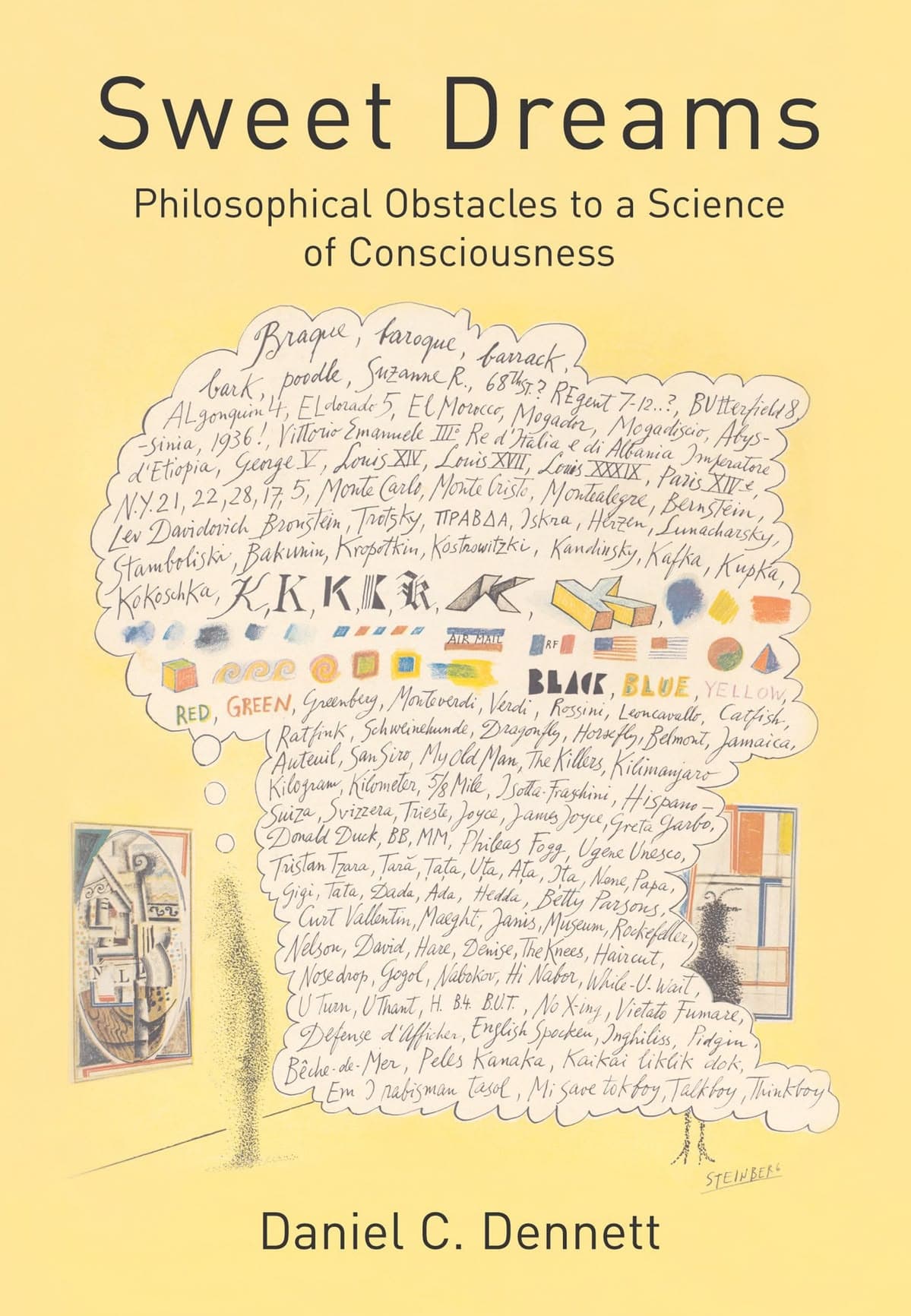
Sweet Dreams: Philosophical Obstacles to a Science of Consciousness

Sweet Dreams is Dennett's return to the consciousness wars, a collection of essays that defends and updates the Multiple Drafts Model first proposed in Consciousness Explained. Its central mechanism is the identification and dismantling of 'philosophical obstacles'—intuitions and thought experiments that Dennett argues obstruct a scientific approach. He recasts Multiple Drafts as the 'fame in the brain' model, isolates the 'Zombic Hunch' as a distorting intuition, and deploys the 'RoboMary' rebuttal to Frank Jackson's color scientist and a card trick to deflate Chalmers's Hard Problem. The book's claim is that consciousness is not a mystery but an object of scientific investigation, once the obstructions are cleared.
Key Insights
✦What is the central argument of Sweet Dreams, and what does it reject?
The book's argument is that a science of consciousness is obstructed not by genuine mystery but by philosophical intuitions and thought experiments that mislead theorists. Dennett returns to the Multiple Drafts Model he proposed in Consciousness Explained and recasts it as the 'fame in the brain' model: consciousness is a matter of which contents win competition for influence in the brain, not a private show witnessed by an inner self . What Sweet Dreams rejects is the premise that consciousness contains an irreducible 'Hard Problem' resistant to scientific explanation. Dennett argues that this sense of mystery is generated by what he calls the 'Zombic Hunch'—the intuition that a being could be physically identical to you but lack experience—and that this intuition is a philosophical obstacle rather than a datum .
✦What is the 'Zombic Hunch,' and why does Dennett treat it as an obstacle?
The Zombic Hunch is the intuition that philosophical zombies—beings physically identical to humans but with no conscious experience—are conceivable, and that this conceivability reveals something real about the nature of consciousness. Dennett treats this hunch not as evidence but as a cognitive distortion. In the opening chapter, he argues that the intuition is generated by a failure to imagine the physical details correctly, and that when the scenario is filled in rigorously, the zombie's apparent lack of experience dissolves . The Zombic Hunch is an 'obstacle' because it leads philosophers to posit a non-physical extra ingredient that no science could investigate. For Dennett, the task is to extinguish the intuition, not to build a theory around it.
✦How does Dennett rebut Frank Jackson's Mary thought experiment in this book?
Dennett's rebuttal takes the form of 'RoboMary,' a variant of Jackson's color scientist. In the original, Mary knows all physical facts about color but has never seen red; when she does, she supposedly learns something new, refuting physicalism. Dennett's RoboMary is a robot or a human who has pre-loaded her color vision system with all the relevant information and can simulate the experience internally. The point is that Mary's 'new' knowledge is not new information about the world but a change in her cognitive organization—she has gained the ability to represent color in a new format, not access to a non-physical fact . The RoboMary variation is designed to show that the intuition pump works only by smuggling in assumptions about what Mary could and could not have known, and that a properly specified physicalist Mary would not be surprised.
✦What is the 'fame in the brain' model, and how does it relate to the earlier Multiple Drafts Model?
The 'fame in the brain' model is Dennett's updated metaphor for consciousness. In Consciousness Explained, the Multiple Drafts Model described consciousness as the result of parallel processes of editorial revision, with no single finish line. In Sweet Dreams, Dennett supplements this with a political metaphor: consciousness is a matter of 'clout' or 'fame' within the brain, where some contents achieve widespread influence and access while others do not . The model is meant to explain why some mental contents become conscious while others remain unconscious without positing a central theater. Dennett acknowledges that the model is not a full theory but a framework for asking the right questions, and he presents it as a 'revision and renewal' rather than a replacement of his earlier view .
✦How was Sweet Dreams received, and what were the main criticisms?
Reception was respectful but qualified. The Globe and Mail named it one of the 100 Most Influential Books of 2005, and the New Scientist described Dennett as 'pummeling those diehard intuitions that he believes, rightly, still obstruct the progress of cognitive neuroscience' . But reviewers noted that the book is a collection of essays rather than a unified treatise, with the first five chapters autonomous and the remaining three revisiting earlier material . A review in Think asked whether the book was 'a wake up call—or more sweet slumber,' suggesting that Dennett's dismissal of the Hard Problem may convince only those already persuaded . The deeper criticism, from philosophers sympathetic to Chalmers, is that Dennett's method of deflating intuitions can be applied equally to his own position.
✦What is the relationship between Sweet Dreams and Dennett's earlier Consciousness Explained?
Sweet Dreams is explicitly a sequel and a defense. Dennett writes in the preface that the theory he sketched in 1991 is 'holding up pretty well' but that it is 'time for some revision and renewal' in light of empirical advances and theoretical challenges . The book returns to the Multiple Drafts Model and re-examines it against critics, updates the model with the 'fame in the brain' metaphor, and provides new rebuttals to familiar objections. It also defends heterophenomenology, Dennett's third-person method, against persistent misinterpretations . Readers approaching Sweet Dreams without having read Consciousness Explained will find it difficult, because it presupposes familiarity with the earlier framework and addresses specific criticisms rather than restating the original argument.
Wealthy Psyche is an intellectual archive. We do not host, distribute, or sell book copies — physical or digital. We provide structured knowledge to help you think better, faster.