


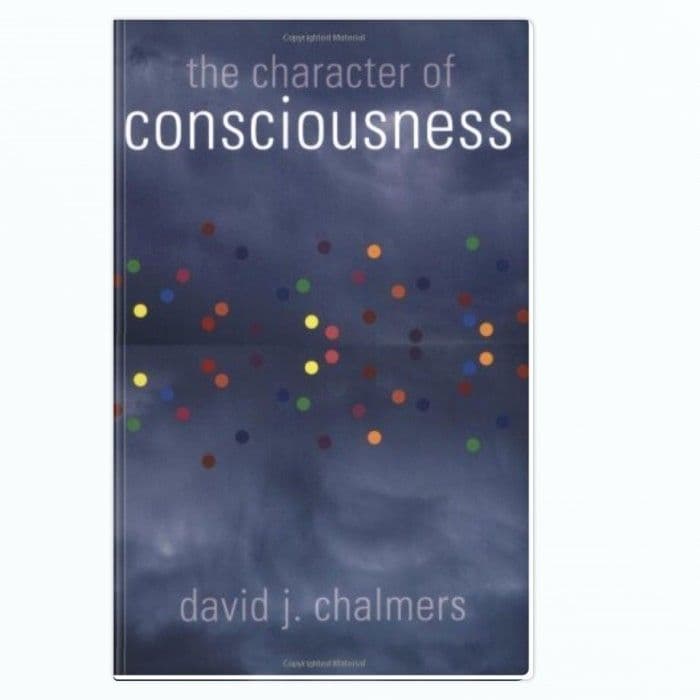
The Character of Consciousness

The Character of Consciousness collects fourteen of Chalmers's essays, unified by a single project: defending the irreducibility of phenomenal consciousness against materialist attempts to explain it away. Its central framework is the 'hard problem,' the question of why physical processes are accompanied by subjective experience at all. Chalmers argues that a science of consciousness must take first-person data seriously, that phenomenal concepts are epistemically rigid and grounded in acquaintance, and that the metaphysics of consciousness requires a nonreductive view. The book's distinctive claim is that consciousness is not a puzzle to be solved by more neuroscience but a feature of reality that demands its own explanatory framework.
Key Insights
✦What is the central argument of The Character of Consciousness, and what does it reject?
The book's central argument is that phenomenal consciousness—the subjective character of experience—cannot be reduced to physical processes without remainder. Chalmers develops this through the 'hard problem': even after we explain all the cognitive and neural functions associated with experience, the question of why those processes feel like something remains unanswered . What The Character of Consciousness rejects is the materialist assumption that consciousness is simply another functional capacity to be explained by neuroscience. Chalmers argues that a science of consciousness must incorporate first-person data, that phenomenal concepts have a special epistemic status, and that the metaphysics of consciousness requires a nonreductive framework. The book is a sustained defense of the view that consciousness is a fundamental feature of reality, not an emergent illusion.
✦What are 'phenomenal concepts,' and why does Chalmers argue they are epistemically rigid?
Phenomenal concepts are the concepts we use to think about our own subjective experiences—the concept of what it is like to see red, for example, as opposed to the concept of the physical state associated with seeing red. Chalmers argues that these concepts are 'epistemically rigid': they pick out the same property in all epistemically possible scenarios, and their possession is grounded in the phenomenal states themselves . This rigidity explains why there is an explanatory gap between physical descriptions and conscious experience. Even if we knew all the physical facts, the phenomenal concept would still pick out something that seems to outstrip those facts. Chalmers grounds this in a relation of 'acquaintance' with phenomenal properties—a direct, first-person awareness that cannot be captured from a third-person perspective.
✦How does the book relate to Chalmers's earlier The Conscious Mind?
The Character of Consciousness is explicitly a sequel and a development. The Conscious Mind (1996) introduced the hard problem and argued for a nonreductive view of consciousness. The later book collects essays written in the intervening years, replying to critics, refining the arguments, and extending the framework into new areas . The book's introduction provides Chalmers's own assessment of how the chapters interrelate and highlights where his thinking has moved on since 1996 . Readers approaching The Character of Consciousness without familiarity with The Conscious Mind will find the earlier book useful for background, but the later collection stands on its own as a comprehensive statement of Chalmers's mature position.
✦How was the book received, and what were the main criticisms?
Reception was generally positive but not uncritical. Reviewers praised the collection for gathering Chalmers's most important essays in one volume and for the clarity of his arguments . Sydney Shoemaker called it 'a valuable book' that brings together 'the important work that David Chalmers has done on the topic of consciousness since the publication of his seminal The Conscious Mind' . But critics raised objections. Some argued that Chalmers's nonreductive view leaves consciousness causally inert, unable to affect the physical world. Others objected that the hard problem is a philosophical illusion generated by a confused picture of experience. A review in Philosophy noted that 'there are many conservative strands in his thought that warrant serious challenge' . The book remains a flashpoint in the consciousness debates, defended by those who accept the hard problem and attacked by those who see it as a dead end.
✦What is the significance of the 'consciousness meter' and the Matrix discussion in the book?
Chalmers includes several provocative ideas alongside the technical arguments. The 'consciousness meter' is a thought experiment about how we might measure consciousness in other systems, raising questions about the criteria for attributing experience to animals, machines, or aliens . The Matrix discussion uses the film as a guide to philosophical problems about perception and the external world: if we could be in a simulation, what does that tell us about the relationship between experience and reality? These accessible essays sit alongside the more technical chapters on phenomenal concepts and two-dimensional semantics, and they reflect Chalmers's conviction that philosophy of mind should engage with culture as well as with neuroscience and logic.
✦How does the book's structure reflect Chalmers's overall approach to consciousness?
The book is divided into six sections: the problems of consciousness, the science of consciousness, the metaphysics of consciousness, concepts of consciousness, the contents of consciousness, and the unity of consciousness . This structure enacts Chalmers's methodological claim that consciousness must be approached from multiple, interconnected angles. No single discipline—neuroscience, philosophy, psychology—can answer the hard problem alone. The first section states the problem; the second asks how science can address it; the third develops the metaphysical implications; the fourth and fifth analyze the concepts and contents of experience; and the sixth addresses the unity of consciousness. The book is thus not a single argument but a framework, a set of tools for thinking about a problem that Chalmers believes will not yield to any single method.
Wealthy Psyche is an intellectual archive. We do not host, distribute, or sell book copies — physical or digital. We provide structured knowledge to help you think better, faster.