


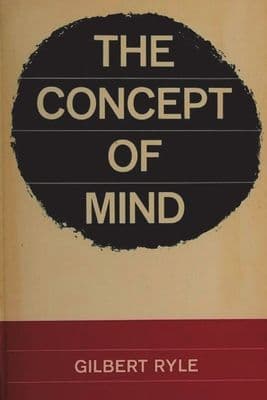
The Concept of Mind

Ryle's central target is the 'Official Doctrine' of Cartesian substance dualism, which he recasts as a 'category mistake' rather than a factual error. The book argues that mental predicates do not refer to hidden inner episodes occurring in a non-physical medium; instead, talk of mind describes how a person is disposed to act, react, and behave in various circumstances. Ryle's method is conceptual cartography: mapping the logical geography of mental concepts to dissolve the puzzles generated by treating mind and body as two parallel kinds of thing.
Key Insights
✦What is the central claim of The Concept of Mind, and what does it reject?
Ryle's central claim is that the mind is not a second, inner theatre where private events occur behind the scenes of bodily behaviour. What we call 'mind' is a complex set of capacities, dispositions, and ways of acting and reacting. The book rejects Cartesian substance dualism—the doctrine Ryle dubs the 'ghost in the machine'—not by arguing that it gets the facts wrong, but by arguing that it commits a category mistake: it applies the logic of thinghood and location to concepts whose grammar works differently. Mental predicates do not name hidden objects; they describe how a person is disposed to conduct themselves across situations.
✦What specific concept did Ryle introduce, and how is it used beyond his own work?
Ryle introduced the 'category mistake' as a diagnostic tool: the error of applying a concept to something of a logical type to which it cannot coherently apply. His example is a visitor to Oxford who sees colleges, libraries, and administrative buildings, then asks where the University is—as if the University were one more building alongside the others. The concept has been taken up widely in analytic philosophy, cognitive science, and even artificial intelligence debates, wherever someone is accused of misclassifying a phenomenon by forcing it into the wrong ontological category. Ryle's specific use of it against dualism remains the paradigm case.
✦How has Ryle's argument held up since its publication?
The critique of Cartesian dualism is widely credited with helping to dislodge substance dualism from mainstream philosophy of mind. However, Ryle's dispositional analysis was quickly challenged by philosophers who argued that it leaves out subjective experience, qualia, and intentionality. Thomas Nagel's 'What Is It Like to Be a Bat?' and Frank Jackson's knowledge argument are often cited as later demonstrations that a purely behavioural or dispositional account cannot capture consciousness. Functionalism and cognitive science also developed models of internal mental processing that Ryle's framework seemed to rule out. The book remains influential, but its positive programme is generally treated as historically important rather than as a live option in its original form.
✦How does The Concept of Mind relate to Wittgenstein's later philosophy?
Ryle and Wittgenstein are both associated with the ordinary language tradition, and Ryle's book is often read alongside Wittgenstein's Philosophical Investigations, though the relationship is complicated. Ryle developed his method of 'logical geography' and the dissolution of puzzles through attention to ordinary usage in the 1930s, partly in dialogue with Wittgenstein's Cambridge work. Anecdotal evidence suggests Wittgenstein was dismissive of Ryle's book in letters, while also reportedly telling a relative that Ryle was one of the few philosophers who understood him. The Concept of Mind is not a Wittgensteinian text, but it shares the commitment to treating philosophical problems as confusions generated by language rather than as substantive discoveries awaiting empirical resolution.
✦Was Ryle a behaviourist, and is that label fair to the book?
Ryle is often called a 'logical behaviourist,' but the label requires care. He was not a psychological behaviourist in the sense of denying that inner events occur or recommending that psychology ignore them. His target was the logical grammar of mental concepts, not the empirical study of behaviour. Ryle's claim is that when we say someone is intelligent, thoughtful, or in pain, we are not reporting an occult inner occurrence; we are describing how they are disposed to act, react, and talk under various conditions. Critics have argued that this amounts to behaviourism in disguise, because it makes mental states wholly analysable in terms of observable responses. Ryle denied the reduction, but the charge has stuck in much of the secondary literature.
✦What is the 'ghost in the machine' metaphor, and is it a fair characterisation of Descartes?
The 'ghost in the machine' is Ryle's polemical image for Cartesian dualism: a person is a physical machine, and the mind is a ghostly occupant inside it, directing its movements from a non-physical control room. The metaphor is vivid and memorable, but scholars have questioned whether it is a fair reading of Descartes. Descartes did not describe the mind as a little person inside the body; he held that mind and body are distinct substances united in a substantial union. Some critics argue that Ryle conflates Descartes with a crude folk dualism that few philosophers actually held. Others defend Ryle's target as a philosophical position rather than a historical reconstruction, arguing that the 'Official Doctrine' he attacks is a logical structure that Cartesian arguments invite.
✦How has the book been misread or oversimplified in popular reception?
The most common oversimplification is to read The Concept of Mind as simply denying that mental states exist or as claiming that 'the mind is just behaviour.' Ryle did not deny that people think, feel, and imagine; he denied that these terms refer to ghostly inner episodes accessible only to the person having them. Another misreading treats the category mistake as a debunking trick that dissolves all mental-talk problems, when Ryle's method was meant to be piecemeal and diagnostic rather than a blanket eliminativism. The book's wit and polemical clarity have made it easy to quote the 'ghost in the machine' line while ignoring the careful conceptual cartography that surrounds it.
Wealthy Psyche is an intellectual archive. We do not host, distribute, or sell book copies — physical or digital. We provide structured knowledge to help you think better, faster.