


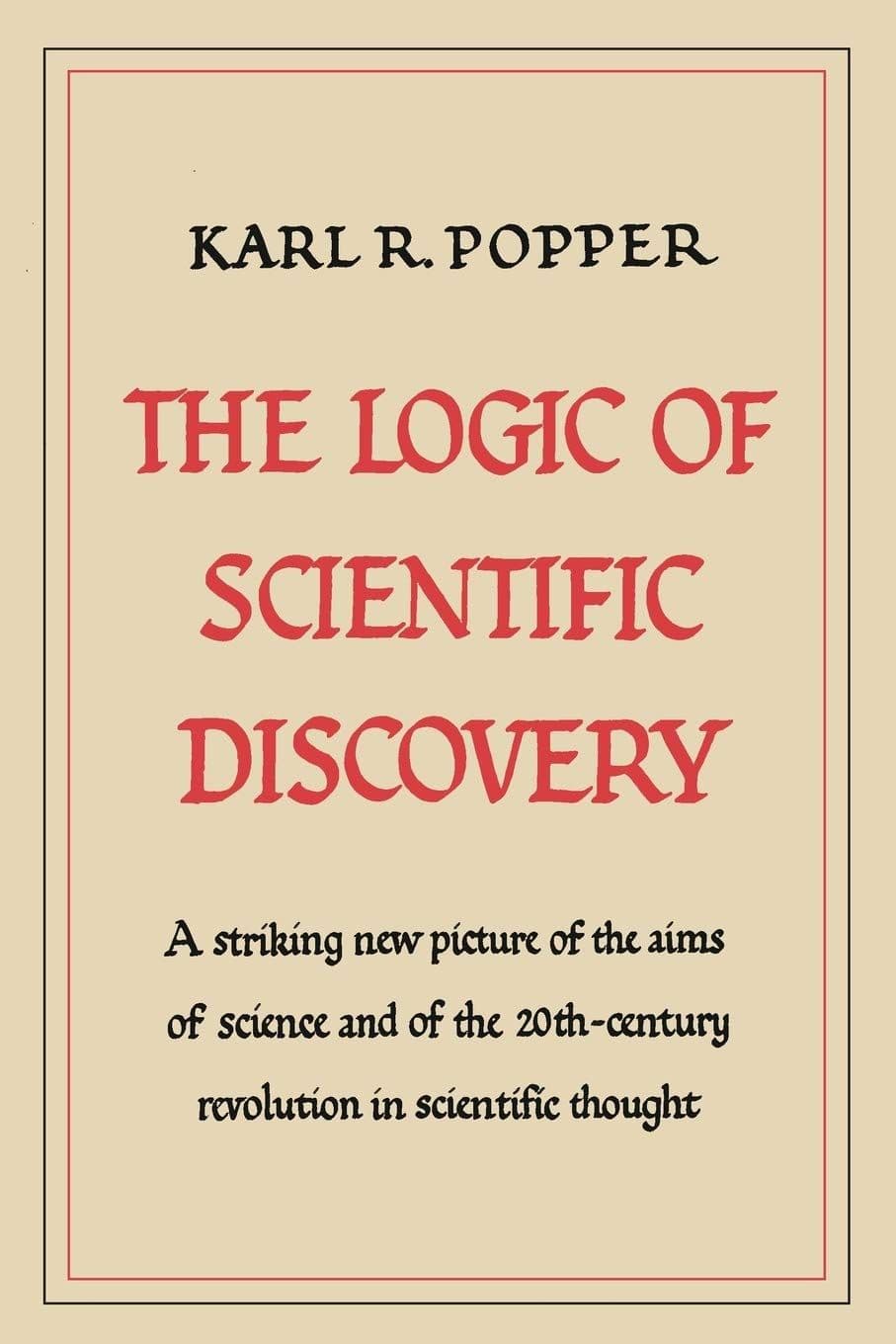
The Logic of Scientific Discovery

Popper's central argument is that scientific theories can never be verified by experience but can be falsified: a single genuine counterexample defeats a universal law, while no number of confirming instances can prove it. The book's distinctive mechanism is the criterion of demarcation—a theory is scientific if and only if it is empirically falsifiable—which he uses to distinguish science from pseudo-science and to reject inductive logic. Scientific progress, on this account, is the survival of conjectures that have withstood severe attempts at refutation.
Key Insights
✦What is Popper's criterion of demarcation, and why does he reject verification?
Popper's criterion of demarcation is falsifiability: a theory is scientific if and only if it makes predictions that could, in principle, be refuted by observation. He rejects verification because universal laws cannot be verified by any finite number of observations—no matter how many white swans you see, you cannot prove that all swans are white. But a single black swan falsifies the law. Popper argues that this asymmetry between verification and falsification is the key to scientific method. The criterion also serves to distinguish science from pseudo-science: theories like Freudian psychoanalysis or Marxist historical materialism, which can explain any possible observation, fail the test because they cannot be refuted. Science, for Popper, is a set of conjectures that are exposed to refutation and survive only tentatively.
✦What is the problem of induction, and how does Popper propose to solve it?
The problem of induction is that inductive reasoning—inferring general laws from particular observations—cannot be justified. Hume showed that any argument for induction must itself rely on induction, making it circular. Popper's solution is to deny that science uses induction at all. Science proceeds by conjecture and refutation: scientists propose bold hypotheses, then attempt to falsify them. The fact that a theory has survived testing does not confirm it inductively; it merely shows that it has not yet been refuted. Popper's account is deductivist: from a universal law and initial conditions, we deduce a prediction; if the prediction fails, the law is falsified. This avoids the problem of induction by eliminating the need for inductive inference. Critics have argued that the solution is too austere and that scientists do rely on inductive reasoning, but Popper's challenge remains influential.
✦How was the book published, and how did the English translation differ from the original German?
The book was first published in German in 1934 as Logik der Forschung by Verlag von Julius Springer in Vienna. The English translation, published by Hutchinson in 1959, was not a straightforward translation: Popper substantially revised and expanded the text, adding new material and responding to developments in the philosophy of science since the original publication. The English edition is thus considerably longer than the German original. Popper translated the work himself, with the assistance of Julius and Lan Freed. The translation is generally regarded as authoritative, though readers should be aware that the English text represents Popper's later views as much as the original 1934 argument. A fourth edition in 1972 added further material, including a postscript.
✦How did the book's reception change between 1934 and 1959, and why does that matter?
When it was first published in 1934, the book was largely ignored. The philosophical climate was dominated by logical positivism, and Popper's rejection of induction and his critique of verification was not well received. By the time the English translation appeared in 1959, the situation had changed dramatically. Popper had become a major figure, and the book was recognised as a classic. The delay in translation meant that the English-speaking world encountered Popper's ideas after they had already been developed and modified. The book's reception was also shaped by the publication of Kuhn's Structure of Scientific Revolutions in 1962, which challenged Popper's account of science. The debate between Popper and Kuhn became one of the defining controversies of twentieth-century philosophy of science.
✦What are the main criticisms of Popper's falsificationism?
The main criticisms are that falsificationism is too simple a model of scientific practice. Kuhn argued that scientists do not abandon theories as soon as they encounter anomalies; they treat anomalies as puzzles to be solved within the prevailing paradigm. Lakatos argued that falsificationism is naive because it ignores the tenacity of research programmes and the role of auxiliary hypotheses in protecting a theory from refutation. Other critics have noted that observations are theory-laden, so it is not always clear what counts as a falsifying instance. Popper's response is that these criticisms describe the sociology of science, not its logic: scientists may be dogmatic, but the logic of scientific discovery is falsificationist. The debate between Popper and his critics remains central to the philosophy of science.
✦What is the most common misunderstanding of Popper's argument?
The most common misunderstanding is that Popper is claiming that scientists should actively try to falsify their theories and abandon them at the first sign of trouble. In fact, Popper is making a logical point about the structure of scientific knowledge, not a prescription for scientific practice. He acknowledges that scientists are often dogmatic and that theories are abandoned only when a better alternative is available. His point is that the rationality of science lies in its willingness to expose theories to criticism and to revise them in the light of evidence, not in the mechanical application of a falsification rule. A related misunderstanding is that Popper denies the value of confirmation. He does not: he argues that confirmation can be valuable if it is the result of a genuine attempt at refutation.
Wealthy Psyche is an intellectual archive. We do not host, distribute, or sell book copies — physical or digital. We provide structured knowledge to help you think better, faster.