


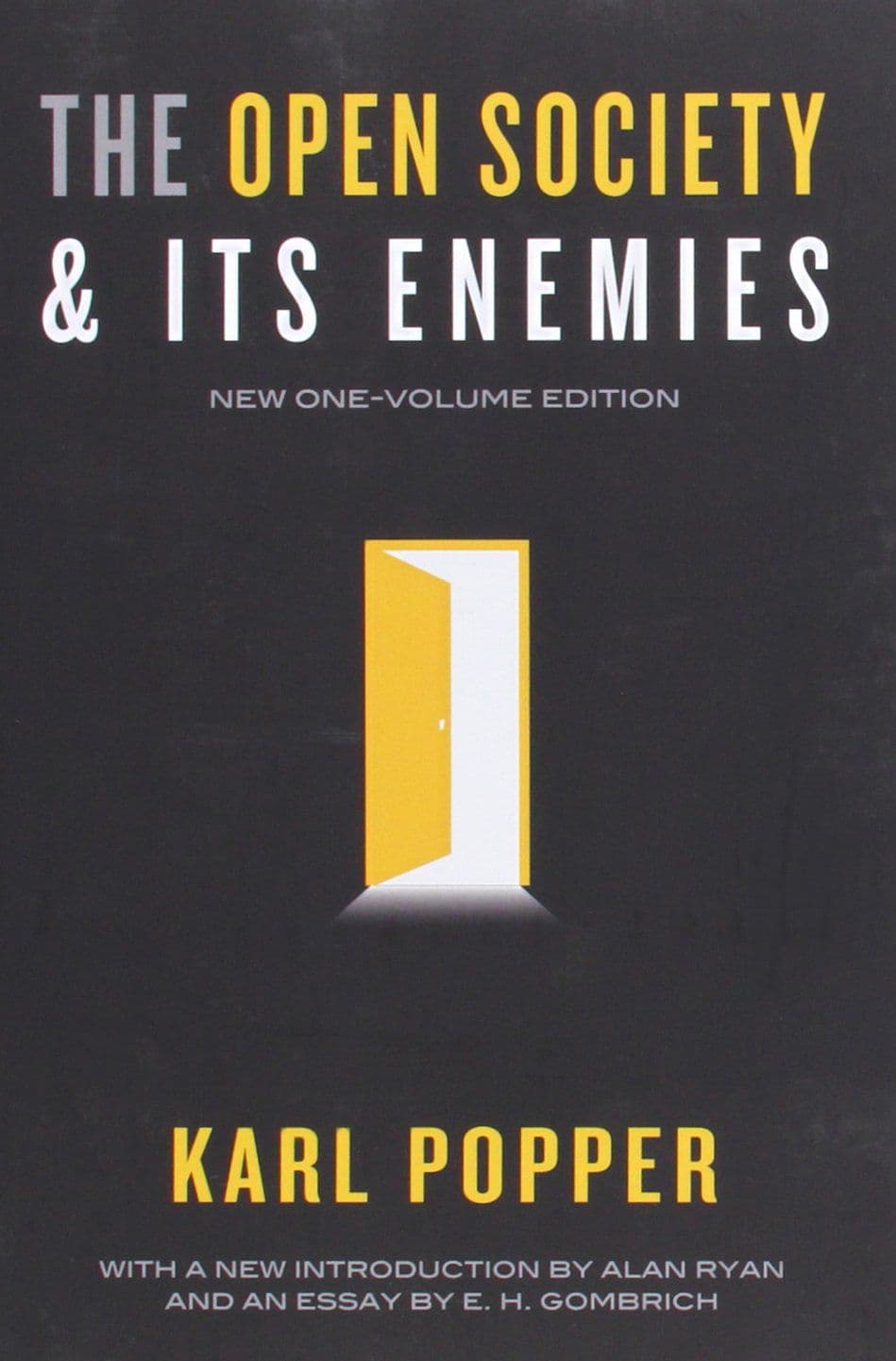
The Open Society and Its Enemies
Popper's central argument is that the open society—one in which individuals are free to criticise their rulers and institutions can be changed without bloodshed—is threatened by historicist philosophies that claim to have discovered the laws of historical destiny. The book's distinctive mechanism is the critique of Plato, Hegel, and Marx as enemies of the open society: each, in different ways, substitutes a vision of collective destiny for the fallibilist, piecemeal politics of liberal democracy. Popper's claim is that the only rational politics is one that treats institutions as experiments to be tested and corrected, not as embodiments of historical necessity.
Key Insights
✦What is the central argument of The Open Society, and who are its 'enemies'?
The central argument is that the open society—one in which individuals are free to criticise their rulers, and institutions can be changed without violence—is threatened by historicist philosophies that claim to have discovered the laws of historical destiny. The enemies are Plato, Hegel, and Marx, each of whom, in Popper's reading, substitutes a vision of collective destiny for the fallibilist, piecemeal politics of liberal democracy. Plato's ideal state is a closed society governed by philosopher-kings who know the truth; Hegel's philosophy of history treats the state as the embodiment of reason; Marx's historical materialism claims to have discovered the laws of social evolution. Popper argues that all three undermine the open society by treating political questions as matters of historical necessity rather than as problems to be solved through criticism and reform.
✦What does Popper mean by the 'open society,' and how does it differ from the 'closed society'?
The open society is one in which individuals are free to criticise their rulers and institutions, and in which political change can occur without bloodshed. It is characterised by the rule of law, democratic accountability, and a commitment to piecemeal reform. The closed society, by contrast, is one in which the group is everything and the individual is subordinate to the collective. It is characterised by tribalism, rigid hierarchy, and the suppression of criticism. Popper draws the distinction from Henri Bergson, but he gives it a political and epistemological content: the closed society is based on the belief that the truth is known and must be enforced; the open society is based on the recognition that no one has a monopoly on truth, and that institutions should be designed to allow for the correction of error.
✦Why does Popper attack Plato, and is his reading of Plato fair?
Popper attacks Plato because he sees the Republic as a blueprint for a closed society: a hierarchical state governed by philosopher-kings who possess absolute knowledge, with a rigid class system and no room for individual criticism. Popper argues that Plato's political programme is totalitarian in its implications, and that his influence has been to legitimise the idea that society should be governed by an elite that knows the truth. The reading has been widely criticised. Many scholars argue that Popper misrepresents Plato, ignoring the historical context of the Republic and reading it as a literal political programme rather than as a thought-experiment. Popper's defenders argue that the attack is intended as a warning about the dangers of utopian political thought, not as a scholarly interpretation of Plato.
✦What is Popper's critique of Marx, and how does it relate to his critique of historicism?
Popper's critique of Marx is that his historical materialism is a form of historicism: it claims to have discovered the laws of social evolution, and it treats the socialist revolution as a historical necessity. Popper argues that this is both intellectually mistaken and politically dangerous. It is mistaken because the growth of knowledge is unpredictable, and therefore the future course of history cannot be predicted. It is dangerous because it justifies the sacrifice of individuals to a supposed historical destiny and undermines the open society's commitment to piecemeal reform. Popper does not deny Marx's moral outrage at injustice; he argues that Marx's method is flawed. The critique is developed in The Poverty of Historicism, which Popper wrote as a companion to The Open Society.
✦How was the book written and published, and what was its reception?
The book was written during the Second World War, while Popper was teaching in New Zealand. It was published in 1945 by Routledge and Kegan Paul in two volumes. The reception was initially mixed: the book was praised for its defence of liberal democracy but criticised for its polemical treatment of Plato and Hegel. Over time, its reputation grew, and it is now regarded as a classic of political philosophy. The book has been translated into numerous languages and has been widely read and debated. Its influence extends beyond philosophy: it has been cited by politicians, economists, and public intellectuals as a defence of the open society and a warning against totalitarian ideologies.
✦What is the most common misunderstanding of The Open Society?
The most common misunderstanding is that Popper is offering a defence of Western liberal capitalism or a simple ideological attack on communism. In fact, Popper's critique is directed at any form of historicism, whether of the left or the right. He is defending a set of procedural values—criticism, accountability, piecemeal reform—not a particular economic system. A related misunderstanding is that Popper is dismissing Plato, Hegel, and Marx as thinkers of no value. On the contrary, he engages with them seriously, and his critique is intended as a tribute to their influence: they are dangerous because they are powerful. The book is a defence of the open society, not a defence of the status quo, and it is best read as a contribution to political philosophy rather than as a work of partisan polemic.
Wealthy Psyche is an intellectual archive. We do not host, distribute, or sell book copies — physical or digital. We provide structured knowledge to help you think better, faster.