


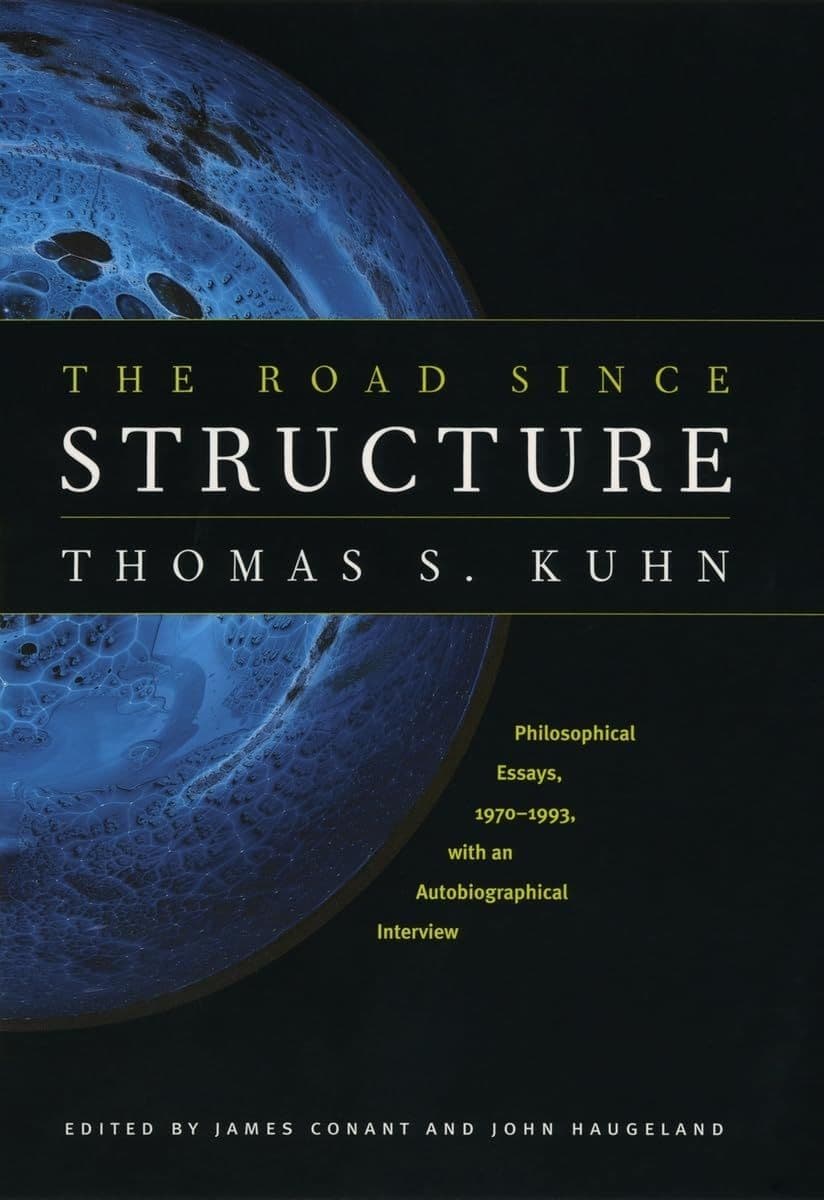
The Road Since Structure: Philosophical Essays, 1970–1993, with an Autobiographical Interview
This posthumous collection argues that Kuhn's later work is not a retreat from Structure but a sustained refinement of its central concepts, especially incommensurability. The book's distinctive mechanism is the turn to language: Kuhn recasts incommensurability as a failure of translatability between scientific lexicons, not as an irrationalist claim about reality. The essays and the autobiographical interview show Kuhn defending a local, historicist account of scientific change against both the relativist readings of his critics and the ahistorical rationality of his Popperian adversaries.
Key Insights
✦What is the central argument of The Road Since Structure, and how does it relate to Kuhn's earlier work?
The central argument is that Kuhn's later essays constitute a significant articulation and defence of his fundamental views, not a retraction of them. Peter Lipton noted in the London Review of Books that 'it's sometimes claimed that Kuhn toned down his radical views after Structure, but this is a mistake' . The book's distinctive contribution is the refinement of incommensurability into a thesis about language: Kuhn argues that scientific revolutions involve changes in the lexicon, the structured vocabulary through which scientists describe nature, and that these changes produce failures of translatability between paradigms. This is not a claim that paradigms are incomparable, but that comparison requires the difficult work of learning a new language. The volume thus shows Kuhn defending his historicist account of science against both relativist and rationalist critics .
✦How was the book assembled, and what does the autobiographical interview contribute?
The volume was edited by James Conant and John Haugeland and assembled with Kuhn's input before his death in 1996 . It is divided into three parts: essays refining the concepts of Structure, replies to critics (including Feyerabend, Popper, and Hempel), and a lengthy autobiographical interview conducted in Athens in 1995, not quite a year before his death . The interview is a remarkable document: Kuhn, usually reticent, discusses his upbringing, his training as a physicist, his war work, his relationships with colleagues, and his struggle to define his philosophical position before and after Structure . It provides a candid account of the development of his ideas and career, and it brings out the extent to which the history of science was for him from the start a vehicle for philosophical inquiry .
✦What does Kuhn mean by 'lexicon,' and how does it refine the concept of incommensurability?
The lexicon is Kuhn's later term for the structured vocabulary that a scientific community uses to describe and classify nature. It is not merely a list of words but a system of interrelated kind-terms with built-in similarities and differences. Incommensurability, on this account, is what happens when two communities have lexicons that cannot be mapped onto one another without remainder: the terms do not translate cleanly, and the world is carved up differently. This is a more precise and defensible thesis than the vague claim that paradigms are 'incommensurable.' It locates the discontinuity in language rather than in reality, and it explains why scientific revolutions are difficult to communicate across the revolutionary divide. The essay 'Commensurability, Comparability, Communicability' is the fullest statement of this position .
✦How does Kuhn respond to his critics in this volume, and what does the volume reveal about his relationship with Popper and Feyerabend?
The second part of the volume contains Kuhn's replies to critics, including 'Reflections on My Critics,' which addresses Popper, Feyerabend, Hempel, and Charles Taylor . The replies show Kuhn defending his position against two opposite misreadings: the relativist reading, which treats incommensurability as a claim that all paradigms are equally valid, and the rationalist reading, which treats it as a failure to meet Popperian standards of criticism. Kuhn's relationship with Popper was one of sustained opposition: Popper treated him as a defender of irrationalism, while Kuhn regarded Popper's falsificationism as an inadequate description of scientific practice. With Feyerabend, the relationship was more complex: Feyerabend was a friend and ally in the critique of method, but Kuhn did not endorse his anarchism. The replies clarify these differences .
✦What is the significance of the title, 'The Road Since Structure,' and how does it frame the volume?
The title signals that the book is a record of the path Kuhn took after Structure, not a repetition of it. The University of Chicago Press describes it as 'the fullest record we have at present of the new direction Kuhn was taking during the last two decades of his life' . The title essay, 'The Road since Structure,' is a retrospective account of Kuhn's intellectual development, explaining how his views evolved and why he continued to regard the problems of Structure as central. The title thus frames the volume as a continuation rather than a departure: the road since Structure is still the road from Structure, and the later essays are refinements of the same project. For readers who know Kuhn only through Structure, the volume reveals the depth and persistence of his later thinking.
✦Is this volume a good introduction to Kuhn's philosophy, or does it presuppose familiarity with Structure?
It presupposes familiarity with Structure. The essays engage with criticisms that only make sense if the reader knows the original argument, and the replies to critics assume knowledge of the debates they address. The autobiographical interview is more accessible and can be read independently, but it is best appreciated by readers who know what Kuhn is reflecting on. For a first encounter with Kuhn, The Structure of Scientific Revolutions remains the essential text. The Road Since Structure is best read as a companion and a deepening: it shows what Kuhn thought about his own work after decades of criticism and reflection. Readers who have struggled with the ambiguities of Structure will find here the clarifications they need .
Wealthy Psyche is an intellectual archive. We do not host, distribute, or sell book copies — physical or digital. We provide structured knowledge to help you think better, faster.