


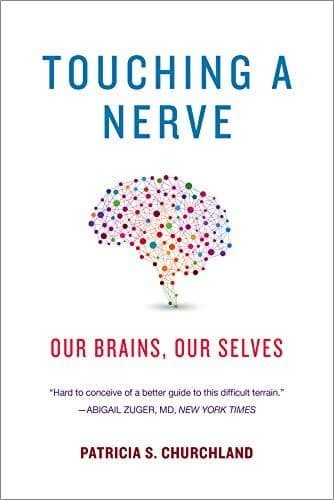
Touching a Nerve: Our Brains, Our Selves

Churchland's central claim is that the self is nothing but the brain: everything we feel, think, and decide is electrical and chemical activity in neural tissue. The book grounds philosophy of mind in biology, arguing that accepting our brain-based nature liberates rather than diminishes us. Churchland interweaves neuroscience with personal narrative, tackling soul beliefs, morality, aggression, free will, and consciousness. She reframes free will as self-control, defends a naturalistic ethics rooted in attachment, and argues that understanding the brain allows us to approach conditions we cannot cure with compassion rather than superstition.
Key Insights
✦What is the central claim of Touching a Nerve, and what does it reject?
Churchland's central claim is that the self is nothing but the brain: everything we feel, think, and decide is electrical and chemical activity in neural tissue . She rejects the view that the mind stems from an immaterial spirit or soul, and she challenges beliefs in an afterlife as incompatible with a scientific understanding of consciousness . The book also rejects the idea that this realization should be depressing. Churchland argues that accepting our brain-based nature liberates us from superstition, allows us to take ourselves seriously as products of evolved mechanisms and social influences, and grounds compassion for conditions we cannot cure .
✦How does Churchland reframe the free will debate in this book?
Churchland shifts the question from abstract metaphysical freedom to the practical capacity for self-control . She argues that we are capable of exercising self-control, and she defends this position vigorously against neuroscientific findings that are sometimes taken to undermine free agency . The chapter also discusses the implications of neuroscience for the penal system. Unlike many authors who argue that determinism requires radical reform of criminal justice, Churchland finds the present system well constructed and in no substantial need of reform, despite the fact that the notion of free agency sits at its heart . Her approach treats freedom as a natural capacity of brains rather than a metaphysical mystery.
✦What role does personal narrative play in the book, and how was it received?
Churchland embeds weighty neuroscientific issues in personal stories, aiming to interweave the science with her own experiences . A reviewer in Organon noted that the humour and warmth of Churchland's personality shines through the pages, and felt disappointed when the autobiographical streak almost completely disappeared in the second half . The Choice review observed that this technique provides high-level discussions of traditional neuroscientific topics that are accessible to a much broader audience, without diminishing the rigor of the science . The book is thus more accessible than her academic works, though some philosophical readers found the narrative approach less satisfying than her earlier systematic treatises.
✦What is the biggest criticism of Touching a Nerve from philosophical reviewers?
The most pointed criticism is that the book lacks Churchland's own philosophical contribution. Tomáš Marvan, reviewing in Organon, argued that Churchland is a first-rate philosopher with distinguished views of her own, yet in this book she is largely content with summarizing the work of cognitive and affective neuroscientists . The result, in Marvan's judgment, is 'more of a high-end work in popular neuroscience than an essay in neurophilosophy' . He also noted an inconsistency: the book contains no discussion of eliminativism, yet it insists that beliefs and desires are helpful instruments of daily social interaction, leaving unresolved how these positions square with each other .
✦How does the book relate to Churchland's earlier work on morality?
Touching a Nerve draws heavily on Churchland's previous book Braintrust (2011), which developed the neurobiological account of morality rooted in attachment and oxytocin . The chapter on morality summarizes this framework, centering on the role of hormones, neurotransmitters, and neuromodulators in producing empathy, altruism, and fairness . Churchland uses real-life examples to illustrate how culture and environment contribute to specific moral codes—for instance, noting that some things taken to be immoral in Western societies are not immoral for the Inuit . The book extends this naturalistic ethics into discussions of aggression, sex, and warfare, arguing against single-gene explanations for complex behaviours.
✦How has the book been received outside academic philosophy?
The book reached a general audience, including an appearance by Churchland on The Colbert Report in January 2014, where she sparred with Stephen Colbert on questions about how brain wiring affects morality and decision-making . Slate magazine interviewed her about 'neuroexistentialism'—the unsettling realization that our hopes, loves, and existence are functions of grey tissue—and Churchland argued that this realization should inspire rather than scare us . The Choice review recommended the book for lower-level undergraduates and general readers, praising its accessibility . Churchland herself described neuroscience as liberating because it allows us to see our connections to other biological things without 'metaphysical junk' about the afterlife .
Wealthy Psyche is an intellectual archive. We do not host, distribute, or sell book copies — physical or digital. We provide structured knowledge to help you think better, faster.