


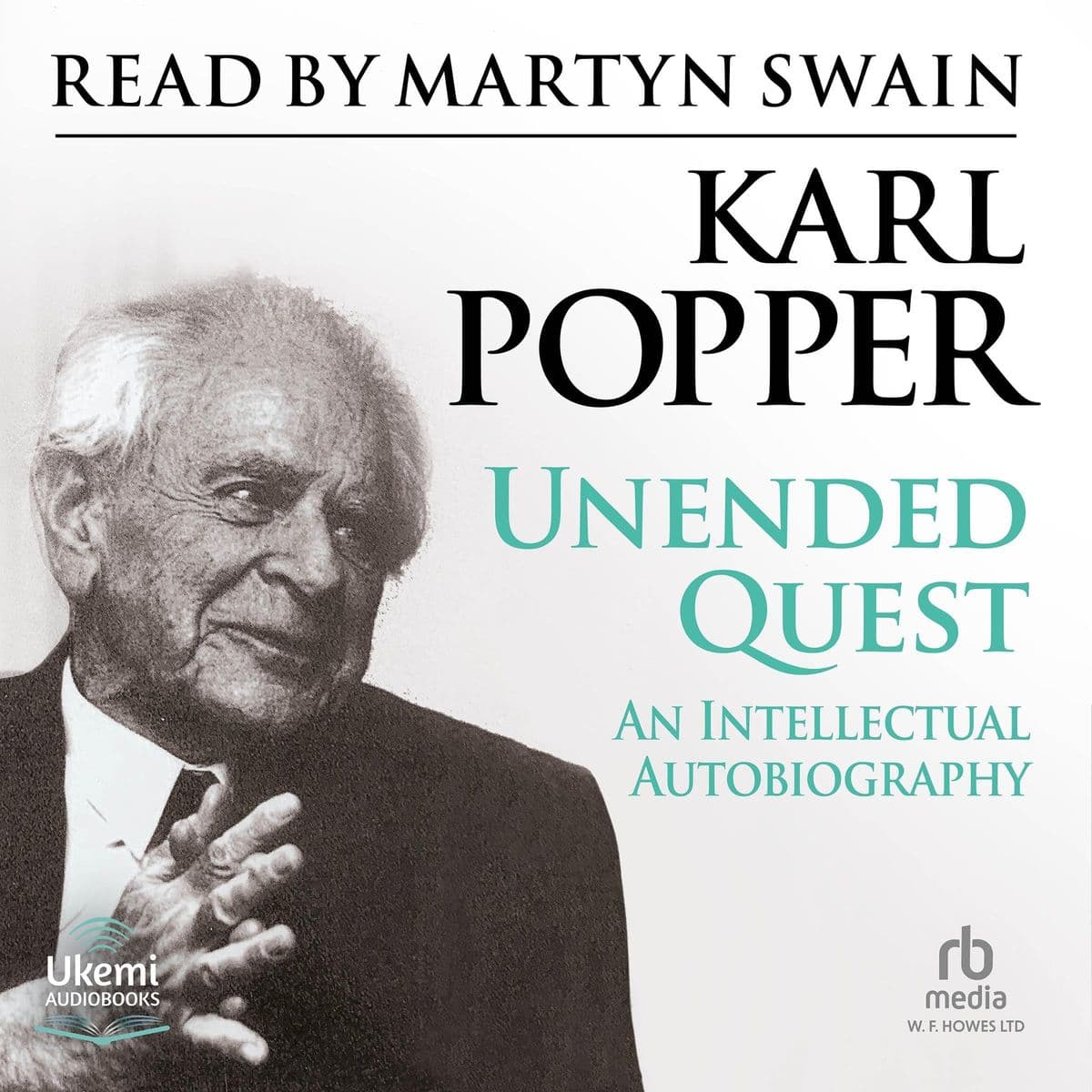
Unended Quest: An Intellectual Autobiography
Popper's intellectual autobiography argues that philosophy is not a profession but an unended quest, and that its problems arise from outside philosophy—from science, politics, and the puzzles of everyday life. The book traces his development from the social and political crises of interwar Vienna through his engagement with Einstein, Freud, and the Vienna Circle, to the formulation of falsificationism. Its distinctive claim is that the growth of knowledge, not the justification of belief, is the central problem of epistemology, and that this problem is solved by conjecture and refutation.
Key Insights
✦What is the central claim of Unended Quest, and how does it differ from a conventional autobiography?
The central claim is that philosophy is not a profession but an unended quest, and that its problems arise from outside philosophy—from science, politics, and the puzzles of everyday life. Popper's autobiography is not a chronological narrative of personal life; it is an account of the development of his ideas and the problems that drove them. He writes that he has 'always been interested in the growth of knowledge' and that this interest, not a desire to justify belief, is what led him to philosophy. The book is thus an intellectual autobiography in the strict sense: it traces the formation of a philosophical position through its engagement with specific problems. It is also a defence of the view that philosophy should be problem-driven rather than school-driven.
✦What was Popper's relationship to the Vienna Circle, and how does he describe it in the book?
Popper was never a member of the Vienna Circle, though he was closely associated with it and engaged in sustained debate with its members. In Unended Quest, he describes his relationship to the Circle as one of critical distance: he shared their interest in the logic of science and their rejection of metaphysics, but he rejected their verificationism and their inductivism. He recounts his meetings with Moritz Schlick, Rudolf Carnap, and Otto Neurath, and he explains why he never accepted their positivist programme. The book is a valuable source for understanding the intellectual climate of interwar Vienna and the debates that shaped the philosophy of science. Popper's account is partisan—he is defending his own position—but it is also vivid and detailed.
✦What role did Einstein play in Popper's intellectual development, and how does the book describe it?
Popper describes Einstein as a decisive influence on his development. He was struck by Einstein's willingness to expose his theory of relativity to risky predictions—predictions that could have refuted it—and he contrasted this with the theories of Freud and Adler, which seemed able to explain any observation and therefore could not be refuted. This contrast led Popper to his criterion of demarcation: a theory is scientific if it is falsifiable. In Unended Quest, he recounts how he came to see that the difference between Einstein's theory and the theories of Freud and Adler was not a difference in empirical support but a difference in testability. The book thus provides the biographical context for the central idea of The Logic of Scientific Discovery.
✦How was Unended Quest written and published, and what is its relationship to Popper's other works?
Unended Quest was first published in 1974 by Open Court and Routledge. It was written for the Library of Living Philosophers volume on Popper, edited by Paul Arthur Schilpp, and it was subsequently published as a separate book. Popper revised it in later editions, adding new material and responding to criticism. The book is thus not a straightforward memoir but a philosophical work in its own right, in which Popper reflects on his intellectual development and the problems that drove him. It is closely related to The Logic of Scientific Discovery and The Open Society and Its Enemies, providing the biographical and intellectual context for both. Readers seeking the origins of Popper's ideas will find the book indispensable.
✦What does Popper mean by the 'growth of knowledge' as the central problem of epistemology?
Popper argues that epistemology has traditionally been concerned with the justification of belief—with the question of what we know and how we can be sure of it. But this, he argues, is the wrong problem. The central problem of epistemology is the growth of knowledge: how does scientific knowledge develop, and how can we understand its progress? This shift is fundamental. It moves epistemology away from the search for certainty and toward the study of how knowledge is produced, criticised, and improved. Popper's answer is that knowledge grows through conjecture and refutation: theories are proposed, tested, and either provisionally accepted or rejected. The growth of knowledge is an evolutionary process, and epistemology should be understood as the theory of this process. The book is a sustained defence of this view.
✦What is the most common misunderstanding of Popper's autobiography?
The most common misunderstanding is to read Unended Quest as a personal memoir rather than as a philosophical work. Popper is not interested in telling the story of his life for its own sake; he is interested in explaining how his ideas developed and what problems they were designed to solve. The book is thus a contribution to philosophy, not merely a historical document. A related misunderstanding is to treat the book as a definitive statement of Popper's position. He revised it in later editions, and it is best read alongside his major works. It is a valuable supplement to the philosophy, not a substitute for it, and it should be read as an account of how a philosopher came to see the problems that shaped his life's work.
Wealthy Psyche is an intellectual archive. We do not host, distribute, or sell book copies — physical or digital. We provide structured knowledge to help you think better, faster.