


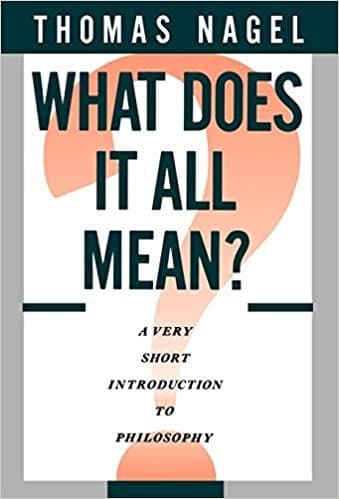
What Does It All Mean?: A Very Short Introduction to Philosophy

Nagel's central claim is that philosophy is best learned by thinking directly about its problems, not by studying its history. This short introduction presents nine fundamental questions—knowledge of the external world, other minds, the mind-body problem, language, free will, morality, justice, death, and the meaning of life—without naming a single philosopher or using technical jargon. Nagel states his own views where he has them, but deliberately leaves the questions open, arguing that the value of philosophy lies in confronting the problems themselves rather than in arriving at settled answers.
Key Insights
✦What is the central claim of What Does It All Mean?, and what does it reject?
Nagel's central claim is methodological: the best way to learn about philosophy is to think about its questions directly, not to study the history of philosophical writings. He rejects the standard introductory approach that surveys philosophers and schools, arguing that 'the philosophical raw material comes directly from the world and our relation to it' rather than from past texts . The book therefore names no philosophers and uses no technical jargon. Nagel presents nine problems—knowledge, other minds, mind-body, language, free will, right and wrong, justice, death, and meaning—and while he states his own opinions, he deliberately leaves the questions open, encouraging readers to think for themselves .
✦Why did Nagel choose to write an introduction without historical references?
Nagel's rationale is that philosophical problems arise naturally in human life, not from academic tradition. He observes that around age fourteen many people begin to think about these problems on their own, before encountering any philosophy books . By stripping away historical references, Nagel aims to show that philosophy is a natural activity accessible to anyone willing to think carefully, not a specialized discipline requiring prior study. The Frankfurter Allgemeine review praised this approach, noting that Nagel starts from questions people actually ask and illustrates classical problems through everyday situations—like choosing between a peach and chocolate cake in a cafeteria line to introduce free will . The result is a book that is itself philosophical rather than merely about philosophy.
✦How does the book treat the mind-body problem, and what position does Nagel take?
Nagel presents the mind-body problem through the question of what the relation is between conscious experience and the brain. He lays out the main positions—physicalism (mental states are just brain states), dualism (mind and body are distinct), and the dual aspect theory (the brain has conscious states that are not merely physical)—without declaring a winner . His own sympathy lies with the dual aspect view, which holds that conscious states are features of the brain but cannot be fully captured by physical description. This position reflects his broader conviction that subjective experience resists reduction to objective terms, a theme he developed in 'What Is It Like to Be a Bat?' and The View from Nowhere. The chapter functions as an invitation to the problem rather than a resolution of it.
✦How was the book received, and what is its place in Nagel's oeuvre?
The book was well received as an accessible introduction and has remained in print for decades. The Frankfurter Allgemeine review judged that although Nagel occasionally indicates what he thinks is the right solution, he never forces his opinion on the reader; his aim is less to offer solutions than to show why quick solutions are not to be expected in philosophy, making the book itself a philosophical work . The Generalanzeiger called it 'excellent' for covering knowledge, other minds, mind-body, language, free will, death, and meaning in under 100 pages . Within Nagel's oeuvre, it serves as a popular gateway to the more systematic arguments of Mortal Questions and The View from Nowhere, translating their central concerns into plain language for beginners.
✦What is a common misconception about this book's purpose?
A frequent misconception is that What Does It All Mean? is a summary of philosophy's answers or a survey of major thinkers. It is neither. Nagel explicitly avoids naming philosophers or schools, and he does not present a catalogue of positions for memorization. The book's purpose is to demonstrate philosophy as an activity—thinking hard about a problem, considering objections, and trying out ideas—rather than as a body of doctrine. A LibraryThing reviewer noted that readers expecting a historical overview or a comparison of Plato and Aristotle will be disappointed, but that Nagel's goal is to clarify the questions themselves and to show why they remain unresolved . The book succeeds if it makes readers into philosophers, not if it makes them knowledgeable about philosophy.
✦How does the book relate to Nagel's more technical works?
What Does It All Mean? distills themes from Nagel's scholarly books into an accessible format. The mind-body chapter previews the concerns of 'What Is It Like to Be a Bat?' and The View from Nowhere; the free will chapter introduces the tension between subjective agency and objective determinism that Nagel treats systematically in the later book; and the chapters on right and wrong gesture toward the ethical inquiries of Mortal Questions. The book is thus a companion rather than a replacement: it opens the door to the problems, while the technical works develop the arguments. Nagel's publisher describes it as setting forth 'the central problems of philosophical inquiry for the beginning student,' positioning it as a pedagogical entry point to his broader corpus .
Wealthy Psyche is an intellectual archive. We do not host, distribute, or sell book copies — physical or digital. We provide structured knowledge to help you think better, faster.