


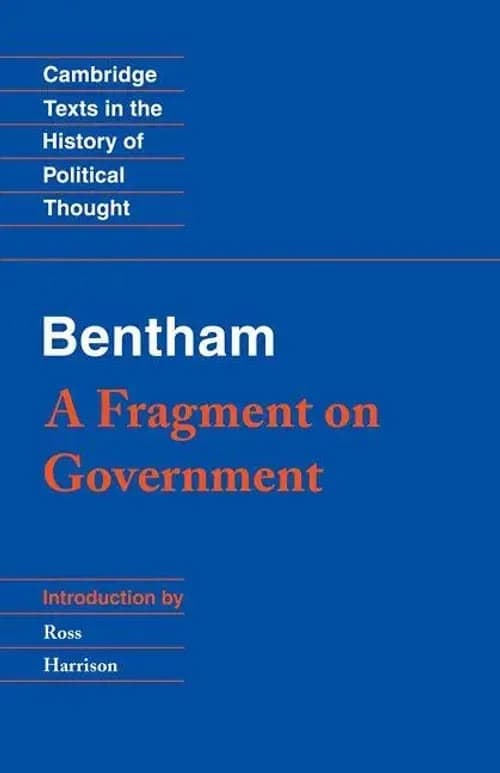
A Fragment on Government
Bentham's first book is a sustained attack on William Blackstone's Commentaries, targeting the doctrine of an original contract and other fictions that Bentham saw as dressing up legal tradition as rational authority. Its distinctive mechanism is the counter-application of the utility principle as a critical test: rather than building a system, Bentham uses 'the greatest happiness of the greatest number' to expose laws and constitutional theories that serve ruling-class interests under the guise of reason. The Fragment is less a treatise than a declaration of independence from ancestor-worship in jurisprudence.
Key Insights
✦What is the central claim of A Fragment on Government, and what does it reject?
The central claim is that the principle of utility—the greatest happiness of the greatest number—is the only rational measure for judging government and law. Bentham rejects Blackstone's attempt to ground political obligation in an original contract and in the accumulated authority of tradition. Where Blackstone presents English law as a coherent system animated by reason, Bentham argues that much of it is obfuscation serving established interests. The Fragment is not a constructive treatise on government but a critical demonstration that Blackstone's foundational doctrines cannot survive utilitarian scrutiny. Its target is the intellectual legitimacy of inherited authority, not the details of legal doctrine.
✦What specific concept did the book introduce, and where is it used today?
The Fragment is widely identified as the first systematic application of the utility principle to the theory of government . Bentham did not invent the phrase 'the greatest happiness of the greatest number,' but he made it the explicit standard against which political institutions and legal doctrines are measured. This critical use of utility—as a test rather than a creative doctrine—shaped subsequent utilitarian political thought. Contemporary legal positivism and public choice theory inherit Bentham's suspicion of legal fictions that obscure whose interests a rule serves, though the utility standard itself has been extensively revised and contested within ethics and political philosophy.
✦How does the Fragment differ from Bentham's later Introduction to the Principles of Morals and Legislation?
The Fragment is primarily negative and polemical, whereas the Introduction (printed 1780, published 1789) is systematic and constructive. In the Fragment, Bentham uses utility as a weapon against Blackstone's doctrines of contract and sovereign authority; he does not yet develop the full hedonic calculus or the detailed taxonomy of pleasures and pains that structures the later work. The Fragment also remains closely bound to a critique of a specific text, while the Introduction aims at a general science of morals and legislation. The later work extends the critical principle of the Fragment into a comprehensive normative framework, but the Fragment's distinctive contribution is the demonstration that utility can dismantle established political fictions.
✦How has the Fragment's argument held up since its publication?
The Fragment's direct target, Blackstone's contract theory, no longer commands the authority it held in the 1770s, so the book's polemical force has diminished in that specific respect. Its historical significance, however, has been widely recognized: it has been described as marking the beginning of modern English legal criticism and reform . The utility principle that Bentham deploys has itself been subjected to sustained critique, notably by later intuitionists and by twentieth-century critics of hedonistic consequentialism. The Fragment is now read less for its substantive doctrine than as a document of the critical turn in utilitarian ethics—the moment when utility became a tool for exposing the rationalizations of established power.
✦Is A Fragment on Government a complete statement of Bentham's ethics?
No, and treating it as such is a common misreading. The Fragment is a young man's work, published when Bentham was in his late twenties, and it is occasioned by a specific provocation: Blackstone's lectures and Commentaries . It announces the utility principle but does not defend it at length or work out its implications for moral psychology, punishment, or legislation. Readers who expect a systematic ethics will find instead a forensic critique. The Fragment is best understood as the opening move in Bentham's lifelong campaign, not its summary. The fuller development of utilitarian ethics comes in the Introduction and later writings.
✦What is the textual and publication history of the Fragment?
The Fragment was first published anonymously in 1776, the same year as the American Declaration of Independence . A second, enlarged edition appeared in 1823, adding material and acknowledging Bentham's authorship . The authoritative modern text is the edition prepared by J. H. Burns and H. L. A. Hart for Bentham's Collected Works (Athlone Press, 1977), which collated the first edition with a pirated Dublin edition, the 1823 edition, and later popular editions. Notably, Burns and Hart found that both the 1891 Montague edition and the 1948 Harrison edition had followed the pirated Dublin text rather than the official London edition—a textual curiosity that illustrates the editorial mediation behind standard modern reprints .
Wealthy Psyche is an intellectual archive. We do not host, distribute, or sell book copies — physical or digital. We provide structured knowledge to help you think better, faster.