


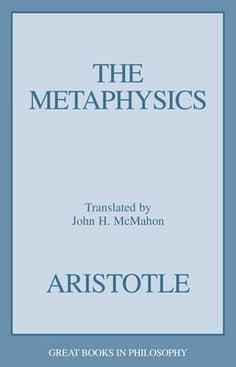
Metaphysics (Ta meta ta physika)
Aristotle's Metaphysics is a collection of treatises on being qua being and on the first principles and causes of all things. Its central thesis is that substance (ousia) is the primary way of being, and that the substance of a thing is its form, the essence expressed in its definition, which Aristotle defends against Platonic separate Forms. The work develops the analysis of potentiality and actuality, treats unity, plurality, and the principle of non-contradiction, and culminates in Book Lambda's argument for an unmoved mover, a pure activity of thought that moves the cosmos as an object of desire. It is both a critique of predecessors and an inquiry into the science of first philosophy.
Key Insights
✦What is the central claim of the Metaphysics, and what does it reject?
Aristotle claims that there is a science of being qua being, and that being is said in many ways but all of them are related to substance, the primary kind of being. He argues that the substance of a thing is its form or essence, not its matter and not a universal separated from particulars. This rejects the Platonic view, criticized in Books One, Thirteen and Fourteen, that Forms exist apart from sensible things. He also rejects Pythagorean and other number-based accounts of reality. The work's key move is to explain how a thing can be a unified substance through the relation of form to matter.
✦Is the Metaphysics a single book, and what is its textual history?
The title, which means roughly 'the things after the physics', was likely given by later editors, traditionally associated with Andronicus of Rhodes, and the fourteen books were arranged from lecture material rather than composed as one treatise. Book Alpha Minor is often thought to be a later insertion, Book Delta is a philosophical lexicon, and Book Kappa partly duplicates other books. Werner Jaeger proposed a developmental thesis in which Aristotle gradually moved away from Platonism, a view later scholars have challenged. The apparent lack of unity shapes how readers interpret the whole.
✦What is the science sought in the Metaphysics, and why is it disputed?
The work describes its subject variously as wisdom, the study of first causes and principles, the study of being qua being, and theology, the study of divine substance. Interpreters have asked how these fit together. Some, following the medieval tradition, see a unified science in which the study of being is centered on the highest being; others, including Owen with his notion of focal meaning, stress that the study of being unifies by relation to substance, and that theology is one part. Scholars such as Michael Frede and Gwilym Owen debated the point, which remains open.
✦How does the work treat substance and form in Books Zeta, Eta, and Theta?
These central books ask what makes something a substance and conclude that form is primary. Zeta considers and rejects candidates such as the underlying subject, the universal, and the genus, and argues that substance is essence expressed in definition. Eta and Theta supplement this with matter, potentiality, and actuality, so that form is the actuality of a material potentiality. The books are famously difficult, and scholars including Myles Burnyeat and Michael Frede have disagreed over whether individual forms or species forms are primary, which affects how Aristotle's metaphysics relates to his biology.
✦How has the unmoved mover been misread?
Book Lambda argues for an eternal, immaterial first mover that causes motion as an object of love or desire, and describes its activity as thought thinking itself. A common misreading identifies it with a creator who acts on the world, or with the God of later religion. Aristotle's mover is a final cause, and the text says little about its relation to ordinary events. Medieval thinkers such as Avicenna, Maimonides, and Thomas Aquinas adapted the argument to their own theologies, which has shaped how it is received. Scholars debate whether there is one such mover or many.
✦Which translations and commentaries should readers consult?
The Metaphysics is difficult in Greek and in English, and commentary is essential. Standard options include W. D. Ross's translation in the revised Oxford Translation edited by Jonathan Barnes, C. D. C. Reeve's Hackett translation, and Hugh Lawson-Tancred's Penguin version. Ross's Greek edition with commentary remains a reference, and Myles Burnyeat's study guide to Book Zeta is a useful aid. Readers should compare how translators render ousia, to ti en einai, energeia, and entelecheia, since choices such as 'substance' or 'being' affect interpretation.
Wealthy Psyche is an intellectual archive. We do not host, distribute, or sell book copies — physical or digital. We provide structured knowledge to help you think better, faster.