


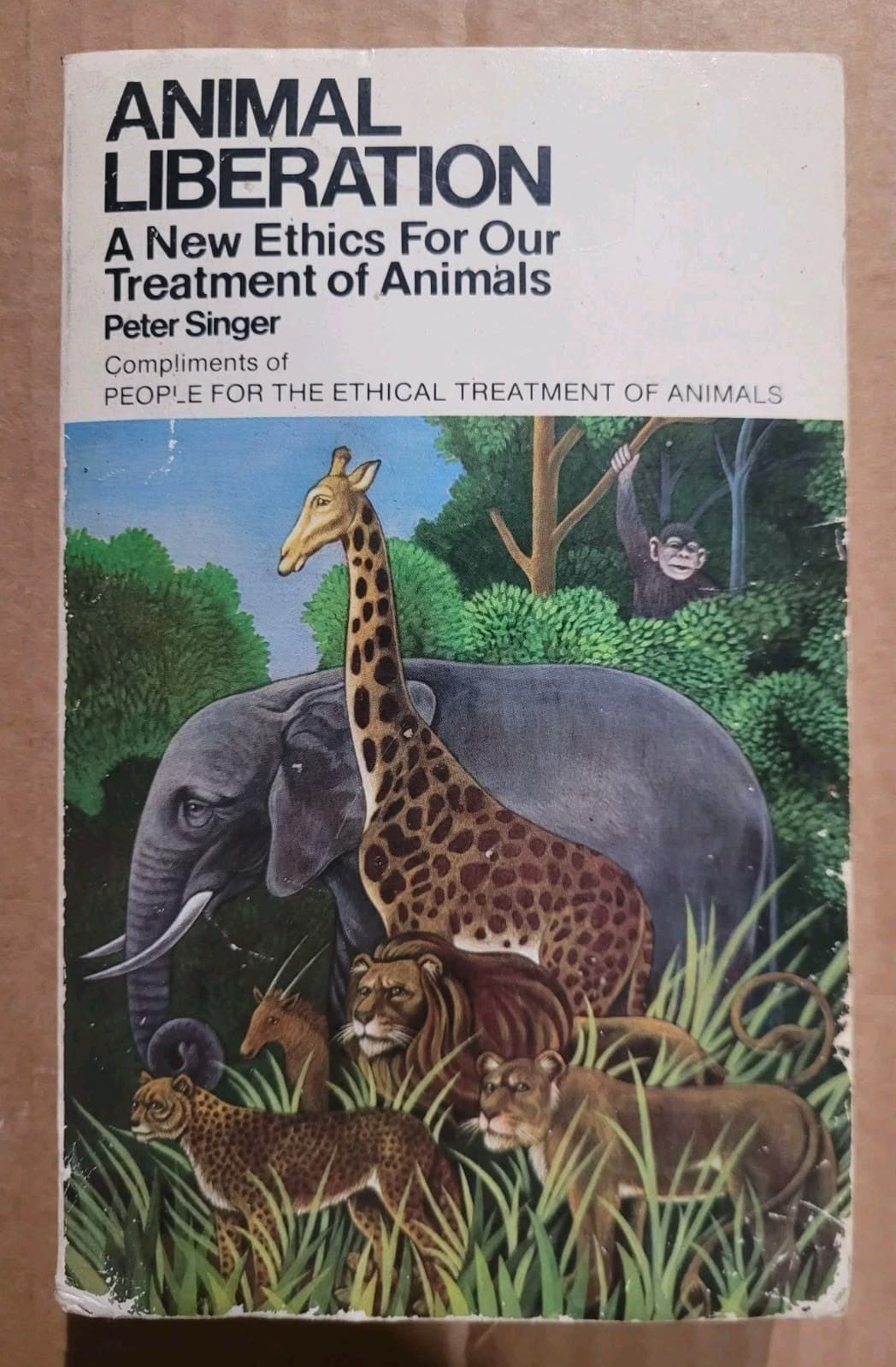
Animal Liberation: A New Ethics for Our Treatment of Animals

Singer's book argues that the capacity to suffer, not intelligence or species membership, is the only morally relevant criterion for consideration of interests. The central mechanism is an extension of utilitarian impartiality: if discrimination based on race or sex is unjustified, discrimination based solely on species—'speciesism'—is equally unjustified. Singer documents the practices of factory farming and animal experimentation to show that the suffering inflicted on sentient beings cannot be justified by trivial human benefits, and concludes that the most practical response is a vegetarian or vegan diet and a rejection of most vivisection.
Key Insights
✦What is the central argument of Animal Liberation, and what does it reject?
Singer argues that the interests of all beings capable of suffering deserve equal consideration, and that giving lesser consideration to beings based solely on their species membership is a form of discrimination he calls speciesism. The book rejects the assumption that intelligence or rationality is the basis for moral standing, noting that many humans (infants, the severely cognitively disabled) lack these capacities to the same degree as some animals, yet are granted full moral consideration. The argument is utilitarian in structure: Singer seeks to minimize suffering, and the suffering of animals in factory farms and laboratories is extensive and avoidable. He concludes that the most practical response is to adopt a vegetarian or vegan diet and to condemn vivisection except where the benefits demonstrably outweigh the harm .
✦What specific concept did the book popularize, and where is it used today?
Singer popularized the term 'speciesism,' which had been coined by Richard D. Ryder, to describe the systematic disregard of nonhuman animals . The concept is used today in animal ethics, law, and advocacy as a parallel to racism and sexism: a prejudice based on species membership that lacks moral justification. Singer's specific formulation—that speciesism is analogous to other forms of arbitrary discrimination because it ignores the morally relevant criterion of sentience—became the foundational philosophical statement of the animal liberation movement. The term has since been extended to debates about animal experimentation, factory farming, and the legal status of animals as property, and it remains the central conceptual tool for arguing that animal suffering deserves the same moral weight as comparable human suffering.
✦How did Richard Posner challenge Singer's utilitarian vision, and how did Singer respond?
In a 2001 Slate debate, Richard Posner argued that Singer failed to acknowledge the radicalism of his own ethical vision. Posner wrote that Singer's position finds greater value in a healthy pig than in a profoundly intellectually challenged child, would require inflicting lesser pain on a human to avert greater pain to a dog, and would sacrifice a human being to save 101 chimpanzees if the chimpanzee has even 1 percent of normal human mental ability . Posner's point was that Singer's consistent utilitarianism leads to conclusions most people would find monstrous. Singer replied and rejected this characterization, arguing that Posner had misrepresented the implications of his position. The exchange became a canonical debate about the unsettling consequences of taking equal consideration of interests seriously across species boundaries.
✦How did Singer himself assess the book's impact decades later?
Singer has been strikingly candid about his disappointment. In a 1999 interview with The New Yorker, he said the book's effects had been 'mostly minor' and that when he wrote it he genuinely believed it would change the world. He added that walking around the corner to McDonald's was enough to see how unsuccessful he had been . This assessment is notable because Animal Liberation is widely credited with founding the modern animal liberation movement and inspiring activists including Ingrid Newkirk, who said it 'forever changed the conversation about our treatment of animals' . Singer's regret reflects the gap between the book's influence on a movement and its failure to transform the everyday practices of factory farming and meat consumption on a global scale.
✦How does the book differ from Tom Regan's The Case for Animal Rights?
Both books argue that animals deserve serious moral consideration, but their foundations are incompatible. Singer's argument is utilitarian: the capacity to suffer is what matters, and the goal is to minimize suffering. He explicitly rejects the language of rights as unnecessary and potentially confused . Regan's The Case for Animal Rights (1983) argues that animals have inherent moral rights because they are 'subjects-of-a-life' with beliefs, desires, memory, and a sense of their own future. Regan's rights-based approach forbids treating animals as mere means even if doing so would maximize overall welfare, which is a conclusion Singer's utilitarianism cannot endorse. The disagreement is foundational: Singer's book is the canonical utilitarian statement on animal ethics, while Regan's is the canonical rights-based alternative.
✦What is the publication history of the book, and how has it been revised?
Animal Liberation was first published in 1975 by the New York Review and distributed by Random House [citation:2][citation:8]. Subsequent editions appeared in 1990, 2002, 2009, and a 40th-anniversary edition in 2015 . The 2009 edition added a preface and an afterword addressing developments since the original publication, and the 2015 edition included a new introduction by Yuval Noah Harari [citation:11]. A substantially revised and updated version, titled Animal Liberation Now, was published in 2023 . The revisions matter because Singer has used them to respond to three decades of criticism, to update empirical claims about factory farming and research practices, and to address new issues such as the treatment of animals in the developing world, where the book's initial focus on Western practices had been a limitation.
Wealthy Psyche is an intellectual archive. We do not host, distribute, or sell book copies — physical or digital. We provide structured knowledge to help you think better, faster.