


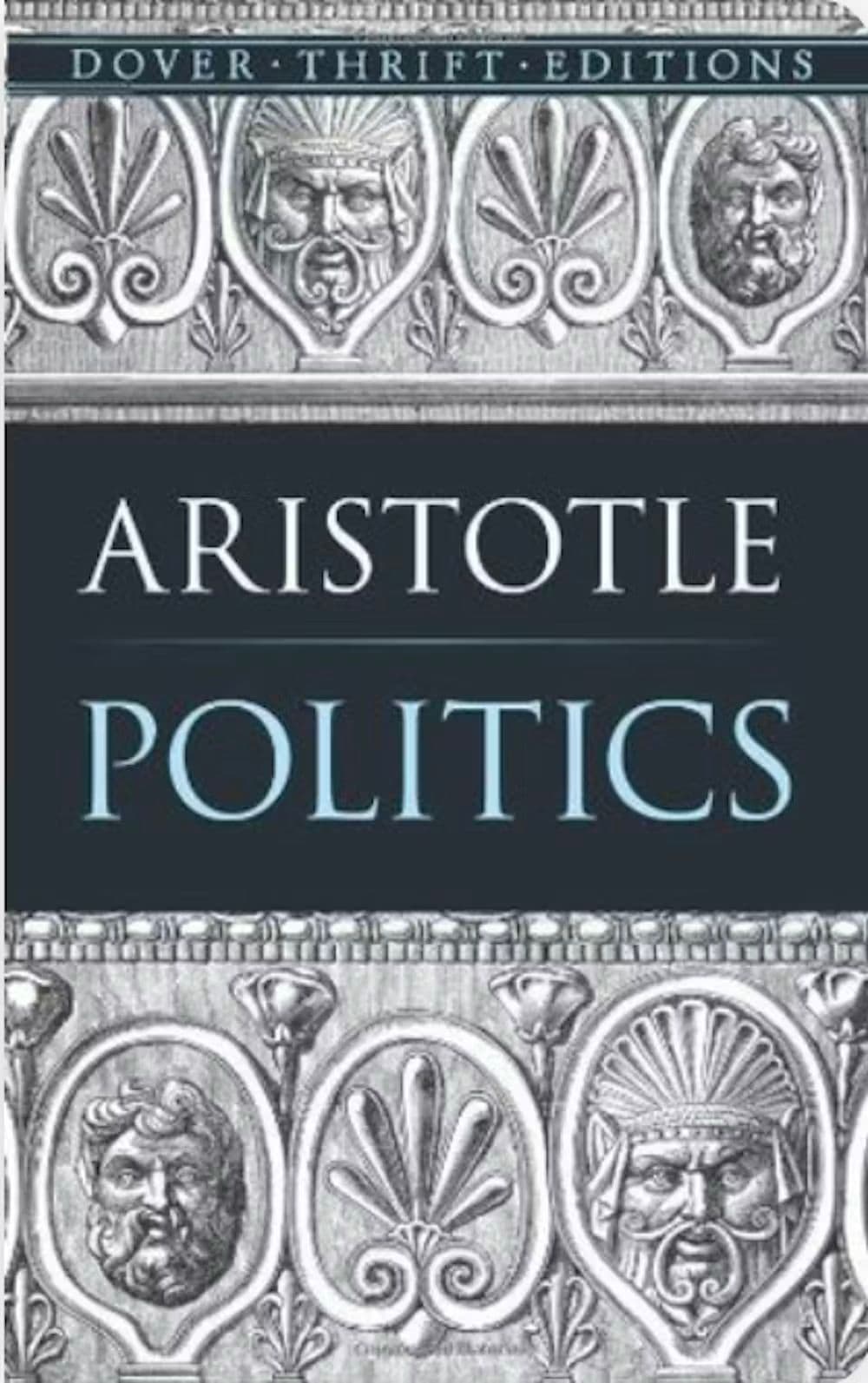
Politics (Politika)
Aristotle's Politics argues that the polis exists by nature and that human beings are by nature political animals, fulfilling their capacity for speech and moral judgment only in a community aimed at the good life, not mere survival or exchange. From this starting point the work derives its main method: classify constitutions by who rules and whether they rule for the common good or for their own benefit, then study how actual regimes preserve or destroy themselves. It defends a mixed constitution anchored in a strong middle class, treats the household and slavery as parts of the city's structure, and measures every regime by the education of its citizens toward virtue.
Key Insights
✦What is the central claim of the Politics, and what does it reject?
Aristotle claims that the city is a natural community whose end is the good life, and that human beings realize their nature as speaking, deliberating creatures only within it. This rejects the view that political society is a convention made for mutual protection or economic exchange. It also rejects the idea that the city is merely a larger household. For Aristotle, the household, village, and city differ in kind, and the city alone is self-sufficient and aimed at living well. Political arrangements are therefore to be judged by the character they form in citizens and not only by security or wealth.
✦How does Aristotle classify constitutions, and why does it matter?
He distinguishes regimes by the number of rulers, one, few, or many, and by whether they govern for the common advantage or for their own. Correct forms are kingship, aristocracy, and polity; their deviations are tyranny, oligarchy, and democracy. The scheme is a starting point rather than a rigid system, since later books examine how real cities blend elements, with oligarchy and democracy defined by the interests of the rich and the poor as much as by numbers. The classification matters because it ties political legitimacy to the end served by rule, not merely to who holds power.
✦How does the Politics criticize Plato's Republic?
In Book Two Aristotle examines Plato's proposals for communal property and shared wives and children among the guardians, and argues that the city is not improved by pursuing maximal unity. He contends that what is common to the greatest number receives the least care, that sharing children dilutes affection, and that a city needs diversity and distinct roles. He also evaluates the constitutions of Sparta, Crete, and Carthage and the proposals of Phaleas and Hippodamus. The critique shows his method of testing political ideals against human motivation and historical experience.
✦What is the mixed constitution, and why does Aristotle favor the middle class?
Aristotle's preferred practical regime, which he calls polity, blends oligarchic and democratic features so that neither the rich nor the poor can dominate. He argues that a large middle class stabilizes a city, because those of moderate means are less prone to arrogance and envy and more willing to be ruled and to rule in turn. Modern readers have often seen this as an early argument for constitutional balance. Scholars note, however, that he offers it as the best attainable regime for most cities, while a separate discussion treats the best regime under ideal conditions.
✦How should readers handle Aristotle's defense of natural slavery?
Book One argues that some people are slaves by nature because they lack the deliberative capacity to govern themselves and benefit from being ruled. The argument has been widely criticized, and scholars such as Nicholas Smith, Malcolm Schofield, and others debate its coherence, noting that Aristotle also acknowledges that actual slavery in Greece often fell outside his own criterion, since many slaves were captured in war. Readers should treat the passage as a historically embedded and philosophically unstable argument, not as an ethical authority, and should consider how it intersects with his exclusion of women, laborers, and foreigners from full citizenship.
✦Which translations and textual issues should readers know about?
The Politics survives as a collection of eight books whose order and unity have long been disputed. Some scholars, including Werner Jaeger, proposed that the books record different stages of composition, while others read the text as a single project with its own dialectical structure. Some books, notably the discussion of the best regime in Books Seven and Eight, end abruptly, which suggests the work is unfinished or lectures in revised form. Standard English options include Carnes Lord's translation, C. D. C. Reeve's, and the revised Oxford Translation edited by Jonathan Barnes. Readers should check how each handles the order of the books and key terms such as politeia and polis.
Wealthy Psyche is an intellectual archive. We do not host, distribute, or sell book copies — physical or digital. We provide structured knowledge to help you think better, faster.