


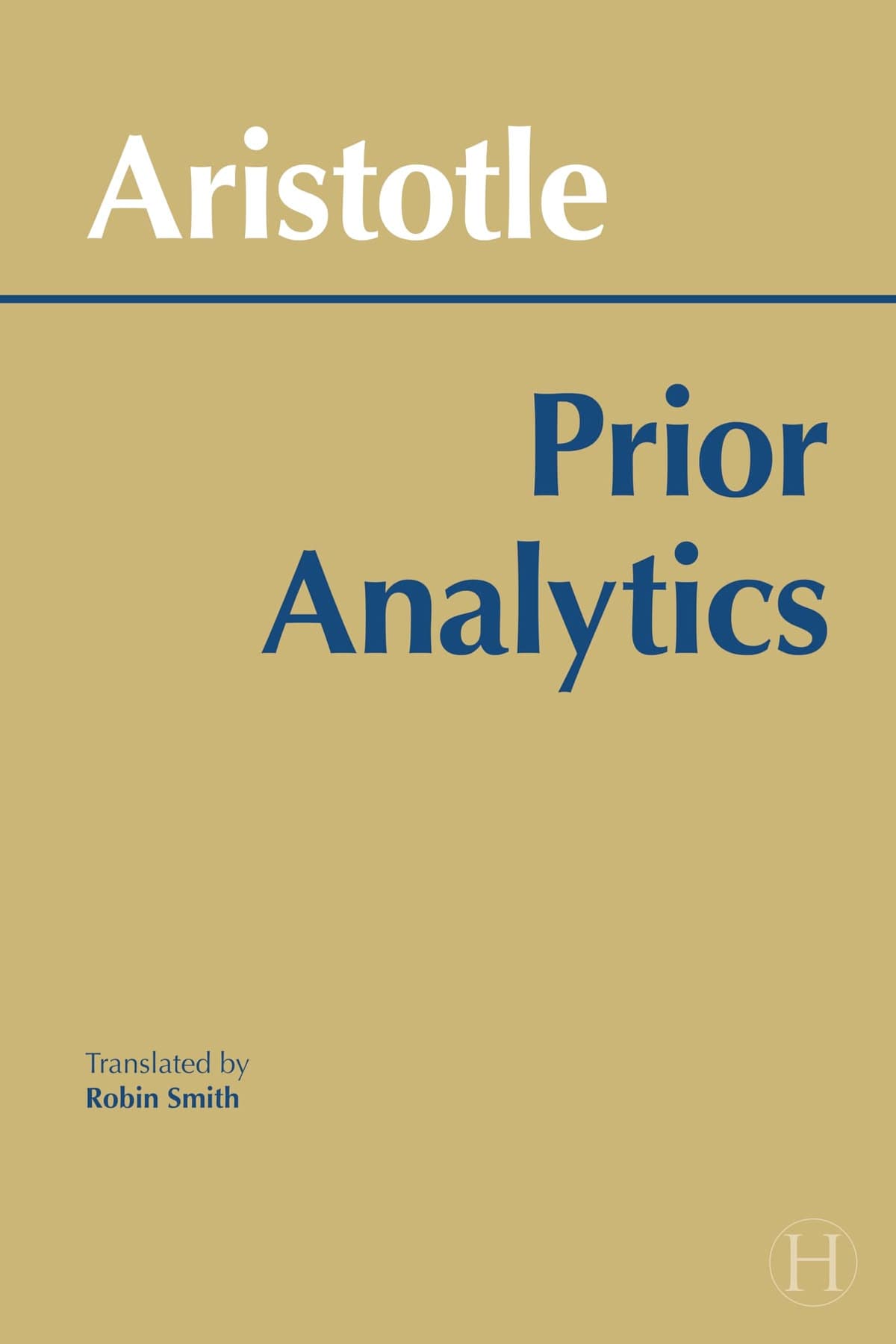
Prior Analytics (Analytica Priora)
Aristotle's Prior Analytics presents the first known formal theory of deductive inference, centered on the syllogism: an argument in which, certain things being laid down, something other than what was laid down follows of necessity from their being so. It classifies syllogisms by the arrangement of terms into three figures, shows which moods are valid, and reduces the imperfect ones to the perfect syllogisms of the first figure by conversion and other proofs. Book One extends the theory to modal syllogisms mixing necessity, possibility, and assertion, and to practical advice on finding arguments. Book Two adds treatments of induction, example, and refutation, and ties the study of inference to the Posterior Analytics.
Key Insights
✦What is the central claim of the Prior Analytics, and what does it set aside?
Aristotle claims that valid deduction can be studied by its form alone: whether a conclusion follows depends on how the terms are arranged in the premises, not on what the terms mean. He shows this by systematically testing combinations of premises across three figures, establishing which yield conclusions and which do not, using counterexamples with specific terms to prove invalidity. This sets aside the dialectical practice of judging arguments case by case, as in the Topics, in favour of a general theory. The result is the first axiomatic-style logical system, in which the perfect syllogisms of the first figure serve as the starting point.
✦How does the work organize the syllogistic figures and moods?
The figures differ in the position of the middle term, which is predicate of one premise and subject of the other in the first figure, predicate of both in the second, and subject of both in the third. Aristotle examines which combinations of universal and particular, affirmative and negative premises are productive. Medieval logicians later gave the valid moods mnemonic names such as Barbara and Celarent, and added a fourth figure, which Aristotle did not recognize. The first figure is called perfect because its validity is evident without further proof, while the others are shown valid by reduction to it.
✦How was the Prior Analytics read by modern logicians?
Jan Łukasiewicz, in his 1951 study Aristotle's Syllogistic, reconstructed the system as an axiomatized theory of implications over variables, stressing that Aristotle treated syllogisms as conditional propositions instead of rules of inference. Timothy Smiley and John Corcoran, working in the 1970s, argued instead that Aristotle's system is a natural-deduction style system of rules with a notion of deduction. These readings differ on whether the work is closer to propositional or to proof-theoretic logic, and the debate shapes how its relation to modern predicate logic is judged.
✦What is the dispute over the modal syllogistic?
Chapters on syllogisms with premises of necessity and possibility are among the most difficult in Aristotle. Some of his claims, notably about mixed necessity-and-assertoric premises in the first figure, appear inconsistent with his own definition of necessity, and Theophrastus and Eudemus, his pupils, proposed revisions. Modern interpreters including Storrs McCall, Richard Patterson, and Kevin Flannery have offered competing reconstructions, some defending coherence through readings that restrict terms or distinguish senses of necessity. The controversy is a reminder that the work is incomplete or unsettled in places.
✦How is the Prior Analytics misunderstood?
A common oversimplification treats Aristotelian logic as the whole of logic, or as a theory that has been simply superseded by Frege. The syllogistic is a theory of a limited class of inferences about categorical sentences, and it cannot capture relations or multiple generality, which modern predicate logic handles. Another misreading treats the syllogism as a method for discovering truths instead of a method for testing the validity of arguments. Aristotle himself ties the study to demonstration in the Posterior Analytics, but the Prior Analytics concerns validity regardless of truth.
✦Which translations and commentaries of the Prior Analytics should readers consult?
Robin Smith's translation with notes in the Hackett series is a standard English choice, and his Clarendon Aristotle volume on Book One adds commentary. A. J. Jenkinson's version appears in the revised Oxford Translation edited by Jonathan Barnes, and W. D. Ross's Greek edition with commentary remains a reference for the text. Because the technical vocabulary, including terms such as horos and sullogismos, has to be rendered consistently, readers should check the translator's introduction and its treatment of the modal chapters.
Wealthy Psyche is an intellectual archive. We do not host, distribute, or sell book copies — physical or digital. We provide structured knowledge to help you think better, faster.