


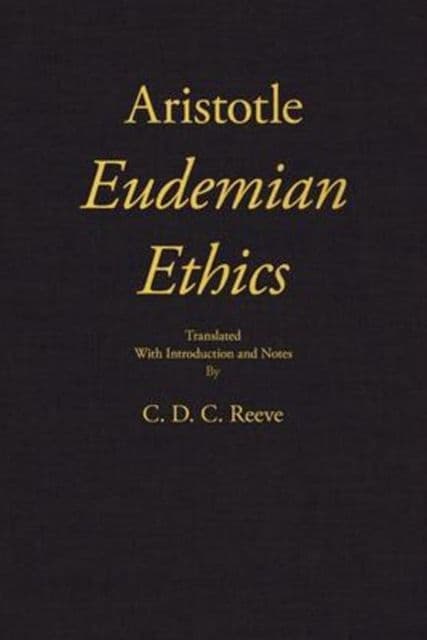
Eudemian Ethics (Ethika Eudemeia)
Aristotle's Eudemian Ethics is one of two surviving full treatments of ethics attributed to him, and it develops the claim that the human good, eudaimonia, is the complete activity of the soul in accordance with virtue, with the best life centered on the service and contemplation of the divine. It distinguishes the good as end from the conditions of attaining it, treats each moral virtue as a mean between excess and deficiency, and gives distinctive attention to kalokagathia, the complete and fine excellence of character, and to good fortune. Its closing account of what makes choices and possessions good sets it apart from the more political tone of the Nicomachean Ethics.
Key Insights
✦What is distinctive about the argument of the Eudemian Ethics?
Like the Nicomachean Ethics, it defines the human good as eudaimonia, virtuous activity of the soul, but it has its own emphases. It gives more attention to the idea that the good must be an achievable end for action, to the role of luck and natural endowment, and to kalokagathia, the combination of complete virtue and the goods that make it fine. It also gives a more explicitly Platonic-looking treatment of the divine, arguing that the best choice of natural goods is whatever best promotes the contemplation and service of god. Interpreters debate how far this theological close differs from the Nicomachean emphasis on contemplation.
✦How do the Eudemian and Nicomachean Ethics relate, and which came first?
Three books are common to both works, the books on justice, the intellectual virtues, and pleasure, with friendship also treated in both. Scholars disagree on which version is earlier. Werner Jaeger argued for a developmental thesis in which the Eudemian Ethics is the earlier, more Platonic work, while Anthony Kenny argued that the Eudemian Ethics is the later and more mature treatment. Others, including Christopher Rowe, have emphasized the shared books and revisions. The question affects how Aristotle's ethical views are understood to have developed.
✦What is kalokagathia, and why does the work stress it?
Kalokagathia, a fusion of the Greek words for fine and good, was a traditional ideal of the complete gentleman. In Book Eight Aristotle treats the kalos kagathos as the person for whom the natural goods are good because he has the virtues that enable him to use them well, and who chooses fine actions for their own sake. The concept connects the work's focus on character with its concern for external goods and fortune. It is a feature of the Eudemian Ethics that has received renewed attention from scholars comparing it with the Nicomachean account.
✦How does the work treat good fortune, and why is it controversial?
Book Eight raises the question of why some people succeed without deliberation, and Aristotle discusses good fortune, eutuchia, as a factor in a flourishing life. The passage, which also touches on the role of the divine in impulses that guide people rightly, is difficult and has been interpreted in different ways, as pointing to natural gifts, to divine influence, or to a kind of non-rational guidance. Because the topic appears to conflict with the emphasis on deliberate virtue, it figures in debates about how far a good life depends on things beyond our control.
✦Why is the text's history unsettled?
The traditional title is thought to refer to Eudemus of Rhodes, a pupil of Aristotle, though the connection is disputed, and the work was long overshadowed by the Nicomachean Ethics. The text is compressed lecture material rather than a polished composition, and the manuscripts show uncertainty in places, especially in the shared books, which were transmitted with the Nicomachean Ethics. Modern editions, notably those of Susemihl and later R. R. Walzer and J. M. Mingay for the Oxford Classical Texts series, establish the Greek text, and the shared books are normally studied in the Nicomachean context.
✦Which translations and commentaries should readers consult?
English readers can use the translation of the Eudemian Ethics by Brad Inwood and Raphael Woolf in the Cambridge Texts series, Anthony Kenny's Oxford World's Classics translation with notes, and Michael Woods's Clarendon Aristotle volume, which includes commentary on the books not shared with the Nicomachean Ethics. The revised Oxford Translation edited by Jonathan Barnes also includes it. Because key terms such as eudaimonia, arete, and kalokagathia are rendered in different ways, readers should compare introductions and check how each edition handles the shared books.
Wealthy Psyche is an intellectual archive. We do not host, distribute, or sell book copies — physical or digital. We provide structured knowledge to help you think better, faster.