


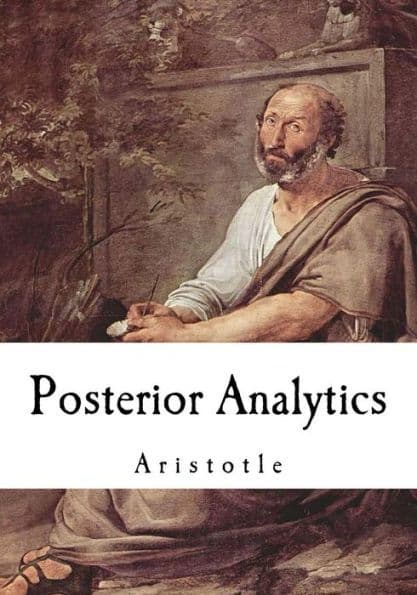
Posterior Analytics (Analytica Posteriora)
Aristotle's Posterior Analytics is a treatise on scientific knowledge (epistēmē) and demonstration. Its central thesis is that genuine scientific understanding consists in grasping the cause of a fact through a demonstration, a syllogism whose premises are true, primary, immediate, better known than the conclusion, and explanatory of it. Because chains of demonstration cannot regress forever or circle back, the work argues that science rests on indemonstrable first principles, which are grasped not by proof but by induction and intellectual insight (nous). It also treats definition as the statement of an essence, and ties the four kinds of inquiry to the search for a middle term, which supplies the cause.
Key Insights
✦What is the central claim of the Posterior Analytics, and what does it reject?
Aristotle claims that scientific knowledge is knowledge of why something is so, achieved by demonstrating a conclusion from premises that state its cause. He rejects two ways of avoiding the regress of proof: that demonstration can go on infinitely, and that premises can justify one another in a circle. Both would make knowledge impossible, he argues, so demonstrations must begin from principles that are not themselves demonstrated. This yields a foundational model of science in which explanation, not mere derivation, is what makes an argument demonstrative.
✦How do we come to know the first principles, according to the work?
The closing chapter of the treatise addresses this directly. Aristotle argues that principles cannot be innate in a fully formed state, nor derived by demonstration, since demonstration presupposes them. Instead, perception gives rise to memory, repeated memories to experience, and experience to a grasp of the universal. The faculty that apprehends the principles is nous, intellectual insight. The passage is brief and compressed, and interpreters disagree about whether it describes a literal induction, a kind of intuition, or a gradual conceptual formation.
✦How does the Posterior Analytics relate to the Prior Analytics?
The Prior Analytics develops the theory of the syllogism, the formal machinery of valid deduction. The Posterior Analytics asks what additional conditions a syllogism must meet to count as scientific demonstration: its premises must be necessary, explanatory, and more fundamental than the conclusion. The two works are therefore traditionally paired, and together with the Categories, On Interpretation, Topics, and Sophistical Refutations they form the collection later called the Organon. Reading the Posterior Analytics without the syllogistic theory behind it makes much of its technical vocabulary opaque.
✦Does Aristotle actually practice the method the Posterior Analytics describes?
This is a long-standing scholarly question. Jonathan Barnes, in his commentary, argued that the treatise describes an ideal of finished, axiomatized science and not the practice Aristotle follows in his biological or physical works, which proceed through inquiry and dialectic. Others stress that the work is about the structure of settled understanding, which can be reached only after investigation. The mismatch between the demonstrative ideal and the exploratory character of the Physics or the History of Animals is one reason scholars debate whether the treatise is a methodology or a theory of explanation.
✦How is the work misread in discussions of scientific method?
A common oversimplification treats it as a rigid recipe for deductive science, or as a crude forerunner of empiricism. In fact it is concerned with the structure of knowledge once achieved, in particular with how explanation and necessity fit together, and it gives induction only a brief, foundational role. Another misreading assumes that it applies equally well to ethics. Aristotle elsewhere, in the Nicomachean Ethics, cautions that ethical subject matter admits less precision, so the demonstrative ideal should not be imposed directly on practical reasoning.
✦Which translations and commentaries of the Posterior Analytics should readers consult?
The work survives in Greek and is difficult, so commentary matters as much as translation. Jonathan Barnes's translation and notes in the Clarendon Aristotle series is a standard scholarly choice, and the revised Oxford Translation of Aristotle's complete works, edited by Barnes, is widely used. W. D. Ross's Greek edition with commentary remains a reference for the text. Readers should compare how translators render key terms such as epistēmē, nous, and aitia, since choices such as 'understanding' versus 'scientific knowledge' shape interpretation.
Wealthy Psyche is an intellectual archive. We do not host, distribute, or sell book copies — physical or digital. We provide structured knowledge to help you think better, faster.