


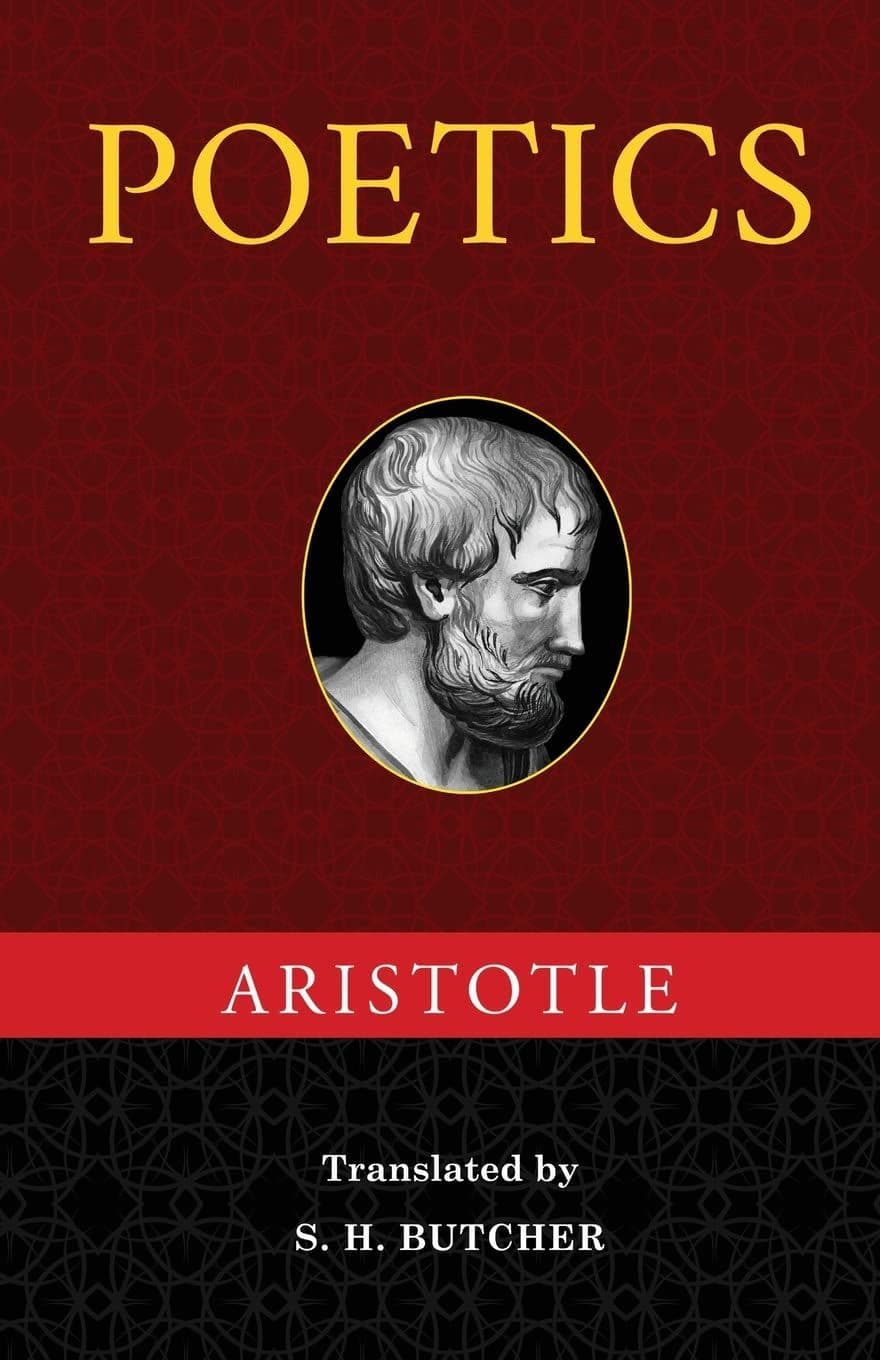
Poetics (Peri Poietikes)
Aristotle's Poetics is a treatise on poetic composition, concentrating on tragedy and epic, and its central thesis is that poetry is a form of mimesis, the imitation of action, whose quality depends first on the construction of the plot (muthos). A good tragedy imitates a complete action of suitable magnitude, arranged by probability or necessity, and through pity and fear accomplishes the catharsis of such emotions. Aristotle ranks plot above character, thought, diction, melody, and spectacle, praises reversal and recognition, analyzes the tragic hero's error (hamartia), and compares tragedy with epic. The surviving text treats comedy only in passing, and the discussion of comedy is lost.
Key Insights
✦What is the central claim of the Poetics, and what does it reject?
Aristotle claims that poetry is imitation of human action and that its excellence lies chiefly in the structure of the plot. He thereby answers Plato's criticism in the Republic that poetry is a third-hand copy of reality that stirs unruly emotions and misleads citizens. Aristotle holds that imitation is natural to humans and a source of learning, and that poetry is more philosophical than history because it deals with what could happen according to probability or necessity, not only with what did happen. Tragedy, in his view, offers understanding and a distinctive pleasure.
✦What does catharsis mean, and why is it disputed?
Aristotle says tragedy accomplishes, through pity and fear, the catharsis of such emotions, but he does not define the term in the surviving text. Interpretations include purgation, a medical-style discharge of emotion; purification, a cleansing of the emotions themselves; and clarification, an intellectual understanding of the events pitied and feared. Scholars including Leon Golden, Stephen Halliwell, and Martha Nussbaum have defended different readings, and Jacob Bernays's nineteenth-century medical interpretation remains influential. The lost second book, which may have treated catharsis more fully, is part of the difficulty.
✦What is hamartia, and is it a tragic flaw?
Aristotle argues that the best tragic hero is neither wholly good nor wholly wicked, and falls into misfortune through some hamartia. A popular reading treats it as a moral flaw of character, as in the idea of a fatal flaw. Many scholars, such as Stephen Halliwell and Martha Nussbaum, argue that hamartia is better understood as an error of judgment or a mistake, often arising from ignorance of key facts, as with Oedipus. The term's range from moral failing to simple mistake makes the oversimplified 'tragic flaw' translation misleading.
✦How does Aristotle rank plot over character, and what do reversal and recognition do?
He holds that tragedy is an imitation of action rather than of persons, so the arrangement of events is its soul, and character serves the action. The best plots are complex, combining peripeteia, a reversal of fortune, with anagnorisis, a shift from ignorance to knowledge, ideally arising from the plot's own structure. Oedipus Rex is his model. He also requires unity of action and a plot with a beginning, middle, and end. The so-called three unities of time, place, and action were later systematized by Renaissance critics and are mostly not Aristotle's own.
✦How is the Poetics misunderstood as a rulebook?
Early modern critics, especially in Italy and France, such as Lodovico Castelvetro and later the French classicists, treated it as a set of prescriptive rules for dramatists, including the unities of time and place, which Aristotle does not state. The text is descriptive and analytical, derived from the Greek drama he knew, and its notes are sometimes elliptical. Another misreading takes it as a guide to all literature or to modern forms like the novel. Readers should treat it as a theory of Greek poetry that has proved adaptable but not binding.
✦Which translations and textual issues should readers know about?
The Poetics survives as a short, compressed and probably incomplete text, with the discussion of comedy lost and possible corruptions in the manuscripts. The Greek text is edited by Rudolf Kassel for the Oxford Classical Texts series, and Stephen Halliwell's translation in the Loeb Classical Library is widely used, alongside Malcolm Heath's Penguin version and Richard Janko's translation with commentary, which reconstructs the lost material from a later tractate. Readers should compare how translators render mimesis, hamartia, and catharsis.
Wealthy Psyche is an intellectual archive. We do not host, distribute, or sell book copies — physical or digital. We provide structured knowledge to help you think better, faster.