


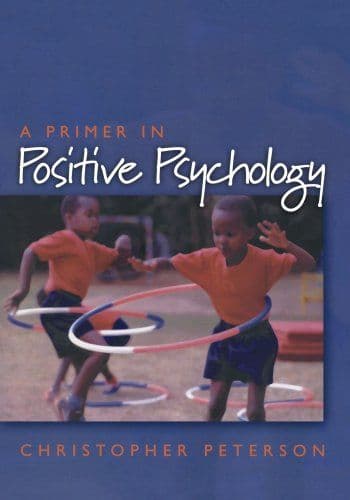
A Primer in Positive Psychology

Peterson's primer is organized around a tripartite framework—positive subjective experience, positive individual traits, and positive institutions—and it treats each level as an empirical question rather than a moral prescription. The book's distinctive spine is its insistence that positive psychology is 'not a spectator sport': every chapter pairs research findings with exercises, self-assessments, and cultural references that push readers to test claims against their own lives. Peterson, a co-creator of the VIA character strengths classification, gives the taxonomy of strengths and virtues unusual centrality, and his recurring refrain that 'other people matter' functions as the book's quiet thesis about what makes the field cohere.
Key Insights
✦What is the central claim of A Primer in Positive Psychology, and what does it reject?
The book's organizing premise is that positive psychology is the scientific study of what goes right in life, and that this subject matter deserves the same empirical seriousness psychology has traditionally reserved for pathology. Peterson rejects two positions: the first is that positive psychology is a happiness movement or a set of prescriptions for feeling good, and the second is that studying the positive means denying the negative. He states explicitly that positive psychology does not deny life's valleys; its signature claim is that what is good is as genuine as what is bad and therefore merits equal attention. The book is structured as a textbook, not a tract, and Peterson's own definition of the field was famously compressed into four words: 'Other people matter.'
✦What specific framework organizes the book's chapters?
Peterson organizes the material around a three-level framework inherited from positive psychology's early program: positive subjective experience (pleasure, flow, happiness, positive thinking), positive individual traits (character strengths, values, interests, abilities), and positive institutions (families, workplaces, schools, communities). This structure is not merely organizational; it encodes the field's claim that well-being operates simultaneously at experiential, dispositional, and social-ecological levels. The VIA classification of twenty-four character strengths across six virtues, which Peterson co-created with Seligman, receives extended treatment in the character strengths and values chapters, making the book one of the most accessible primary expositions of that taxonomy. The final chapters on enabling institutions and the future of the field extend the framework beyond the individual.
✦What does 'not a spectator sport' mean in the context of this book?
Peterson uses this phrase to describe his pedagogical commitment: readers should not treat positive psychology as a body of findings to be memorized but as a set of claims to be tested against their own experience. Every chapter includes exercises, self-assessments, and suggestions for further exploration, including lists of films, websites, and popular songs that illustrate chapter themes. The second chapter is explicitly titled 'Learning about Positive Psychology: Not a Spectator Sport.' This design reflects Peterson's identity as an award-winning undergraduate teacher at Michigan, where he was recognized with the Arthur F. Thurnau Professorship. The exercises are not therapeutic prescriptions but demonstrations of how research questions can be brought into first-person inquiry.
✦How does this book relate to Peterson and Seligman's Character Strengths and Virtues?
A Primer extends and popularizes the VIA classification that Peterson and Seligman introduced in their 2004 handbook Character Strengths and Virtues. The earlier work was a massive taxonomic reference, organizing twenty-four strengths under six virtues (wisdom, courage, humanity, justice, temperance, transcendence) and proposing them as a counterweight to the DSM's catalogue of disorders. The Primer translates that taxonomy into teachable chapters with exercises, and it presents the VIA Inventory of Strengths as a tool readers can use to identify their own signature strengths. Peterson's lead role in creating the VIA classification is one of the reasons the Primer carries unusual authority as an introduction: the reader is learning the strengths framework from one of its principal architects.
✦What did reviewers identify as the book's limitations?
Toni Brennan's 2007 review in Psychology Learning and Teaching praised the book as a valuable resource for advanced students but noted a tension in its treatment of family and relationships. Brennan observed that when Peterson discusses stability, marriage, and monogamy, the prose can evoke a conventional normative picture—'the white picket fence and the swing'—and she expressed disappointment that positive psychology here did not depart from 'business-as-usual psychology in its celebration of normativity.' The critique is not that the science is wrong but that the framing naturalizes a particular social arrangement. Brennan also noted that the utopian tone of the closing chapters on enabling institutions is where Peterson's rhetorical force is strongest, which cuts both ways: inspiring and insufficiently critical.
✦How has the book's argument held up since its publication?
The book remains widely used as an introductory text, with readers on platforms like Amazon and Goodreads still calling it the 'gold standard' for an intro to positive psychology years after its publication. Its tripartite structure and VIA-centered treatment have aged reasonably well because they reflect the field's own self-understanding in its first decade. However, the field has since moved toward greater methodological scrutiny, replication concerns, and debates over the generalizability of findings drawn largely from Western, educated samples. Peterson himself died in 2012, and the book cannot incorporate later developments in positive psychology's second wave, which emphasizes complexity, negativity, and contextual nuance. It remains a historically situated introduction rather than a current-state survey.
Wealthy Psyche is an intellectual archive. We do not host, distribute, or sell book copies — physical or digital. We provide structured knowledge to help you think better, faster.