


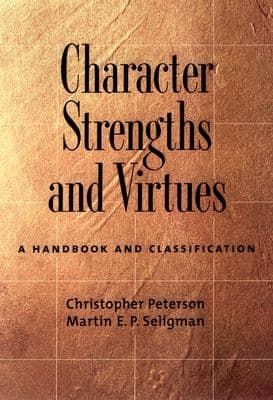
Character Strengths and Virtues: A Handbook and Classification

Peterson and Seligman's central framework is a systematic taxonomy of positive human traits designed as a counterpart to the DSM: twenty-four character strengths organized under six virtues—wisdom, courage, humanity, justice, temperance, and transcendence. The book does not argue that these strengths are universal moral truths; it proposes them as empirically grounded categories assembled through historical and cross-cultural review, then operationalized through self-report measures like the VIA-IS. Each strength receives a dedicated chapter covering its definition, measurement, correlates, and cultivation. The project's ambition is to give psychology a shared vocabulary for what goes right, parallel to psychiatry's vocabulary for disorder.
Key Insights
✦What is the central claim of Character Strengths and Virtues, and what does it reject?
The book's claim is taxonomic rather than therapeutic: psychology lacks a shared vocabulary for positive traits, and a systematic classification can provide one. Peterson and Seligman explicitly frame the VIA as a counterpart to the DSM—not a replacement for it, but a parallel instrument for describing what goes right rather than what goes wrong [citation:7]. They reject the assumption that character strengths are merely subjective preferences or culturally arbitrary values. Instead, they argue that the twenty-four strengths emerged from a convergence of historical, religious, and philosophical traditions, suggesting some cross-cultural ubiquity. The book is also careful to reject the idea that the classification is a prescriptive moral code; it presents itself as descriptive science, though critics have challenged whether that distinction holds.
✦What specific concept did the book introduce, and how is it used today?
The book introduced the VIA (Values in Action) classification of twenty-four character strengths organized under six virtues [citation:7]. This taxonomy became the basis for the VIA Inventory of Strengths (VIA-IS), a self-report questionnaire widely used in research and applied settings. The classification is cited across positive psychology interventions, strengths-based coaching, educational programs, and organizational development. Peterson and Seligman's stated hope was that clinicians could use the vocabulary to build strengths rather than only remediate deficits, and that researchers would gain a common framework for cumulative science [citation:7]. The VIA survey remains freely accessible online and has been completed by millions of respondents, making it one of the most widely deployed instruments to emerge from positive psychology.
✦How does the VIA classification differ from the DSM, and does the analogy hold?
Peterson and Seligman explicitly positioned the VIA as a 'manual of sanity' parallel to psychiatry's diagnostic manual [citation:5]. The structural analogy is clear: both are taxonomies with defined categories, operational criteria, and assessment instruments. But the differences are substantive. The DSM classifies disorders for clinical diagnosis and treatment reimbursement; the VIA classifies strengths for description and cultivation, with no diagnostic authority. The DSM's categories are meant to capture pathology that impairs functioning; the VIA's strengths are meant to capture healthy traits that vary continuously across populations. Critics have noted that the analogy may have rhetorical value but limited scientific precision, since the VIA lacks the DSM's extensive field trials and reliability data at the level of individual diagnostic categories.
✦What did reviewers and philosophers criticize about the VIA's relationship to virtue ethics?
A substantial philosophical critique appeared in a 2014 article in New Ideas in Psychology, which assessed the VIA against Alasdair MacIntyre's virtue ethics framework [citation:10]. The author argued that the VIA fails on two foundational features of classical virtue ethics: the unity of virtue thesis (the idea that virtues are interconnected and cannot be properly understood in isolation) and the constitutive relationship between virtue and happiness. Instead of treating virtues as interdependent, the VIA construes each strength as an independent variable to be measured separately, and it officially endorses a fact/value distinction that classical virtue ethics rejects. The critique concludes that the VIA's aspiration to be a 'social science equivalent of virtue ethics' is undermined by these structural commitments, though it acknowledges the classification's practical utility.
✦Has the empirical structure of the VIA classification held up in subsequent research?
The six-virtue structure has not fared well in independent factor-analytic studies. A 2009 study of Croatian samples reported that the factor structure failed to confirm the six superordinate virtue framework Peterson and Seligman proposed [citation:11]. Robert McGrath's large-scale analyses, cited in Oxford Bibliographies, found five latent factors—interpersonal strengths, emotional strengths, strengths of restraint, theological strengths, and intellectual strengths—that only partially overlapped with the original six virtues [citation:15]. These findings do not invalidate the twenty-four individual strengths as useful descriptive categories, but they do challenge the claim that the strengths cluster neatly into the six virtue dimensions presented in the book. The gap between the theoretical taxonomy and empirical factor structure is one of the most significant open questions the VIA left unresolved.
✦How does this book relate to Seligman's Authentic Happiness, published two years earlier?
Authentic Happiness (2002) was Seligman's popular manifesto for positive psychology, arguing that psychology had neglected the study of well-being and proposing that happiness could be cultivated through identifiable practices. Character Strengths and Virtues is the scholarly infrastructure that Authentic Happiness anticipated but did not supply. In Authentic Happiness, Seligman called for resurrecting character as a central concept in psychology; the VIA handbook delivers the taxonomy and measurement apparatus to make that call operational [citation:10]. The relationship is one of popular program to technical foundation: Authentic Happiness made the case for why character mattered, and Character Strengths and Virtues provided the systematic classification that allowed researchers and practitioners to specify what they meant by character and measure it.
Wealthy Psyche is an intellectual archive. We do not host, distribute, or sell book copies — physical or digital. We provide structured knowledge to help you think better, faster.