


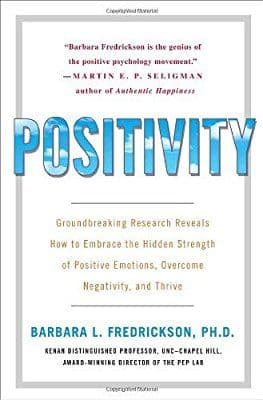
Positivity: Groundbreaking Research Reveals How to Embrace the Hidden Strength of Positive Emotions, Overcome Negativity, and Thrive

Fredrickson's central argument is that positive emotions are not merely pleasant states but functional adaptations that broaden a person's momentary thought-action repertoire and build durable personal resources, creating an 'upward spiral' of flourishing. The book translates her broaden-and-build theory into a practical program, arguing that a specific ratio of positive to negative emotional experience—initially proposed as 3-to-1—marks a tipping point between languishing and flourishing. It is a work of popular synthesis that makes a mechanistic claim about how transient affective states compound into long-term psychological growth.
Key Insights
✦What is the central claim of Positivity, and what does it reject?
The book argues that positive emotions are functional adaptations, not decorative pleasantries. Fredrickson's broaden-and-build theory holds that joy, gratitude, interest, and similar states widen attention and thought-action repertoires, which in turn builds physical, intellectual, and social resources over time. This rejects the dominant negative-emotion bias in psychology, which treated positive affect as epiphenomenal or merely hedonic. The practical corollary is the 'upward spiral': small, repeated experiences of positivity compound into durable well-being, while negativity narrows and depletes. The book's distinctive move is to attach this process to a numerical threshold—a positivity ratio—that supposedly separates flourishing from languishing, a claim that became its most contested feature.
✦What happened to the 3-to-1 positivity ratio that the book promotes?
The ratio originated in a 2005 paper Fredrickson co-authored with Marcial Losada, a management theorist who applied differential equations from fluid dynamics to team speech data. In 2013, Nicholas Brown, Alan Sokal, and Harris Friedman published a devastating critique in American Psychologist demonstrating that Losada's mathematical modeling was riddled with elementary errors and that the data were unsuitable for the equations used . Fredrickson conceded she never understood Losada's math but maintained that broader evidence supports the benefits of high positivity ratios. The episode is now a standard case study in psychology's replication and methodology problems. The paperback edition of Positivity still advertised the '3-to-1 ratio' as 'top-notch research,' a claim the book's own author later qualified.
✦How has Positivity been received by academic reviewers?
The book was reviewed in the Journal of Positive Psychology by Anjali Mishra in 2009, but the more revealing reception came from the broader scientific community after the ratio critique . Academic reviewers have generally accepted the broaden-and-build theory's core claims—that positive emotions widen cognition and build resources—while treating the ratio as an overreach. The 2008 loving-kindness meditation study by Fredrickson and colleagues provided empirical support for the build hypothesis without relying on the contested ratio . The distinction matters: the theory has robust support; the numerical tipping point does not. Popular readers and critics often conflate the two, either dismissing the entire framework because of the ratio or defending the ratio because the framework is sound.
✦How does Positivity relate to Fredrickson's earlier theoretical work?
Positivity popularizes and extends Fredrickson's 1998 and 2001 papers on the broaden-and-build theory, which argued that positive emotions evolved to broaden thought-action repertoires and build enduring resources . The 2001 American Psychologist article is the canonical theoretical statement; Positivity is its mass-market translation, adding the ratio framework drawn from the 2005 Losada collaboration and practical exercises for tracking one's emotional diet. The book thus sits at a junction: it extends the theory into applied self-help while incorporating a mathematical claim that Fredrickson's earlier work did not depend on. Readers who want the scientific foundation should read the 2001 paper; readers who want to see how a theory becomes a brand should read Positivity alongside the 2013 critique.
✦What is a common misconception about what Positivity actually argues?
A frequent misreading treats the book as claiming that negative emotions are bad and should be eliminated, or that positivity means forced cheerfulness. Fredrickson explicitly argues the opposite: negativity is adaptive and necessary, and the ratio framework presumes that some negativity is present. The '3-to-1' figure is often cited as if it means three positive thoughts for every negative one, a crude arithmetic that misses the theory's emphasis on heartfelt, genuine emotion rather than performed optimism. The book also distinguishes positivity from happiness, arguing that positivity is broader and more functional than a simple hedonic state. These distinctions tend to collapse in popular reception, where Positivity is filed alongside generic optimism literature it was written to complicate.
✦What specific concept from the book has proven durable despite the ratio controversy?
The broaden-and-build theory itself has accumulated substantial empirical support independent of the ratio. The 2008 loving-kindness meditation field experiment found that induced positive emotions produced increases in mindfulness, purpose in life, social support, and decreased illness symptoms, with these resource gains predicting improved life satisfaction and reduced depressive symptoms . Subsequent work in affective neuroscience has connected the theory's predictions to experience-dependent plasticity in emotion circuitry, suggesting that repeated positive affective states may have measurable neural correlates . The 'upward spiral' metaphor—transient positivity building durable resources that in turn generate further positivity—has become a standard framework in positive psychology, even among researchers who reject the specific numerical threshold.
Wealthy Psyche is an intellectual archive. We do not host, distribute, or sell book copies — physical or digital. We provide structured knowledge to help you think better, faster.