


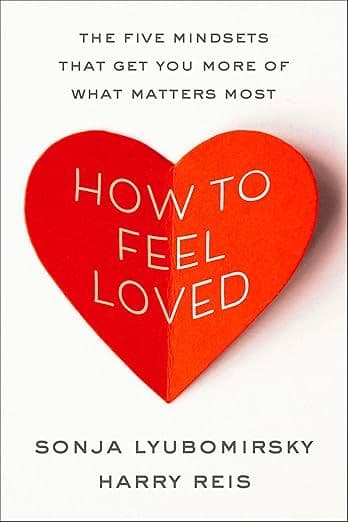
How to Feel Loved: The Five Mindsets That Get You More of What Matters Most

Lyubomirsky and Reis argue that being loved and feeling loved are distinct psychological states, and the gap between them is not closed by becoming more appealing or acting more lovable. The book's central framework is a set of five conversational mindsets—Sharing, Listening-to-Learn, Radical Curiosity, Open-Heart, and Multiplicity—that reshape dialogue so both parties can reveal their vulnerable selves and become deeply known. These mindsets animate a dynamic back-and-forth process the authors call the Relationship See-Saw. The argument rejects the assumption that feeling loved follows automatically from being loved or from performing prescribed romantic behaviors.
Key Insights
✦What is the central claim of How to Feel Loved, and what does it reject?
The book's central claim is that feeling loved is a distinct psychological experience from being loved, and that the gap between them is not closed by becoming more appealing, available, or lovable—the strategies most people reflexively pursue . Lyubomirsky and Reis reject the assumption that performing prescribed loving behaviors or adhering to normative relationship scripts produces emotional connection; they argue such self-monitoring can actually undermine closeness and contribute to loneliness and disconnection . Instead, they propose that feeling loved depends on mutual vulnerability and responsiveness: showing your full and vulnerable self to others and encouraging loved ones to reveal their full and vulnerable selves to you . This applies across romantic, familial, and friendship contexts, not just romantic love.
✦What are the five mindsets, and how do they work together?
The five mindsets are Sharing (showing vulnerabilities and the inner world, not just polished parts), Listening-to-Learn (truly tuning in rather than taking turns speaking), Radical Curiosity (genuine interest in another and asking better questions), Open-Heart (kindness and affirmation of who the other truly is), and Multiplicity (embracing the messy complexity in everyone, including oneself) . These are not independent techniques but interlocking orientations that reshape conversations. The authors describe their combined effect through the metaphor of the Relationship See-Saw: a dynamic back-and-forth in which both people alternately reveal and receive, enabling each to deeply know the other and become deeply known . The mindsets are presented as tools for remaking everyday conversations rather than as grand romantic gestures or personality overhauls.
✦How does this book relate to Lyubomirsky's earlier work on happiness?
How to Feel Loved extends Lyubomirsky's happiness research into the specific domain of felt connection. Her earlier bestsellers, The How of Happiness and The Myths of Happiness, established her as a leading researcher on what makes people happy and what misconceptions undermine well-being . This book narrows the lens to a single, central driver of well-being—feeling loved—and partners her with Harry Reis, a relationship scientist whose expertise complements her background in happiness and positive psychology. The publisher's framing positions the book as drawing on 'the science of happiness, love, and human connection' to offer a framework for nurturing what makes people feel truly loved . The collaboration signals a deliberate convergence of two research traditions: subjective well-being and close relationships.
✦Who is Harry Reis, and what does his collaboration bring to the book?
Harry T. Reis is a Dean's Professor in the Department of Psychology at the University of Rochester and one of the world's leading experts on relationships and social connection . His work is frequently featured in media including NPR's Hidden Brain, Scientific American, and the New York Times, and he has received awards for both research and teaching . The Mental Research Institute, which supported Reis's work through grants, notes that the book draws on decades of research to demonstrate that feeling loved is a separable psychological experience from loving behavior and objective indicators of being loved . Reis's expertise in relationship science provides the book's grounding in interpersonal processes—responsiveness, mutual vulnerability, and closeness—while Lyubomirsky contributes the happiness and well-being framework.
✦What does the book say about the Relationship See-Saw?
The Relationship See-Saw is the book's metaphor for the dynamic, reciprocal process that generates felt love. It captures the back-and-forth of mutual vulnerability: one person shares something genuine, the other receives it with curiosity and care, and the exchange creates a moment of being deeply known . The see-saw image implies balance and alternation rather than one-sided effort. The authors' argument is that this process is under your control: rather than trying to change the other person or make yourself more lovable, you can change the conversation . The mindset shifts—Sharing, Listening-to-Learn, Radical Curiosity, Open-Heart, Multiplicity—are the practical means by which the see-saw is set in motion and sustained. The metaphor also suggests that feeling loved is not a static state but an ongoing interactional achievement.
✦What did early reviews say about the book's approach?
Booklist's review notes that the authors 'bust some common myths about happiness' and then focus on the five mindsets for deepening conversations and building lasting connections . The reviewer observes that the authors support their theories with scientific research, personal stories, and quotes from figures including the Dalai Lama, and that while they acknowledge love comes in many packages, they argue the same techniques that make a partner feel closer also work with colleagues, children, and close friends . The review concludes that readers longing for closeness will be inspired to put in the effort. Endorsements from Angela Duckworth, Arthur C. Brooks, Dan Buettner, and Eli Finkel emphasize the combination of research rigor and practical applicability.
✦Is this book a self-help manual or a work of relationship science?
The book is best characterized as research-backed practical guidance—a genre in which Lyubomirsky has established expertise. It synthesizes empirical findings from psychology, well-being research, and relationship science to clarify how feelings of being loved are formed, maintained, and disrupted , then translates those findings into five actionable mindsets. The publisher's description emphasizes that the authors 'draw on the science of happiness, love, and human connection' rather than presenting original experimental research . The book includes personal stories and practical examples alongside citations of scientific work. Readers seeking a purely theoretical monograph should look elsewhere; readers seeking a rigorous but accessible guide to improving felt connection will find the book's evidentiary grounding more substantial than typical self-help fare.
Wealthy Psyche is an intellectual archive. We do not host, distribute, or sell book copies — physical or digital. We provide structured knowledge to help you think better, faster.