


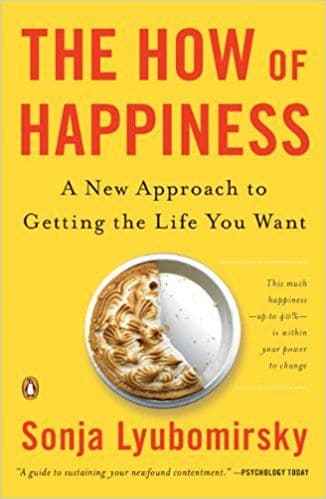
The How of Happiness: A Scientific Approach to Getting the Life You Want

Lyubomirsky's central framework is the '40% solution': roughly half of individual differences in happiness is genetic, about 10% is circumstance, and a startling 40% is within our power to change through intentional activity. The book translates this arithmetic into a practical program of twelve evidence-based happiness strategies—gratitude, kindness, savoring, goal commitment, and others—while insisting that no single strategy fits everyone. It rejects the assumption that happiness is either fixed by temperament or delivered by external achievements, arguing instead that sustainable well-being depends on choosing activities that fit one's values and circumstances, then sustaining them through effort and habit.
Key Insights
✦What is the central claim of The How of Happiness, and what does it reject?
The book's central claim is the '40% solution': roughly 50% of individual differences in happiness is governed by genes, 10% by life circumstances, and a remaining 40% by intentional activities—what we do and how we think [citation:4][citation:12]. Lyubomirsky rejects the assumption that happiness is either fixed by temperament or delivered by external achievements like marriage, money, or status. External circumstances, she argues, account for only a sliver of the variance, and people adapt quickly to both good and bad changes. The practical implication is that sustainable happiness requires deliberate, sustained effort in choosing and practicing activities that fit one's values and needs, not waiting for circumstances to align. The book is a guide to that effort, not a promise of effortless bliss.
✦What specific framework did this book popularize, and where is it used today?
The book popularized the 40% solution and the concept of 'intentional activities' as the lever for sustainable happiness [citation:12]. This framework has become a staple in positive psychology education and coaching, where practitioners use the pie-chart model to explain why interventions target behavior and thinking rather than circumstances. The book also introduced a Person-Activity Fit Diagnostic, a tool for matching individuals to happiness strategies based on their personality and values, which reflects Lyubomirsky's insistence that there is no universal happiness prescription [citation:14]. The twelve strategies themselves—gratitude, kindness, savoring, goal pursuit, forgiveness, and others—are widely cited in applied positive psychology literature and form the basis of many evidence-based well-being programs.
✦How does The How of Happiness relate to Lyubomirsky's later book The Myths of Happiness?
The How of Happiness (2007) provides the constructive program: here is the 40% you can change, and here are twelve strategies for changing it. The Myths of Happiness (2013) clears away the cognitive obstacles that prevent people from executing that program [citation:2]. The later book argues that false beliefs about what specific life events—marriage, divorce, children, wealth, illness—will do to our long-term happiness lead people to make poor decisions and suffer unnecessarily. In this sense, the relationship is complementary: the first book tells you how to increase happiness, and the second tells you why your intuitions about happiness are systematically wrong. Both books share the same empirical foundation in hedonic adaptation research, but they apply it to different problems.
✦What did reviewers identify as the book's strengths and limitations?
The book received strong endorsements from major figures: Daniel Gilbert called it 'smart, fun, and interesting—and unlike almost every other book on the same shelf, it also happens to be true,' while Martin Seligman called it 'the right place to look for science-based advice on how to become happier' [citation:3][citation:8]. A Globe and Mail review, however, identified the book's main limitation as its difficulty: 'there's too much to do, too much to think about, too many steps and substeps to memorize and quizzes to fill out,' suggesting that readers seeking relief from misery might find the program overwhelming rather than accessible [citation:14]. Academic reviewer Bergsma, writing in the Journal of Happiness Studies, acknowledged the book as 'the state of the art in popular advice about happiness' while still finding it left 'a lot to be desired' in terms of what a truly rigorous evidence-based guide might accomplish [citation:8].
✦How has the book's 40% solution held up given subsequent research?
The 40% figure is a heuristic, not a precise empirical constant, and Lyubomirsky herself has acknowledged that the exact percentages are debated among scholars [citation:20]. The core insight—that a substantial portion of happiness is modifiable through intentional activity—has been broadly supported by intervention research. However, the genetic and circumstance percentages (50% and 10%) derive from behavioral genetics studies whose assumptions have been questioned, and the neat partition of variance is a simplification of complex gene-environment interactions. The book's practical recommendations, which are the heart of its contribution, do not depend on the exact arithmetic: the twelve strategies have been tested in numerous studies, and the general principle that intentional activity can raise well-being is well established. Readers should treat the percentages as orienting devices rather than precise measurements.
✦What does the book say about the role of effort and habit in sustaining happiness?
Lyubomirsky is explicit that the 40% is not a free lunch. The book's final section addresses the 'five hows' behind sustainable happiness: positive emotion, optimal thinking and variety, social support, motivation, and effort and commitment [citation:1]. The emphasis on effort is a distinguishing feature of the book's approach: happiness strategies are not one-time interventions but ongoing practices that require deliberate cultivation and periodic variation to avoid adaptation. The book also addresses setbacks, acknowledging that people will falter and that the pursuit of happiness is a long-term project rather than a quick fix. This insistence on effort and habit distinguishes the book from self-help approaches that promise transformation through a single insight or technique, and it reflects Lyubomirsky's research background in the mechanisms of sustained behavior change.
✦How does the book's approach differ from Martin Seligman's Authentic Happiness?
Seligman's Authentic Happiness (2002) introduced the three routes to happiness—pleasure, engagement, and meaning—and argued that the full life involves cultivating all three. Lyubomirsky's book is more prescriptive and individualized: rather than offering a general theory of what happiness consists of, she provides twelve specific activities and a diagnostic for choosing among them based on personal fit [citation:14]. The emphasis on fit is a distinctive contribution: Lyubomirsky argues that a strategy that works for one person may fail for another because of differences in values, personality, and circumstances. This is a more granular and practical approach than Seligman's broader framework. Both books share the positive psychology commitment to treating well-being as empirically investigable and cultivable, but Lyubomirsky's focus is on the mechanics of individual change rather than the philosophical architecture of the good life.
Wealthy Psyche is an intellectual archive. We do not host, distribute, or sell book copies — physical or digital. We provide structured knowledge to help you think better, faster.