


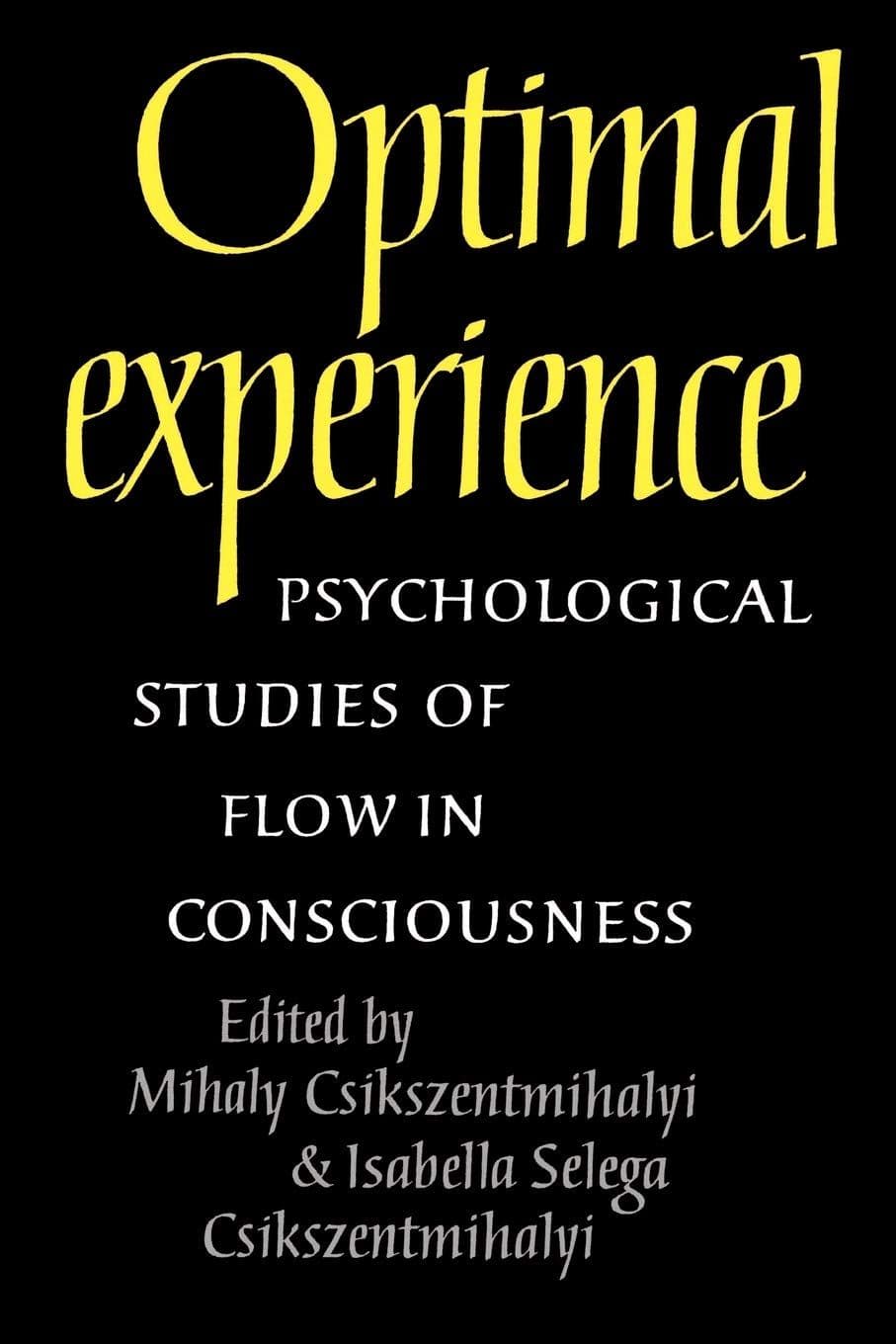
Optimal Experience: Psychological Studies of Flow in Consciousness
Co-edited with Isabella Selega Csikszentmihalyi, this volume is the first comprehensive scholarly consolidation of flow research, assembling theoretical models, cross-cultural case studies, and measurement methodology into a single framework. Its distinctive contribution is the extension of flow theory beyond the laboratory: contributors examine flow in Japanese motorcycle gangs, elderly Korean immigrants, ocean cruisers, Jesuit history, and Italian versus American students, demonstrating that optimal experience is not a Western or leisure-class phenomenon but a universal dimension of human consciousness that varies with cultural context and social structure. The book is a research anthology, not a popular synthesis, and it established the empirical agenda that later flow books would popularize.
Key Insights
✦What is the central claim of Optimal Experience, and what does it reject?
The volume's organizing claim is that flow—the state in which people meet environmental challenges with appropriate skills, producing well-being, mastery, and heightened self-esteem—is a universal dimension of human experience that can be studied empirically across cultures and social contexts [citation:1][citation:14]. The editors reject the assumption that optimal experience is a luxury of Western leisure or privileged populations. Contributors document flow in Japanese motorcycle gangs, elderly Korean immigrants, ocean cruisers, and Italian and American students, showing that the capacity for enjoyment is not confined to any single culture or class [citation:1][citation:10]. The book also rejects purely theoretical treatments of flow: it is organized as a comprehensive survey of theoretical models, empirical case studies, and measurement methodology, not as a popular synthesis or self-help guide.
✦What specific framework or method does this volume introduce or consolidate?
The book consolidates the Experience Sampling Method (ESM) as the primary empirical tool for studying flow in everyday life. Part IV is dedicated entirely to measurement, with chapters on the systematic assessment of flow in daily experience, the quality of experience in flow channels, and comparisons of Italian and U.S. students [citation:1][citation:10]. This methodological apparatus allowed researchers to capture flow as it occurred rather than relying on retrospective self-report, and it became a signature of Csikszentmihalyi's research program. The volume also introduces the concept of 'flow channels'—the experiential zones defined by the balance of challenges and skills—and applies it cross-culturally. Contemporary Psychology praised it as 'an impressive cross-cultural effort' and 'a valuable compilation of major theoretical and empirical developments in one volume' [citation:1].
✦How does this book relate to Csikszentmihalyi's 1975 Beyond Boredom and Anxiety and 1990 Flow?
Optimal Experience (1988) sits between the two. Beyond Boredom and Anxiety (1975) first introduced the flow concept through interviews with climbers, surgeons, and other intrinsically motivated groups; it was a single-author monograph establishing the phenomenon. Optimal Experience is an edited anthology that consolidates a decade of subsequent research, assembles contributions from collaborators across disciplines, and formalizes the measurement methodology [citation:1]. Flow (1990) then abstracted the concept for a mass audience, stripping away the academic scaffolding and presenting it as a general theory of happiness. In this sequence, Optimal Experience is the scholarly bridge: it demonstrates that flow was a robust research program before it became a cultural shorthand, and it preserves the empirical details that the 1990 bestseller necessarily simplified.
✦What does the book argue about the relationship between flow and culture?
The volume argues that while the flow experience itself is universal—people everywhere report absorption, mastery, and enjoyment when challenges match skills—the contexts that produce flow vary profoundly across cultures and social structures. Chapters on Japanese bosozoku motorcycle gangs, elderly Korean immigrants, and Italian versus American students show that flow is shaped by cultural values, work arrangements, and historical circumstances [citation:1][citation:10]. Antonella Delle Fave and Fausto Massimini's chapter on modernization argues that changing work and leisure contexts alter the opportunities for flow, while Isabella Csikszentmihalyi's historical chapter on the Jesuits demonstrates that flow can be cultivated within religious institutions. The book's cross-cultural commitment was unusual for its era and remains one of its distinctive contributions to positive psychology's prehistory.
✦What did reviewers identify as the book's strengths and limitations?
Contemporary Psychology called it 'an impressive cross-cultural effort' and 'a valuable compilation of major theoretical and empirical developments in one volume,' praising its attention to intrinsic motivation in work and play [citation:1]. Exceptional Human Experience described it as 'an interdisciplinary anthology of some of the most stimulating conceptual extensions of the original flow model' [citation:1]. New Scientist praised its combination of theoretical modeling, situational accounts, and methodological description [citation:1]. The main limitation is structural: as an edited collection, its chapters vary in quality, scope, and accessibility, and the volume lacks the unified voice of Csikszentmihalyi's single-authored books. It is a research anthology for specialists, not an introduction for general readers, and its density limits its reach outside academic psychology.
✦How does this volume relate to the positive psychology movement?
Optimal Experience was published a decade before Martin Seligman's formal call for a positive psychology, but it exemplifies the movement's core commitments before the movement had a name. It treats enjoyment, mastery, and optimal experience as scientifically investigable phenomena; it emphasizes strengths and engagement rather than pathology; and it insists that well-being is an active achievement rather than a passive state. Csikszentmihalyi was a founding figure of positive psychology, and flow became one of the field's central constructs alongside learned optimism and character strengths. The volume's cross-cultural and methodological rigor also anticipated positive psychology's later reckoning with questions of generalizability and measurement. Reading it today shows the empirical foundation on which the more popular positive psychology edifice was built.
✦Who were the contributors, and what does the roster reveal about the research network?
The contributor list includes Isabella Selega Csikszentmihalyi, Richard G. Mitchell Jr., Ikuya Sato, Maria T. Allison, Margaret C. Duncan, Seongyeul Han, Reed Larson, Richard Logan, Antonella Delle Fave, Fausto Massimini, Jim MacBeth, Massimo Carli, Judith Le Fevre, Jeanne Nakamura, Anne J. Wells, and Kevin Rathunde [citation:1]. The roster reveals a deliberately international and interdisciplinary network: Sato brought Japanese studies, Han brought Korean immigrant research, Delle Fave and Massimini brought Italian perspectives, and Larson had collaborated with Csikszentmihalyi on adolescent experience sampling. Several contributors—Nakamura, Rathunde, and Larson—would go on to have distinguished careers in positive psychology and developmental psychology. The volume thus documents not just a theory but the formation of a research community around the flow concept, with Chicago as its institutional hub and cross-cultural collaboration as its method.
Wealthy Psyche is an intellectual archive. We do not host, distribute, or sell book copies — physical or digital. We provide structured knowledge to help you think better, faster.