


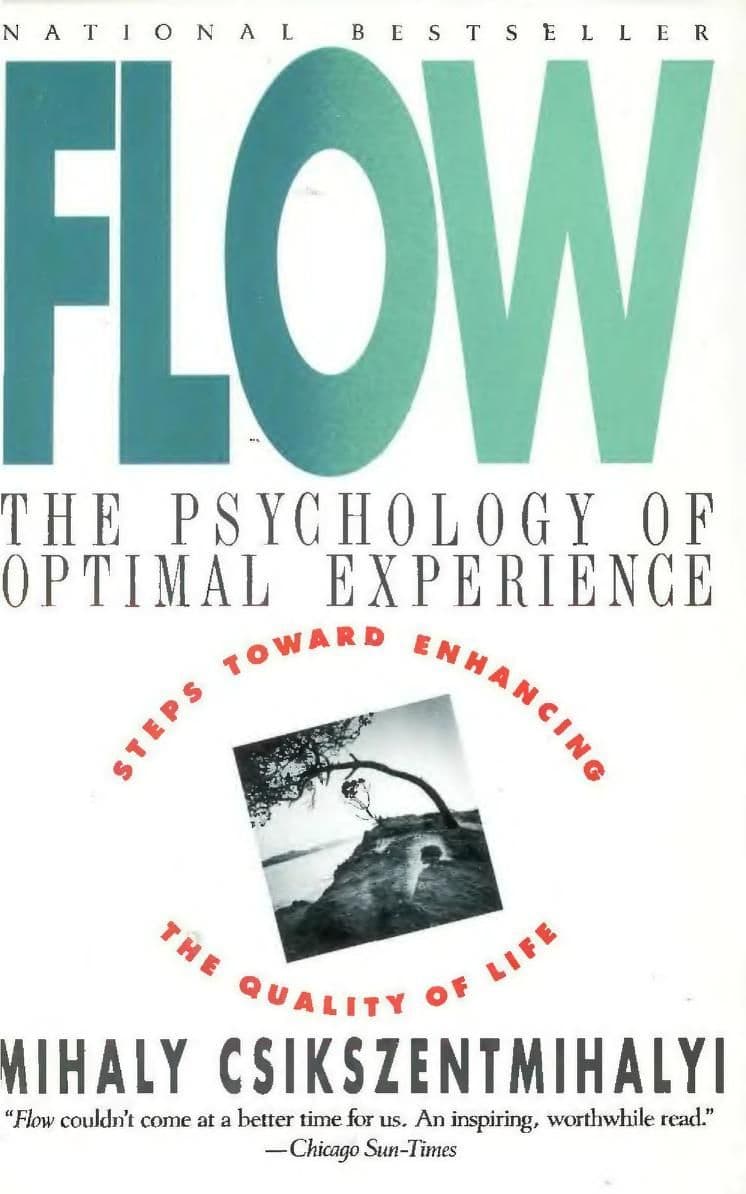
Flow: The Psychology of Optimal Experience

Csikszentmihalyi's central framework is the flow state: a condition of complete absorption in an activity where challenges match skills, goals are clear, feedback is immediate, and self-consciousness disappears. The book argues that happiness is not a destination or a passive pleasure but a byproduct of cultivating these optimal experiences across work, leisure, relationships, and solitude. It rejects the assumption that happiness arrives through external circumstances or mindless consumption, insisting instead that it depends on how attention is ordered and how consciousness is controlled. Drawing on decades of experience sampling research, it is both a scientific account of enjoyment and a practical guide to living a more engaged life [citation:1][citation:3].
Key Insights
✦What is the central claim of Flow, and what does it reject?
The book's central claim is that what makes experience genuinely satisfying is a state of consciousness called flow—deep absorption in an activity where challenges and skills are balanced, goals are clear, and feedback is immediate [citation:1]. Csikszentmihalyi rejects the assumption that happiness is a destination to be reached through external circumstances, material acquisition, or passive leisure. He distinguishes pleasure (externally focused, temporary) from enjoyment (internally generated, sustainable), and he argues that few moments of happiness occur when we are idle [citation:3]. The book is an exploration of happiness, but its answer is counterintuitive: we are most happy when actively engaged in meaningful pursuit, stretching our abilities, not when relaxing or consuming. This is why work often produces more flow than leisure [citation:1][citation:3].
✦What specific concept did this book popularize, and where is it used today?
The book popularized the flow concept, which Csikszentmihalyi had first introduced in his 1975 academic monograph Beyond Boredom and Anxiety. Flow is the state of complete involvement in an activity, characterized by narrowed attention, merged action and awareness, a sense of control, and intrinsic reward [citation:1]. The concept has since been applied across an extraordinary range of domains: education, sports psychology, game design, organizational behavior, and even technology adoption research, where studies use flow theory to understand continued use of mobile apps and digital platforms [citation:6]. Csikszentmihalyi's work is credited with giving psychology a rigorous vocabulary for optimal experience, and Flow remains the most widely cited and accessible statement of the theory [citation:7].
✦How does Flow relate to Csikszentmihalyi's earlier and later books?
Flow (1990) extends the research program begun in Beyond Boredom and Anxiety (1975), which first presented the flow concept based on interviews with rock climbers, surgeons, and other intrinsically motivated groups. The later book abstracts the concept from its academic scaffolding and presents it as a general theory of optimal experience for a broad readership [citation:1]. It was followed by Finding Flow (1997), a shorter, more prescriptive application of flow principles to everyday life, and Creativity (1996), which applied flow to exceptional creators [citation:7][citation:18]. The relationship across these books is one of progressive popularization and application: the 1975 book established the concept empirically, the 1990 book made it culturally influential, and the later books extended it into specific domains.
✦What did critics identify as weaknesses in the book's argument or evidence?
Reader and reviewer critiques have focused on several recurring issues. Some readers describe the book as overly anecdotal and dated, with prose that does not itself 'flow' [citation:4]. One detailed complaint alleges factual errors and sweeping generalizations about human behavior, while another notes the book's use of concepts like energy and entropy where attention and distraction would be more appropriate [citation:4]. A more substantive critique is that the book does little to specify how to deliberately enter a flow state, despite its practical ambitions; one reader described it as more descriptive than prescriptive [citation:4]. The book is also a product of its time, drawing primarily on research conducted before the replication crisis in psychology prompted greater methodological scrutiny. These criticisms do not invalidate the flow concept, but they qualify the book's status as a definitive scientific statement.
✦What is the paradox of work, and why does the book emphasize it?
One of Flow's most striking findings, drawn from experience sampling research, is that people report more flow experiences at work than during leisure, yet they say they would rather be doing something else [citation:1]. The paradox is that work, despite being obligatory and often stressful, provides structured challenges, clear goals, and feedback—the conditions that generate flow. Free time, by contrast, often defaults to passive consumption like television, which produces boredom rather than enjoyment. Csikszentmihalyi uses this paradox to argue that the work/leisure distinction is psychologically misleading: what matters is the structure of the activity, not its cultural label. The implication is practical rather than radical: rather than escaping work, people can learn to structure work and leisure alike to approximate flow conditions [citation:1].
✦How has the flow concept held up in subsequent psychological research?
Flow has proven remarkably durable and is now a standard construct in psychology, with an extensive empirical literature on its measurement, antecedents, and consequences. The core claim—that challenge-skill balance, clear goals, and immediate feedback produce absorbed enjoyment—has been widely supported across domains including education, sport, and work. The book's specific empirical base, however, was modest by contemporary standards, and Csikszentmihalyi's later work developed the concept far beyond the 1990 formulation. Contemporary research uses methods (experience sampling, neuroimaging) that were not available when the book was written. The book is best understood as the popular synthesis that brought flow into public consciousness, not as the final scientific word on the topic. Its conceptual contribution remains foundational even as the empirical details have been refined.
✦Why is Flow considered a foundational text for positive psychology despite predating the field's formal founding?
Flow was published in 1990, eight years before Martin Seligman's formal call for a positive psychology, but it exemplifies the movement's core commitments before the movement had a name. It treats happiness and optimal experience as scientifically investigable phenomena, emphasizes strengths and engagement rather than pathology, and offers a vision of well-being that is active rather than passive. Csikszentmihalyi was a founding figure of positive psychology, and flow became one of the field's central constructs alongside Seligman's learned optimism and Peterson's character strengths. The book's cultural impact—it became a bestseller and was cited well beyond academia—also helped create the audience and legitimacy that positive psychology would later draw on. Reading Flow today is a way of understanding the intellectual and cultural soil from which positive psychology emerged.
Wealthy Psyche is an intellectual archive. We do not host, distribute, or sell book copies — physical or digital. We provide structured knowledge to help you think better, faster.