


https://i.pinimg.com/736x/96/f4/fa/96f4fa9a7a8b42aa8ee270c019ea74cf.jpg

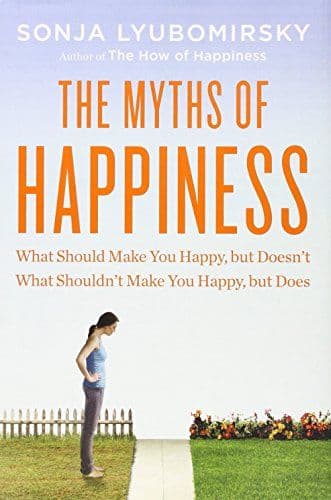
Lyubomirsky's central argument is that our beliefs about what will make us happy—and what will destroy us—are systematically wrong, and these misconceptions are a greater threat to well-being than the events themselves. Drawing on hedonic adaptation research, she shows that people return to a baseline happiness set-point after both good and bad turns, meaning marriage, children, wealth, divorce, and illness have far smaller long-term effects than we anticipate. The book isolates major adult turning points in relationships, work, and aging, arguing that the space between expectation and reality is where suffering and opportunity both reside.
Key Insights
✦What is the central claim of The Myths of Happiness, and what does it reject?
The book's central claim is that our misconceptions about how much life events will affect our long-term happiness are perhaps the greatest threat to well-being [citation:2][citation:4]. Lyubomirsky rejects the culturally transmitted promise that lifelong happiness will arrive once we hit markers of adult success—marriage, children, the right job, wealth—and the corresponding fear that failures like divorce or illness will permanently destroy us. Drawing on hedonic adaptation research, she argues that people are far more adaptable than they think, returning to a baseline happiness level after both positive and negative turns [citation:4]. The problem is not that good things bring no joy or bad things bring no pain, but that we overestimate both their intensity and their duration, leading to toxic decisions and unnecessary suffering.
✦What is hedonic adaptation, and why is it central to the book's argument?
Hedonic adaptation is the psychological process by which people return to a relatively stable baseline of happiness after significant life changes, whether positive or negative [citation:4]. Lyubomirsky uses this finding to dismantle the myths that organize adult expectations. If adaptation is powerful, then a marriage or a promotion will not deliver the permanent boost we anticipate, and a divorce or a diagnosis will not consign us to permanent misery. The book's practical implications follow from this: rather than placing too much weight on initial emotional responses to turning points, readers should cultivate awareness of adaptation and learn to slow its effects after good events while finding the way forward after bad ones [citation:4]. The concept is the empirical engine behind the book's corrective to cultural happiness scripts.
✦How does this book relate to Lyubomirsky's earlier bestseller The How of Happiness?
The Myths of Happiness extends the project of The How of Happiness (2008) by shifting focus from general strategies for increasing happiness to the specific misconceptions that derail it at major life junctures. The earlier book argued that sustainable happiness is possible through intentional activity; the later book argues that this potential is blocked by false beliefs about what specific achievements and failures will do to us [citation:1][citation:2]. Kirkus noted that Lyubomirsky is the author of The How of Happiness and that the new book dismantles culturally generated myths while offering strategies to reach personal happiness potentials [citation:18]. The relationship is complementary rather than sequential: one book provides the positive program, the other clears away the cognitive obstacles that make the program harder to execute.
✦What did reviewers identify as the book's strengths and limitations?
Publishers Weekly called it 'provocative and fresh,' praising Lyubomirsky's demonstration that positively reframing life events can mine the best out of even the darkest situations [citation:14]. Kirkus found the approach 'well-researched and eminently pragmatic,' though it noted that like the pursuit of happiness itself, it requires commitment and discipline since 'there's no magic formula' for achieving bliss [citation:18]. CHOICE Magazine offered the most pointed limitation: while the research underlying Lyubomirsky's explosion of happiness myths is sound and her footnotes extensive and current, the book is designed for a popular audience and leaves out the crucial quantities and proportions that would make it scientifically useful [citation:15]. This is a fair characterization of the trade-off between accessibility and empirical precision that shapes the entire genre of research-driven self-help.
✦How does the book differ from Daniel Gilbert's Stumbling on Happiness?
Both books draw on affective forecasting research and hedonic adaptation, but they differ in scope and purpose. Gilbert's Stumbling on Happiness (2006) is a broader cognitive psychology investigation into why humans are so bad at predicting what will make them happy, covering imagination's systematic errors across many domains. Lyubomirsky's book is narrower and more prescriptive: it isolates specific adult turning points—marriage, divorce, children, work, money, illness, aging—and examines the myths surrounding each, then offers research-based strategies for responding better [citation:7]. Where Gilbert explains the machinery of forecasting error, Lyubomirsky applies it to the culturally scripted expectations that shape adult life decisions. The books are complementary rather than competing: Gilbert provides the cognitive science, Lyubomirsky provides the life-stage application.
✦What does the book argue about adversity and growth?
One of the book's counterintuitive claims is that hardship and suffering do not necessarily make people unhappy, and that phenomena traditionally viewed as negative—divorce, illness, job loss—can promote the development of crucial life skills that lead to a more sustainable form of happiness [citation:14]. Lyubomirsky argues that painful turning points can present opportunities for renewal, growth, or meaningful change, and that what prevents people from making the most of these opportunities is how they choose to react, responses shaped by received myths of happiness [citation:18]. A Star review of the book noted that recent research shows people who have experienced some adversity are ultimately happier and less stressed than those who have experienced none at all [citation:11]. This is not a glorification of suffering but an argument against catastrophizing it.
✦What did critics say about the book's writing style and accessibility?
Reception on this dimension was mixed. Kirkus called it 'informative and engaging,' and the Star described it as 'a smart, lively read that interprets the science for lay readers' [citation:11][citation:18]. Publishers Weekly found it 'provocative and fresh' [citation:14]. However, library patron comments reveal a split: some called it 'exceptionally good' and placed it alongside works by Haidt and Seligman, while others found it 'basic, pedestrian' or even 'so badly written i couldn't get past the introduction' [citation:3]. CHOICE Magazine's assessment is the most balanced: the book is designed for a popular audience, academics will find it leaves out crucial quantities, but the research is sound and the tone cheerful and encouraging [citation:15]. The divergence reflects the inherent tension in writing rigorous science for a general readership.
Wealthy Psyche is an intellectual archive. We do not host, distribute, or sell book copies — physical or digital. We provide structured knowledge to help you think better, faster.