


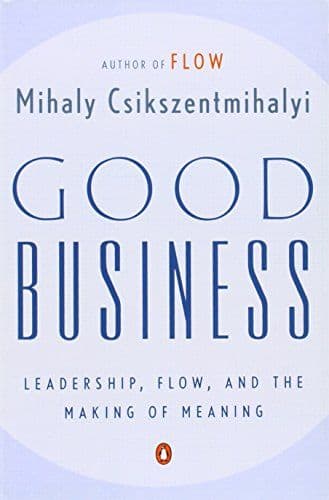
Good Business: Leadership, Flow, and the Making of Meaning

Csikszentmihalyi's central argument is that business has replaced religion and politics as the central force in contemporary life, and that business leaders therefore bear a responsibility to create conditions for human flourishing, not just profit. Drawing on interviews with 39 visionary leaders who combined high achievement with moral commitment, the book applies flow theory to organizations: clear goals, immediate feedback, and balanced challenge-skill ratios make work enjoyable and productive. It rejects the assumption that business success and human happiness are separate or opposed, arguing instead that meaning-making is the foundation of sustainable enterprise.
Key Insights
✦What is the central claim of Good Business, and what does it reject?
The book's central claim is that business and work have replaced religion and politics as the central forces in contemporary life, and that this shift imposes on business leaders a responsibility to provide meaning and foster human flourishing, not merely profit . Csikszentmihalyi rejects the assumption that business success and employee happiness are separate concerns, or that work is inherently a burden to be endured for external reward. Drawing on interviews with 39 leaders who combined high achievement with moral commitment, he argues that organizations can be designed to produce flow—the state of complete absorption in challenging, skilled activity—and that doing so benefits both employees and the bottom line . A reviewer noted that Csikszentmihalyi grounds this argument in Aristotle's concept of the good life rather than Marxist class struggle .
✦What specific research project produced this book, and who were the leaders interviewed?
The book is based on a project begun in 1998 consisting of 39 interviews with business leaders defined as combining high achievement with strong moral commitment—a 'long-term dedication to goals that advance the interests of the community, the people living in it, and humanity in general' . Named interviewees include Peter Bijur (CEO of Texaco), Michael Markkula (co-founder of Apple Computer), Anita Roddick (founder of The Body Shop), and Ted Turner (vice chairman of AOL Time Warner) . The sample was purposive rather than representative: Csikszentmihalyi sought leaders recognized both for success and for caring about more than success, to identify whether ethical commitment and business achievement could coexist and what organizational conditions supported both . The interviews provide case studies that function as a blueprint for doing business that is good materially, spiritually, and ethically .
✦How does the book apply flow theory to the workplace?
Csikszentmihalyi identifies four conditions that prevent flow on the job: unclear goals, inadequate feedback, a mismatch between skills and opportunities, and lack of control over one's work . The remedy follows directly from flow theory: clear goals that can adapt to changing conditions, immediate feedback on actions, and a balance between the challenges of the job and the worker's skills . The book's section on 'Building Flow in Organizations' describes how leaders can create these conditions through policies that allow freedom, control over tasks, and input in decisions . A reviewer summarized the practical implication: an organization whose employees experience flow is more productive, has higher morale, and lower turnover . The argument is not that work should be made easier, but that it should be structured so that difficulty becomes enjoyable rather than alienating .
✦What did reviewers criticize about the book's argument?
Peter A. Schneider's review in the Journal of Consumer Marketing offered the most substantive critique. He questioned the premise that religion and politics have ceased to be important and that CEOs should be responsible for employee happiness, and he noted that the claim about Bill Clinton's inspiration did little to endear him to the author . Schneider also observed that while Csikszentmihalyi sometimes sounds Marxist in his complaints about inequality and managerial greed, he is more accurately inspired by Aristotle's concept of the good life . Other reader reviews describe the book as repetitive, with one noting that the message is interesting but requires sitting through 'a lot of repetitive anecdotes' . These critiques target the book's framing and rhetorical strategy more than its core flow-based prescriptions.
✦How does this book relate to Csikszentmihalyi's earlier work on flow?
Good Business applies the flow framework developed in Flow (1990) to the specific domain of organizational life and leadership. Where Flow presented optimal experience as a general theory of happiness, Good Business asks how organizations can be structured to make flow a regular feature of work rather than an occasional exception . The book extends the earlier work in two ways: it adds a moral and societal dimension, arguing that business leaders have a responsibility to create meaning because business has become society's central institution, and it provides empirical grounding through interviews with actual leaders rather than relying solely on experience sampling data . The publisher's description frames the book explicitly as a follow-up: since Csikszentmihalyi published Flow, world leaders and influential figures have been inspired by it, and Good Business shows how that inspiration can be operationalized in corporate settings .
✦What does the book argue about the distinction between pleasure and enjoyment?
Csikszentmihalyi maintains the distinction he developed in earlier work: pleasure is a conservative force that satisfies existing needs without fostering growth, while enjoyment involves stretching one's capacities and can be stressful or difficult . A mountain climber exhausted at the peak may not experience pleasure but does experience enjoyment; relaxing in a hammock is pleasurable but does not compare to the exhilaration of flow . Applied to work, this distinction explains why a demanding job can be either enjoyable or drudgery depending on whether the challenges match the worker's skills and whether the conditions for flow are present . The implication for leaders is that making work 'pleasant' is not the goal; making it engaging and growth-producing is. The book's ethical argument depends on this distinction: meaningful work requires enjoyment, not just comfort .
✦Why does Csikszentmihalyi argue that business leaders have a responsibility for societal well-being?
The argument rests on a sociological observation: in contemporary society, scientists and businesspeople wield the most influence and power, having displaced religious and political authorities as the central shapers of daily life . With that power comes responsibility. Csikszentmihalyi admits that most business leaders would argue it is not their responsibility to provide visionary leadership, but he counters that if they fail to do so, the alternative will be leadership by charlatans and demagogues . This is a normative claim rather than an empirical finding, and it is the book's most contestable move. A reviewer noted that Csikszentmihalyi believes religious and political leaders have run out of compelling visions, leaving business leaders as the default providers of meaning . Whether this diagnosis is accurate is a matter of debate, but it is the premise on which the book's call to leadership ethics rests.
Wealthy Psyche is an intellectual archive. We do not host, distribute, or sell book copies — physical or digital. We provide structured knowledge to help you think better, faster.