


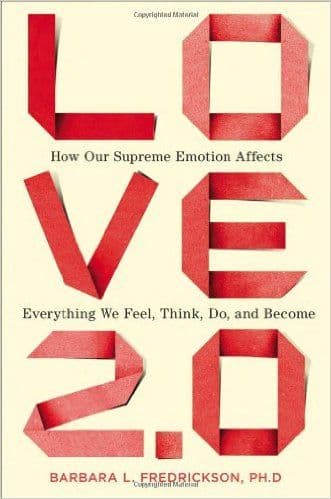
Love 2.0: How Our Supreme Emotion Affects Everything We Feel, Think, Do, and Become

Fredrickson's central move is to redefine love not as a lasting bond, commitment, or exclusive romantic attachment, but as 'positivity resonance': brief, embodied micro-moments of shared positive emotion between two or more people, including strangers. These moments are marked by behavioral synchrony, biochemical alignment (notably oxytocin and vagal tone), and mutual care. The book argues that accumulating such moments—rather than securing a single lasting relationship—builds health, resilience, and connection. It is a deliberate reframing of love as an everyday, trainable, and biologically measurable capacity rather than a rare or unconditional state.
Key Insights
✦What is the central claim of Love 2.0, and what does it reject?
Fredrickson argues that love is not a lasting, exclusive, or unconditional bond but a series of micro-moments of positivity resonance—brief episodes of shared positive emotion marked by behavioral synchrony and biological alignment. She explicitly rejects the cultural 'master narrative' that equates love with romantic commitment, soulmates, and permanence. The book insists that love can occur with strangers, colleagues, or grocery store attendants, and that these fleeting connections are not lesser versions of 'real' love but its fundamental form. This reframing positions love as a trainable capacity rather than a fixed relationship status, measurable through vagal tone and biochemical markers rather than through vows or longevity.
✦What specific concept did the book introduce, and where has it been applied?
The book introduced 'positivity resonance' as a technical term for love: a three-phase process involving shared positive affect, behavioral and biological synchrony, and mutual care. Fredrickson had been developing the underlying broaden-and-build theory for years, but Love 2.0 is where she explicitly fused relationship science with emotion science to redefine love itself. The concept has been applied in organizational psychology (team cohesion), health interventions (loving-kindness meditation to improve vagal tone), and mindfulness practices. The Greater Good Science Center describes the practical aim as strengthening relationships, teams, and communities through attention to everyday micro-connections rather than grand romantic gestures.
✦How does Love 2.0 relate to Fredrickson's earlier book Positivity?
Love 2.0 extends the framework of Positivity (2009) by narrowing focus from positive emotions broadly to one specific emotion—love—and radicalizing its definition. Positivity introduced the broaden-and-build theory for a general audience and proposed the 'positivity ratio' that later became controversial. Love 2.0 shifts away from ratios and tipping points, instead emphasizing that positivity experienced with others may broaden-and-build at a steeper rate than solitary positivity. Fredrickson explicitly states that shared positivity is more biologically impactful than individual positivity. The later book is thus an extension and a strategic retreat: it moves from quantitative thresholds to qualitative moments, while doubling down on the biological claims about vagal tone and health.
✦What did Scientific American's review criticize about the book's evidence?
Scientific American's review argued that Fredrickson overreaches in her evidentiary claims. Specifically, it noted that she cites a study showing best friends' brains synchronize during storytelling, then extends that finding to strangers without empirical support for the leap. The review also criticized her heavy reliance on subjective self-reports from meditation practitioners rather than objective neural measures of love. It described 'most of the evidence she uses to support her theory of love' as falling flat, while praising the practical sections on loving-kindness meditation and vagal tone as the strongest part of the book. The critique is notable because it comes from a mainstream science outlet sympathetic to positive psychology's aims.
✦How does Fredrickson handle the objection that this definition excludes lasting commitment?
Fredrickson anticipates this objection and addresses it directly: she argues that lasting bonds and commitments are real and valuable, but they are not the same thing as love. Love, in her technical sense, is the momentary experience of positivity resonance; a marriage or friendship may provide many such moments, but the relationship itself is not the emotion. She deliberately provokes by saying love is not unconditional, exclusive, or everlasting. The book's practical implication is that people should cultivate attention to micro-moments rather than treating love as a possession to be secured once and maintained. Critics from traditional or religious perspectives have pushed back, arguing this strips love of its moral and sacrificial dimensions.
✦Is the book's subtitle the same across editions, and why does it vary?
The hardcover edition from Hudson Street Press (2013) carries the subtitle 'How Our Supreme Emotion Affects Everything We Feel, Think, Do, and Become.' The paperback reprint from Plume (2014) was retitled 'Creating Happiness and Health in Moments of Connection,' a more practical and benefit-oriented framing. This editorial shift reflects the book's dual identity: a scientific argument for a new theory of love and a self-help-adjacent guide to cultivating connection. The hardcover subtitle emphasizes scope and profundity; the paperback emphasizes actionable outcomes. Readers encountering different subtitles should know they are the same core text, though packaging and framing differ between the hardcover and paperback editions.
Wealthy Psyche is an intellectual archive. We do not host, distribute, or sell book copies — physical or digital. We provide structured knowledge to help you think better, faster.