


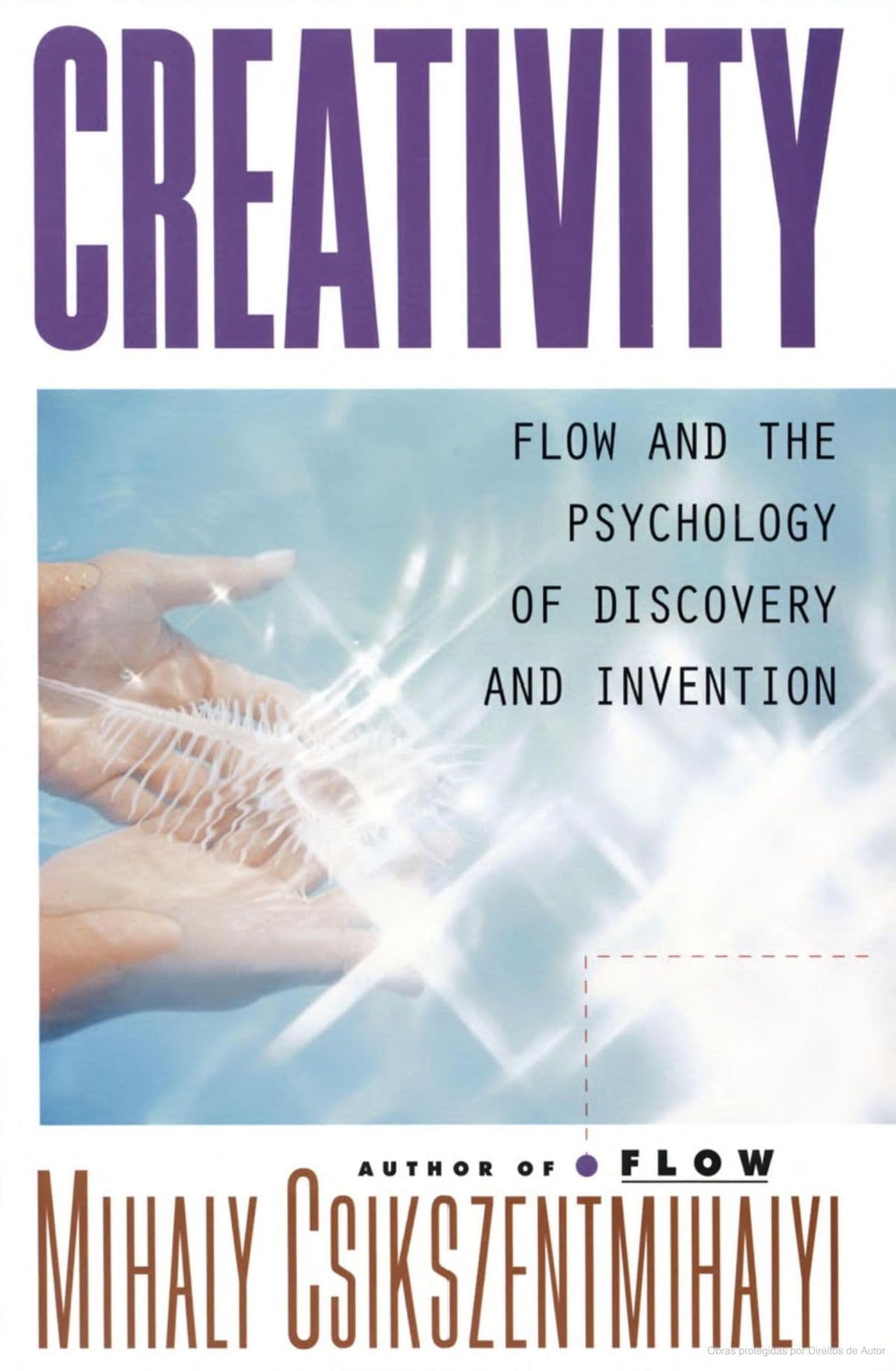
Creativity: Flow and the Psychology of Discovery and Invention

Csikszentmihalyi's central framework is a systems model of creativity: new ideas and products emerge not from isolated minds but from the interaction of three forces—the individual, the domain (a body of knowledge), and the field (the experts who validate innovations). The book is built on interviews with ninety-one exceptional creators, including scientists, artists, and public figures, and it extends his earlier flow theory by asking how optimal experience becomes a lifelong feature of creative work. The argument rejects the romantic notion of the solitary genius, insisting that culture and social validation are constitutive of creativity rather than mere background conditions.
Key Insights
✦What is the central claim of Creativity, and what does it reject?
The book argues that creativity is a systemic phenomenon, not an individual trait. Csikszentmihalyi defines creativity as a process by which a symbolic domain in culture is changed, and this requires three interacting components: the individual with novel ideas, the domain (the body of knowledge and conventions), and the field (the experts who recognize and validate innovation) [citation:15]. He rejects the romantic image of the solitary genius whose brilliance is self-evident. A person may be brilliant, but without a domain to work within and a field willing to accept the novelty, creativity does not occur. The book's interview study of ninety-one exceptional creators supports this framework: none of them worked in isolation, and their breakthroughs depended on gatekeepers and cultural resources [citation:1][citation:15].
✦What specific concept did this book popularize, and how is it used today?
The book popularized the 'systems model of creativity'—the triad of person, domain, and field—which has become a standard framework in creativity research and education. The model is cited in scholarship on organizational innovation, educational design, and cultural policy because it locates creativity in social structures rather than individual cognition alone. A Hungarian-language academic analysis describes Csikszentmihalyi's definition of the creative person as someone whose thoughts or actions change a domain or bring a new one into existence, and it notes that creativity emerges from the interaction between a person's thoughts and their environment rather than from the mind alone [citation:6]. The framework's practical implication is that fostering creativity requires investing in domains and fields, not just identifying talented individuals.
✦How does this book relate to Csikszentmihalyi's earlier book Flow?
Creativity extends the flow theory developed in Flow (1990) by asking how optimal experience becomes a permanent feature of creative lives rather than an occasional state. The publisher's description states that the book 'builds on his flow theory' by profiling individuals who have made flow a persistent feature of their work while contributing to culture [citation:1]. The relationship is one of application and extension: Flow described the phenomenology of absorbed engagement, and Creativity asks what social and personal conditions allow that engagement to produce culturally significant novelty. However, Kirkus Review observed that despite the subtitle, the book 'writes relatively little about the enjoyable, ego- and time-transcending absorption' that flow denotes, focusing instead on the interplay between culture, person, and domain [citation:15].
✦What did reviewers identify as the book's weaknesses?
Kirkus Review offered the most pointed critique: it called the section detailing ten personality polarities 'weakest,' arguing that the traits listed—such as smart yet naïve, or extroverted yet introverted—could describe any balanced or fulfilled person, not specifically creative ones [citation:15]. The review also noted redundancies that make the work 'too long by at least a third' and flagged 'meaningless or fatuous generalizations' in places. Publishers Weekly was more positive but acknowledged that the advice sections sound like 'homilies,' though often worthy ones [citation:15]. These criticisms converge on a structural tension: the book combines rigorous interview research with prescriptive self-help material, and the prescriptive sections are where the scholarly rigor thins.
✦What does the book say about the personalities of creative people?
Csikszentmihalyi argues that creative individuals tend to be complex personalities—they embody dialectical tensions rather than occupying a single pole. A Hungarian analysis of his work lists these polarities: concentration and relaxation, wisdom and childishness, playfulness and discipline, fantasy and realism, extroversion and introversion, pride and humility, independence and respect for tradition, passionate love of work and detachment, pain and joy [citation:6]. Publishers Weekly summarizes the same idea: creative people are 'smart yet naïve, both extroverted and introverted' [citation:15]. Kirkus Review criticized this list as applicable to any well-adjusted person, but Csikszentmihalyi's point is that creativity requires the capacity to move between poles rather than settling into one.
✦What was the interview methodology, and who were the respondents?
Csikszentmihalyi and his research team interviewed ninety-one individuals recognized for changing their fields, including Nobel laureates, artists, writers, and public figures [citation:1][citation:2]. Named respondents include actor Ed Asner, authors Robertson Davies and Nadine Gordimer, scientists Jonas Salk and Linus Pauling, Senator Eugene McCarthy, philosopher Mortimer Adler, biologist Edward O. Wilson, physicist John Bardeen, writer Denise Levertov, and jazz musician Oscar Peterson [citation:1][citation:15]. The interviews covered early years, later years, creative aging, and the domains in which respondents worked. Appendix A provides biographical sketches of respondents, and Appendix B contains the interview protocol [citation:2]. The sample was purposive, not representative: Csikszentmihalyi sought exceptional creators, not a cross-section of the population, which is why the book is about 'Creativity' with a capital C rather than everyday creativity.
✦How has the book's systems model held up in later creativity research?
The systems model has proven durable and is now a standard reference point in the field, particularly in sociocultural approaches to creativity. Its core insight—that creativity is not located in individuals but in the interaction between individuals, domains, and fields—has been absorbed into mainstream creativity scholarship and is cited in research on organizational innovation, education, and cultural evolution [citation:6][citation:7]. The model's main limitation in hindsight is that it describes the social architecture of creativity without fully specifying the cognitive mechanisms by which individuals generate novelty within that architecture. Later researchers have built on Csikszentmihalyi's framework while adding greater attention to neural and cognitive processes, but the systemic insight remains foundational. The book is still widely cited in creativity research decades after publication.
Wealthy Psyche is an intellectual archive. We do not host, distribute, or sell book copies — physical or digital. We provide structured knowledge to help you think better, faster.