


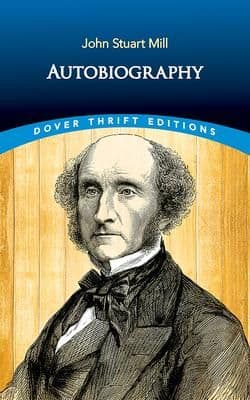
Autobiography
Mill's Autobiography is not a conventional life narrative but a didactic case study in the formation and near-collapse of a utilitarian mind. Its central thesis is that the extraordinary analytical education his father imposed produced a brilliant intellect but left him emotionally barren, triggering the mental crisis of his twentieth year. The book argues, through the narrative of that crisis and his recovery through poetry and feeling, that a complete human being requires cultivation of the sympathies and imagination alongside rigorous reasoning. Mill presents his life as evidence for a philosophical claim about what education and ethics must include.
Key Insights
✦What is the central argument of Mill's Autobiography, and what does it reject?
The Autobiography argues that Mill's father, James Mill, gave him an education of unparalleled analytical rigor but omitted any cultivation of feeling, imagination, or aesthetic experience. This produced a prodigious intellect but left Mill vulnerable to the mental crisis that struck him at twenty, when he asked himself whether the fulfillment of all his utilitarian reforms would make him happy and found the answer was no. The book rejects the assumption that intellectual training alone constitutes education, and by extension rejects a utilitarian ethics that treats pleasure or happiness as a purely calculable quantity divorced from cultivated sensibility. Recovery came through poetry, especially Wordsworth, and through emotional attachment.
✦What specific concept did the Autobiography introduce into ethical discussion?
The Autobiography gave lasting currency to the idea of a 'mental crisis' as a philosophical problem, not merely a personal misfortune. Mill's account of his twentieth-year collapse—his sudden inability to feel pleasure in anything, his sense that the whole utilitarian program had lost its savor—became a canonical case study in the relationship between intellectual formation and emotional life. The concept is not simply psychological; Mill uses it to argue that a philosophy of happiness must account for the conditions under which happiness is actually felt, not merely defined. This narrative became central to later interpretations of Mill's revisions to Benthamite utilitarianism.
✦How faithful is the published text to what Mill actually wrote?
The 1873 first edition, published posthumously by Longmans, Green, Reader, and Dyer, was not prepared directly from Mill's final manuscript [citation:1][citation:13]. It was based on a transcript made by his stepdaughter Helen Taylor, which contained over 2,650 variants from the Columbia manuscript, including more than 450 substantive changes [citation:5]. Many errors were corrected in the first printing, but over eighty substantive variants remained. The Columbia manuscript, first published in 1924, and the 'Early Draft' recovered later reveal a sharper, more candid Mill: his hostility to Christianity was stronger, his criticism of his father's severity was less softened, and a passage of intense self-laceration about his practical incapacity was wisely cancelled on Harriet Taylor's advice [citation:5].
✦What does the Autobiography reveal about Harriet Taylor's role in Mill's intellectual life?
Mill presents Harriet Taylor as the decisive intellectual and emotional influence of his adult life, crediting her with shaping his mature views on liberty, women's subjection, and the cultivation of individuality. The Autobiography's account of their twenty-year friendship before marriage, and her death shortly after Mill's retirement from the East India Company, is famously difficult to separate from Mill's idealization of her. Later scholarship, notably F.A. Hayek's edition of their correspondence, treated Mill's claims about her influence seriously rather than dismissing them as infatuation, though the precise extent of her contributions to his published works remains debated [citation:15]. The Autobiography itself is a key document in that debate.
✦How does the Autobiography relate to Mill's later ethical works like Utilitarianism?
The Autobiography provides the biographical and experiential context for the revisions Mill made to classical utilitarianism in Utilitarianism (1861). The mental crisis taught Mill that a life of purely analytical reasoning and reformist calculation was insufficient for happiness, and that the 'higher pleasures'—those of feeling, imagination, and sympathetic attachment—were qualitatively distinct from lower ones. When Mill later argued that competent judges prefer the higher pleasures and that utilitarianism must accommodate individual self-development, he was drawing on the lessons he narrates in the Autobiography. The book is thus not a digression from his philosophy but a record of the experiences that shaped it.
✦How was the Autobiography received by Mill's contemporaries?
Reception was sharply divided. In Russia, where it appeared in translation in 1874, the Autobiography was praised for its psychological insight and its narrative of self-improvement, and Tolstoy found inspiration in Mill's critical self-reflection [citation:3]. In Britain, reactions were more mixed. Thomas Carlyle's judgment that he had 'never read a more uninteresting book' became the most quoted hostile response, reflecting a sense that Mill's account of his own life was curiously dry and intellectualized even about his emotional crises [citation:3]. The Autobiography's deliberate didacticism—Mill addresses only readers interested in his education and his debts to his father and Harriet Taylor—made it vulnerable to the charge of being less a life than a syllabus [citation:6].
Wealthy Psyche is an intellectual archive. We do not host, distribute, or sell book copies — physical or digital. We provide structured knowledge to help you think better, faster.