


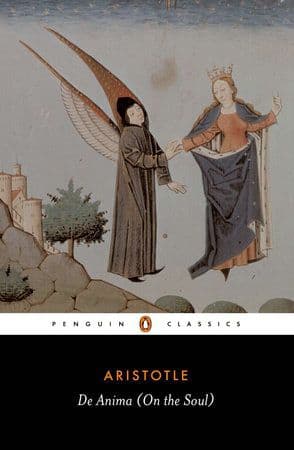
De Anima (On the Soul)
Aristotle's De Anima defines the soul not as a separate substance but as the form of a living body, its first actuality or organizing capacity for life. Through this hylomorphic framework he ranks the soul's capacities in ascending order: nutritive, perceptive, desiring, locomotive, and rational. Each is studied through its objects, so that perception, imagination, and thought are explained by what they are of. The treatise rejects both materialist reductions and Platonic soul-body dualism, and ends in the notoriously compressed account of nous, the intellect, including a distinction between an intellect that becomes all things and one that makes all things.
Key Insights
✦What is the central claim of De Anima, and what does it reject?
Aristotle claims that the soul is the form of a natural body that has life potentially, so that it is to the body as sight is to the eye. This rejects the Platonic picture, as in the Phaedo, of a soul that is a separable substance merely housed in a body. It also rejects early naturalist views that identify the soul with a particular stuff, such as fire or atoms, or with a harmony of bodily parts. For Aristotle, asking whether soul and body are one is as misguided as asking whether wax and its shape are one, since the soul is the organization that makes a body alive.
✦How does De Anima structure the soul's capacities, and why does that matter for ethics?
Aristotle arranges the capacities in a hierarchy: nutrition and reproduction shared with plants, perception and desire shared with animals, and reasoning distinctive to humans. Each higher capacity presupposes the lower ones. This scheme underlies the Nicomachean Ethics, where the human function is defined as activity of the rational part of the soul, and where the non-rational desiring part is described as capable of listening to reason. Ethical virtue, in this light, is the right ordering of desire by reason, a framework that De Anima supplies in more general psychological terms.
✦What is the dispute over the active intellect in Book III?
In a short, dense passage Aristotle distinguishes an intellect that becomes all intelligible things from one that makes them intelligible, comparing the latter to light. He adds that this intellect is separable, unmixed, and immortal. Interpreters have disagreed for centuries about whether it is an individual's own faculty, a single divine intellect, or God. Alexander of Aphrodisias identified it with the divine first cause, while Thomas Aquinas defended a reading on which each person has an active intellect. Averroes argued for one shared intellect for all humans, a position that provoked sharp medieval controversy.
✦How does Aristotle's account of perception work, and why is it distinctive?
Aristotle holds that perception is the reception of the sensible form of an object without its matter, as wax takes the imprint of a ring without the metal. The sense organ becomes like the object in the relevant respect, so perception is a kind of being affected that actualizes a capacity rather than a mere mechanical change. He also posits a common sense that unifies the data of the separate senses and allows us to discriminate between them. Scholars such as Myles Burnyeat and Richard Sorabji have debated whether this reception is literal or spiritual, a controversy that shapes how the work is read.
✦Is De Anima a work of psychology in the modern sense, or has it been misread?
A common misreading treats it as a primitive empirical psychology or a dualist theory of mind. It is a work of natural philosophy, part of the study of living things, and it treats the soul as the principle of all life, including plants. Another debate concerns whether its account of mind is a form of functionalism, as argued by Hilary Putnam in some discussions, or whether it lacks the machinery of modern functionalism and resists such labels, as Burnyeat has argued. Readers should be cautious about mapping its categories directly onto contemporary mind-body debates.
✦Which translations and commentaries of De Anima should readers consult?
The work is in Greek, and translators differ sharply on key terms such as psychē, nous, and phantasia. Standard options include the translation in the revised Oxford Translation edited by Jonathan Barnes, Christopher Shields's translation and commentary in the Clarendon Aristotle series, and Hugh Lawson-Tancred's Penguin version. Ross's Greek edition with commentary remains a reference for the text. Because the transmitted text of Book III is compressed and sometimes uncertain, readers should consult notes that discuss textual variants as well as interpretation.
Wealthy Psyche is an intellectual archive. We do not host, distribute, or sell book copies — physical or digital. We provide structured knowledge to help you think better, faster.