


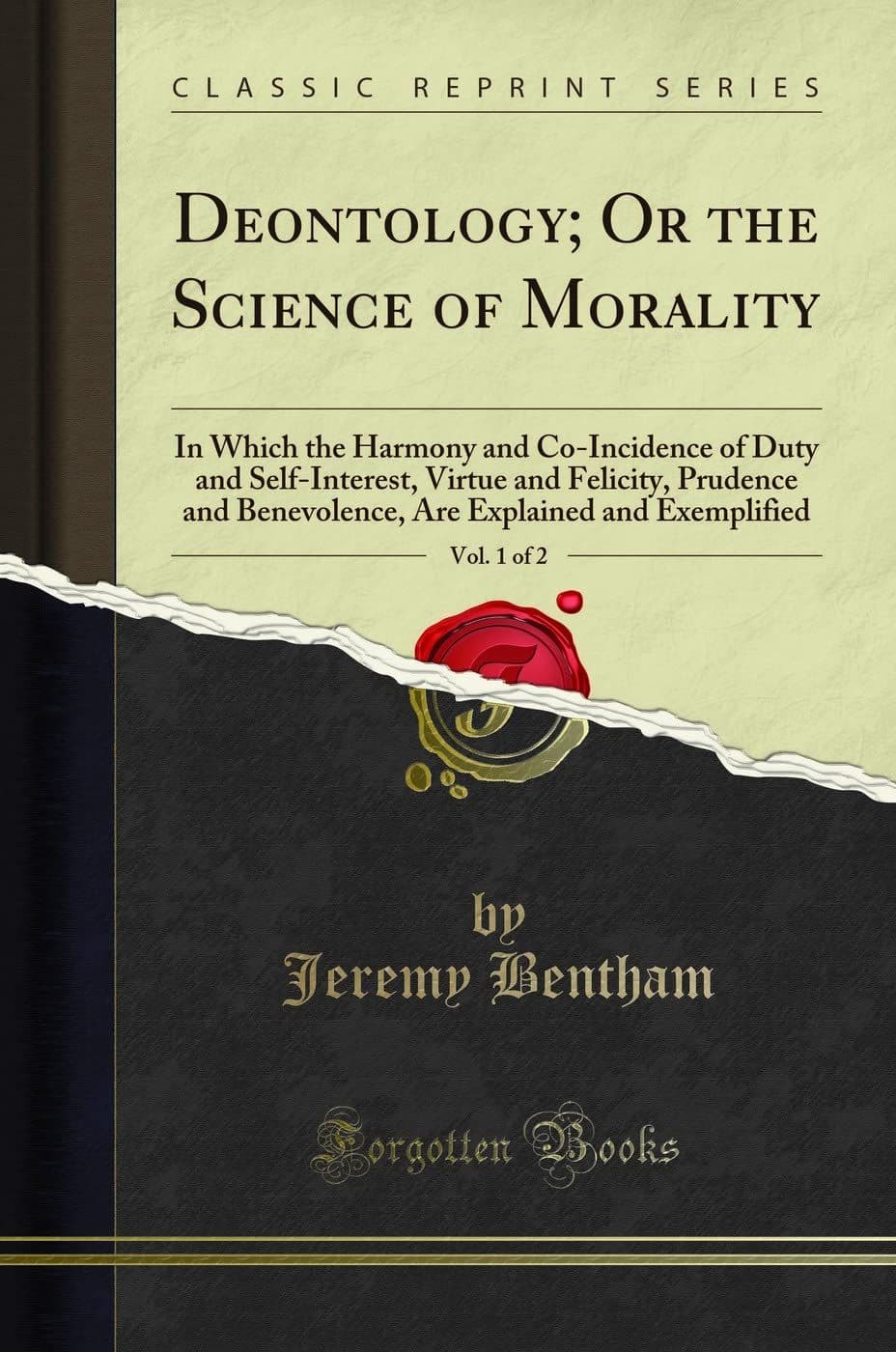
Deontology; or, The Science of Morality
This is not a treatise Bentham published but a posthumous reconstruction of his manuscripts on private ethics, edited by John Bowring and issued in 1834. Its central move is to banish the word 'ought' from moral vocabulary as an 'authoritative imposture,' replacing duty with the calculation of pleasures and pains as the sole intelligible guide to conduct. Yet the text betrays its own editor: within thirty pages it declares that pleasures 'ought to be pursued,' a contradiction critics seized on to argue that Bentham's memory would have been better served by withholding the work.
Key Insights
✦What is the central argument of Deontology, and what does it reject?
The central argument is that private morality should be understood as the art of maximizing pleasure and minimizing pain, with no independent notion of duty standing above this calculation. Bentham rejects the word 'ought' as an 'authoritative imposture,' a talisman of arrogance and indolence that allows moralists to assert obligations without justification . Virtue, on this account, is a 'fictitious entity' when separated from the pursuit of happiness. The book thus extends the principle of utility from legislation into the domain of personal conduct, arguing that prudence and benevolence are simply different calculations of the same hedonic currency. What makes the work distinctive is not the doctrine—which is familiar from the Introduction—but its polemical, almost sarcastic tone against rival moralists.
✦Why did Bentham's own disciples disown Deontology after its publication?
The work was published posthumously by John Bowring in 1834, and key Bentham disciples including Place and the Mills immediately rejected it as an authentic expression of his views . Their objection was partly textual: Bowring had assembled the second volume from 'a number of scraps' and probably 'Bowringised' the material more heavily than the first . But the substance also troubled them. Bentham's assault on the word 'ought' was so extreme that it seemed to undermine the very possibility of moral obligation, and the text's internal contradictions—denouncing 'ought' and then using it within thirty pages—made it an embarrassment . The Mills in particular were engaged in reconstructing utilitarianism as a respectable public philosophy, and Deontology's iconoclasm threatened that project. The book became a liability rather than an asset to the Benthamite cause.
✦What is the textual history of Deontology, and how does it affect interpretation?
The manuscripts date from around 1814 to 1820, written largely after dinner as a comparatively light occupation alongside the serious work of codification . Bowring edited and published the text in two volumes in 1834, but his editorial hand was intrusive: the second volume was pieced together from fragments, and the version published in the 1838–43 Works was 'essentially a paraphrasing' with Bowring's own additions . A scholarly reconstruction based on Bentham's manuscripts, edited by Amnon Goldworth, appeared in 1983 as part of the Collected Works . Readers using the 1834 text are therefore reading Bowring's Bentham, not Bentham's own words, and the contradictions that embarrassed Victorian critics may be partly editorial artifacts rather than authorial positions.
✦How does Deontology relate to Bentham's Introduction to the Principles of Morals and Legislation?
Deontology extends the utilitarian framework of the Introduction into private ethics, a domain the earlier work largely left aside. The Introduction is organized around legislation and punishment; Deontology addresses the individual's conduct toward himself and others, asking how prudence and benevolence can be reconciled with self-interest. A commentator in the Victorian era noted that Deontology is 'Bentham's only work which treats of Ethics proper, in contrast to Jurisprudence,' and that the defects of his thought, disguised elsewhere by his merits as a jurist, stand out in bold relief . The later work does not revise the principle of utility but applies it to personal morality with a polemical intensity that the systematic Introduction largely avoids. The relationship is one of application, but the application exposes tensions the legislative framework could keep hidden.
✦Does Bentham genuinely deny that duty exists?
Bentham's position is more paradoxical than a simple denial. He insists that the word 'ought' is an imposture and that duty, separated from happiness, is a fiction—yet the text also asserts that 'every pleasure is prima facie good, and ought to be pursued' . This is not merely carelessness. Bentham's point is that obligations must be grounded in something observable—pleasure and pain—rather than in an unanalyzable moral quality. When he says pleasures 'ought' to be pursued, he means that they are rationally recommended by the hedonic calculus, not that they are commanded by a mysterious moral law. Critics have argued that this is a distinction without a difference: if 'ought' is banished, it cannot be smuggled back in to recommend pleasure-seeking. The contradiction has been central to the reception of Deontology as a philosophical failure.
✦How has Deontology been treated by later Bentham scholarship?
The work occupies an uneasy place in the Bentham canon. Ross Harrison notes that some scholars, including Mary Peter Mack, have concluded that Bentham simply does not have coherent views about private morality, while David Baumgardt refused to subject Deontology to the same detailed commentary as the other works . The Goldworth edition of 1983 made a serious case for treating the manuscripts as a significant contribution to Bentham's ethical thought, but the work remains marginal compared to the Introduction and the Panopticon writings. Its value now lies less in its doctrine than in what it reveals about the tensions within utilitarianism when the principle is applied to individual conduct: the difficulty of deriving obligation from interest, and the instability of a morality that tries to do without the word 'ought.'
Wealthy Psyche is an intellectual archive. We do not host, distribute, or sell book copies — physical or digital. We provide structured knowledge to help you think better, faster.