


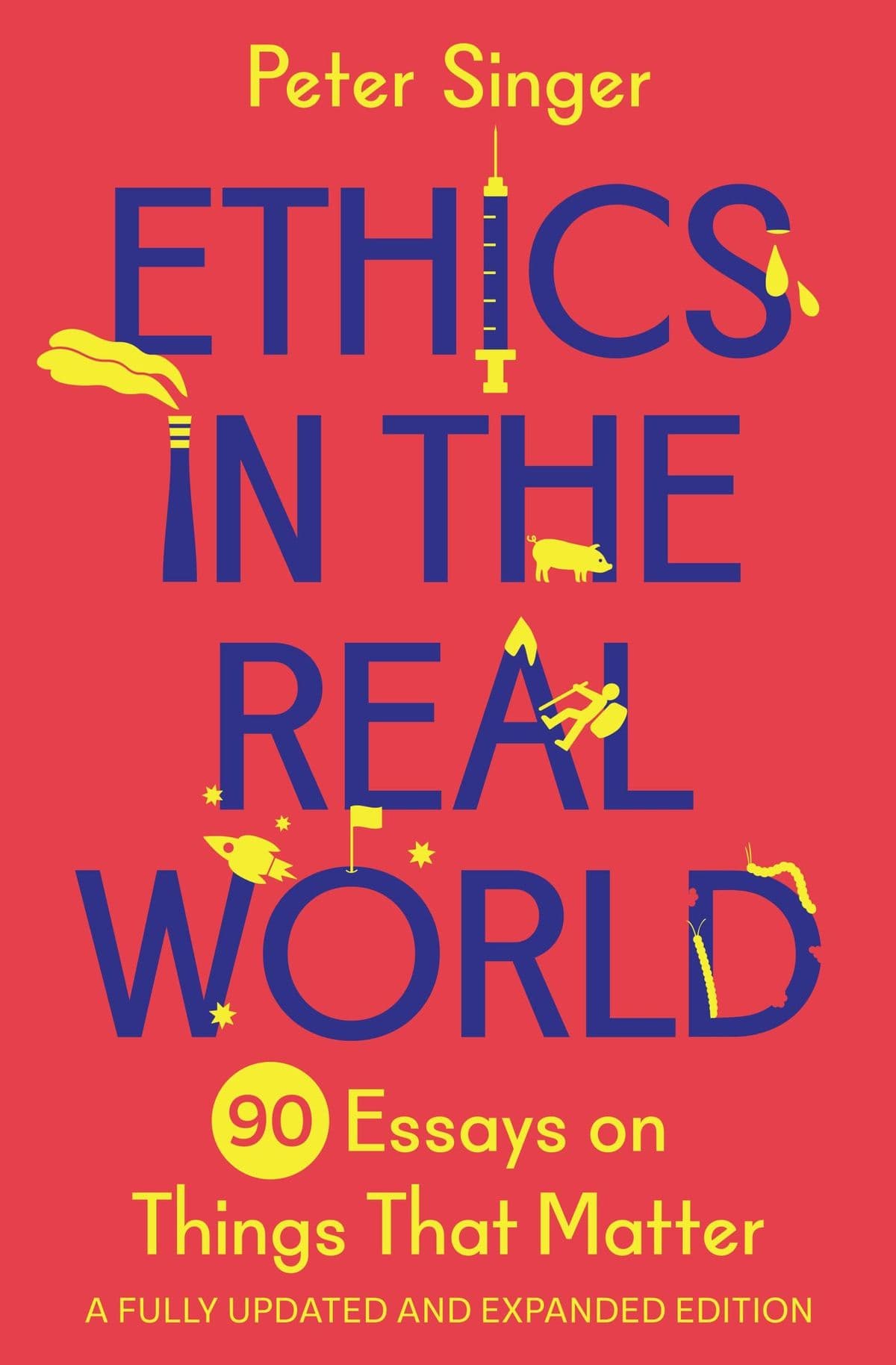
Ethics in the Real World: 82 Brief Essays on Things That Matter

This collection applies Singer's utilitarian method to discrete, real-world controversies in essays of a few hundred words each. The book's central mechanism is compression: Singer strips an issue—kidney markets, doping, climate obligations, sibling incest, robot rights—to its morally relevant features, then asks what impartial consideration of interests requires. The essays are not systematic treatises but demonstrations of how a consistent ethical framework operates under time pressure and public scrutiny. Singer revisits his core commitments (animal liberation, effective altruism, the rejection of the sanctity-of-life ethic) while extending them into unfamiliar territory, from surfing to Stalin statues to the value of a pale blue dot.
Key Insights
✦What is the organizing principle of this collection, and how does it differ from Singer's systematic books?
The collection is organized thematically rather than argumentatively: sections cover big questions, animals, the sanctity of life, bioethics, sex and gender, doing good, happiness, politics, global governance, science and technology, and living/playing/working [citation:3]. Unlike Practical Ethics or The Life You Can Save, which develop sustained arguments, these essays are occasional pieces written for newspapers and magazines, each addressing a discrete controversy in a few hundred words. The unity comes from Singer's consistent method—impartial consideration of interests, attention to empirical evidence, refusal to exempt favored practices from scrutiny—rather than from a single thesis. The book demonstrates what utilitarian reasoning looks like when applied under the constraints of public argument rather than academic exposition.
✦What specific topics does Singer address that are unusual for him, and what do they reveal?
The collection includes essays on topics outside Singer's usual territory: surfing, the ethics of high-priced art, whether to honor racists with statues, the parenting style of elephants, and a suggestion for a family conversation over a holiday feast [citation:6]. These lighter pieces reveal a side of Singer less visible in his systematic works: a willingness to treat ordinary life as morally serious without being solemn, and an interest in how ethical reflection can be integrated into everyday activities rather than reserved for crises. The essay on surfing, for instance, treats a personal pleasure as a legitimate subject for ethical attention—not because it is problematic, but because understanding what makes life worth living is itself a philosophical question.
✦How has the collection changed across its editions, and what does the expansion reveal?
The book has grown substantially. The original 2016 edition contained 82 essays [citation:3][citation:5]. A 2023 edition, subtitled '90 Essays on Things That Matter,' is described as 'fully updated and expanded,' with 37 new essays added [citation:6][citation:7]. The new material addresses developments that emerged after the original publication: free speech and fake news, stopping Putin, pandemic ethics, and colonizing space [citation:6]. The expansion reflects Singer's practice of treating public philosophy as an ongoing engagement with current events rather than a fixed body of work. The 2023 edition thus functions as a record of which issues Singer considered urgent in the intervening years, and how his framework adapted to them.
✦How have critics in the Global South responded to the book's universalist prescriptions?
A review published in Indonesia argues that Singer's essays articulate 'a stringent utilitarian call to minimize suffering through impartial and cost-effective intervention,' but that translating these prescriptions into the cultural and institutional contexts of the Global South is complicated. Drawing on Appiah, Nussbaum, and Sen, the reviewer examines case studies from Indonesia, Rwanda, and Kenya to show how communitarian reciprocity, religious obligation, and postcolonial memory complicate universalist ethics [citation:4]. The critique is not that Singer's arguments are wrong in principle, but that they assume a context of institutional capacity and cultural receptivity that does not universally obtain. The reviewer proposes embedding participatory deliberation in ethical policy frameworks and integrating comparative ethics into administrative training as responses to this gap.
✦How does the book relate to Singer's effective altruism work, particularly The Most Good You Can Do?
The collection's 'Doing Good' section contains essays that directly anticipate and supplement the arguments of The Most Good You Can Do. Essays like 'The One-Percent Solution,' 'Holding Charities Accountable,' 'Good Charity, Bad Charity,' and 'Heartwarming Causes are Nice, but Let's Give to Charity with Our Heads' [citation:3] make the same case for evidence-based giving that Singer would develop at book length. The collection format allows Singer to test these arguments in miniature before expanding them, and to address specific objections—such as the charge that effective altruism ignores the expressive value of giving—in a compressed form. Readers who find the essays compelling can turn to the longer work for the full defense.
✦What was the critical reception of the collection, and what does it suggest about the book's purpose?
Reception was generally positive, with reviewers emphasizing accessibility and range. Dwight Garner in the New York Times noted that the book offers 'a chance to witness this influential thinker grapple with more offbeat questions' . The Economist called it 'an accessible introduction to the work of a philosopher who would not regard being described as accessible as an insult' . Sam Harris praised it as a book for those who want 'a philosophy that can directly alleviate human and animal suffering' [citation:15]. The collection was longlisted for the 2017 PEN/Diamonstein-Spielvogel Award for the Art of the Essay . The reception suggests that the book succeeds on its own terms: as public philosophy that demonstrates, rather than merely describes, how ethical reasoning can engage with the world.
Wealthy Psyche is an intellectual archive. We do not host, distribute, or sell book copies — physical or digital. We provide structured knowledge to help you think better, faster.