


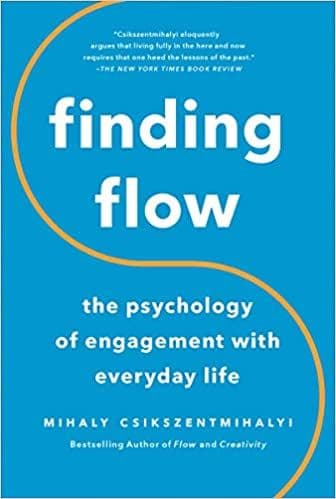
Finding Flow: The Psychology of Engagement with Everyday Life
Finding Flow is Csikszentmihalyi's prescriptive application of his flow theory to the texture of ordinary life. Its central argument is diagnostic: most people oscillate between anxiety at work and passive boredom in leisure because they fail to structure attention toward challenges that match their skills. The book's distinctive contribution is not the flow concept itself—already developed in his earlier academic work—but the claim that everyday work, chores, and relationships can be deliberately transformed into flow experiences through initiative and attention management. It is part psychological study and part self-help guide, offering a practical program for reclaiming ownership of daily experience rather than a new theoretical framework.
Key Insights
✦What is the central claim of Finding Flow, and what does it reject?
The book's central claim is that most people live their days in a state of inattention, oscillating between anxiety during work and passive boredom during leisure, and that this pattern can be deliberately broken by structuring activities to meet flow conditions—challenges that match skills, clear goals, and immediate feedback [citation:1][citation:6]. Csikszentmihalyi rejects the assumption that happiness is something that happens to people or that leisure is inherently restorative. Instead, he argues that enjoyment requires active engagement and that work, often experienced as oppressive, can be transformed into a source of flow through changes in attitude and approach [citation:3]. The book is prescriptive rather than theoretical: it takes the flow concept developed in his academic work and applies it to the practical question of how to live a more engaged daily life.
✦How does Finding Flow differ from Csikszentmihalyi's earlier book Flow?
Flow (1990) presented the theory of optimal experience as a general framework, drawing on decades of research to explain what flow is, why it matters, and how it relates to happiness and creativity. Finding Flow (1997) is explicitly a practical application: it assumes the reader is already persuaded that flow is valuable and asks how to cultivate it in ordinary circumstances [citation:17]. One reader's assessment captures the distinction: Finding Flow is small and explains how to apply the principles from the first book to daily life, and you do not necessarily need to read the first book to benefit from it [citation:3]. The later book is shorter, more prescriptive, and organized around domains of everyday experience—work, leisure, relationships—rather than around the theory's conceptual foundations.
✦What does the book say about the paradox of work?
One of the book's central chapters is titled 'The Paradox of Work,' and it addresses a finding from Csikszentmihalyi's experience sampling research: people report more flow experiences at work than during leisure, yet they say they would rather be doing something else [citation:1][citation:6]. The paradox is that work, despite being experienced as obligatory and often stressful, provides the structured challenges and feedback that generate flow, while free time often defaults to passive consumption like television, which produces boredom. Csikszentmihalyi's prescription is not to escape work but to reframe it: if flow is one of the most enjoyable states available, and work can be a vehicle for it, then treating work as something to be endured rather than engaged with is a self-defeating attitude [citation:3]. The chapter is one of the book's most practically oriented.
✦What did reviewers criticize about the book's execution?
The most pointed criticism concerns the final chapter, which begins with philosophical reflection and then turns to religion. One detailed review describes it as lacking a thesis and coming across as off-topic, marring an otherwise strong treatment of what constitutes a good life [citation:20]. The New York Times review noted that the book's assertions occasionally smack of hyperbole and overgeneralization, while still praising its central message about how we choose what we do and how we approach it determining whether our days add up to something resembling a work of art [citation:10]. Other readers have described the book as repetitive and noted that it does not actually tell you how to find flow, but rather describes what it is and why people who experience it tend to be happier [citation:12]. The criticisms converge on a mismatch between the book's self-help marketing and its more descriptive, essayistic content.
✦Does the book provide concrete techniques for achieving flow, or is it primarily descriptive?
The book is more descriptive than prescriptive, despite its self-help framing. It classifies experiences according to the balance of challenge and skill, discusses how people feel during different activities, and examines work, leisure, and relationships as domains where flow can occur [citation:12]. It does not offer step-by-step exercises or structured programs. One reader noted that a question section at the end of each chapter would have been welcome but was absent [citation:12]. The most concrete guidance is attitudinal: challenge yourself with tasks that require skill and commitment, transform routine tasks by approaching them differently, and choose active leisure over passive consumption [citation:1]. The book's value lies in reframing how readers think about their daily activities rather than in providing a technical manual for inducing flow states.
✦What does the book argue about the 'autotelic personality'?
The penultimate chapter is titled 'The Autotelic Personality,' and it addresses individual differences in the capacity to experience flow [citation:1][citation:15]. An autotelic person is someone who engages in activities for their own sake rather than for external rewards, and who can find flow in a wide range of situations rather than depending on specific conditions to be right. Csikszentmihalyi argues that this is not simply an inborn trait but a set of habits and attitudes that can be cultivated. The chapter fits the book's broader practical orientation: if flow depends on how attention is structured and how challenges are framed, then personality differences in flow proneness are not fixed destinies but patterns that can be changed. The final chapter, 'The Love of Fate,' extends this into a broader philosophical reflection on accepting and engaging with life's circumstances.
✦How does Finding Flow relate to the broader positive psychology movement?
Finding Flow was published in 1997, a year before Martin Seligman's formal call for a positive psychology, but it exemplifies the movement's core commitments before the movement had a name. It treats happiness and optimal experience as scientifically investigable phenomena, it emphasizes strengths and engagement rather than pathology, and it offers a vision of well-being that is active rather than passive. Csikszentmihalyi was a founding figure of positive psychology, and flow became one of the field's central constructs. The book's practical orientation—helping ordinary readers improve their daily lives through psychological insight—also anticipates the self-help-adjacent genre that positive psychology would later produce in abundance. Readers interested in the intellectual prehistory of positive psychology will find Finding Flow a useful bridge between academic research and public application.
Wealthy Psyche is an intellectual archive. We do not host, distribute, or sell book copies — physical or digital. We provide structured knowledge to help you think better, faster.