


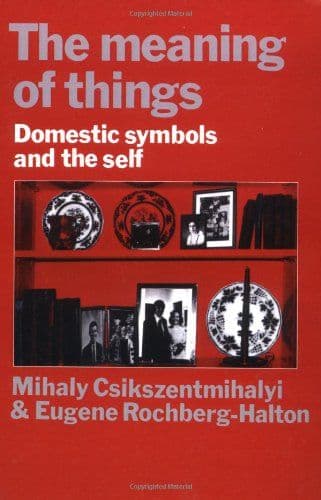
The Meaning of Things: Domestic Symbols and the Self

Co-authored with Eugene Rochberg-Halton, this book is an empirical study of how people invest household objects with meaning, based on interviews with 315 members of 82 Chicago families across three generations. Its central framework treats the person-object transaction as a dynamic triad of self, object, and cultivation: things are not inert commodities but active participants in the development of the self, serving as signs of personal identity, family continuity, and social belonging. The authors distinguish objects valued for action (often preferred by the young) from objects valued for contemplation (often preferred by the old), and argue that the human capacity to create and redirect meaning offers the only hope for survival amid material exploitation [citation:1][citation:5].
Key Insights
✦What is the central claim of The Meaning of Things, and what does it reject?
The book's central claim is that material possessions are not inert commodities but active participants in the cultivation of meaning and the development of the self. Csikszentmihalyi and Rochberg-Halton develop a model of 'personhood' in which goal-directed action and the cultivation of meaning through signs are central, and they analyze the person-object transaction as a dynamic triad of self, object, and cultivation [citation:1][citation:5]. They reject the assumption that materialism is simply about acquisition or status display. Instead, they argue that the meaning of an object can only be understood in terms of how the self infuses it with 'psychic energy' through cultivation, and that this meaning varies significantly between individuals, generations, and family types . The book's final chapter extends this argument to the environmental crisis, suggesting that the human capacity to redirect meaning is the only hope for survival [citation:1].
✦What specific study produced this book, and how was it conducted?
The research was conducted in 1977 by interviewing 315 individuals from 82 families in Chicago and Evanston, Illinois [citation:3]. The sample was stratified by class and race, but the key criterion was that each family represent three generations living close to one another, allowing cross-generational analysis. Respondents were asked to identify household objects that were special to them, explain why, describe what they would feel if the objects were lost, and discuss their attitudes toward their home . The methodology was essentially ethnographic, with no single theoretical framework guiding the study; instead, empirical patterns generated insights that required new theoretical interpretations in an evolving process . This was a departure from Csikszentmihalyi's later experience sampling work on flow, relying instead on in-depth interviews about cherished possessions.
✦What did the study find about generational differences in attachment to objects?
The most robust finding was a generational split between objects of action and objects of contemplation. Children and younger respondents tended to mention objects of action—things they used, played with, or engaged with actively—and emphasized the comfort and enjoyment those objects provided. Older respondents, particularly grandparents, tended to mention objects of contemplation, especially photographs, and emphasized the role of objects as instrumental in or symbolic of social ties, especially kin ties. When the same object was mentioned by both young and old, young people connected to it actively while older people connected to it contemplatively [citation:3]. Parents fell in between, more similar to the older group. The study also found that women in the middle generation were more inclined toward contemplative objects associated with family ideals, while men generally preferred action objects associated with individualistic ideals .
✦What did reviewers identify as the book's strengths and weaknesses?
Michael Schudson's review in the American Journal of Sociology called it 'an unusual and important study,' praising it for adding empirical material to the sociology of consumption where previous theoretical works had contributed little. He suggested that if a social psychology of materialism were ever to emerge, this book would likely be a keystone [citation:3]. However, he found the chapter on 'Characteristics of Happy Homes' the least satisfactory [citation:3]. A review in the Journal of Environmental Psychology criticized the near absence of sociological references, arguing that analyses of domestic symbols cannot do without reference to social class and that the authors neglected relevant work by Baudrillard and Bourdieu on the social determination of taste and object attachment . The book was translated into German, Italian, Japanese, and Hungarian, indicating international scholarly reception [citation:19].
✦How does this book relate to Csikszentmihalyi's later work on flow?
The Meaning of Things is a precursor to Csikszentmihalyi's flow research, not an application of it. Published in 1981, it predates the popular Flow (1990) by nearly a decade and comes from a different methodological tradition: in-depth interviews about domestic objects rather than experience sampling of momentary activities. However, the theoretical continuity is visible. Both projects are concerned with how people invest attention and psychic energy into activities and objects, and how this investment cultivates the self. The book's model of 'cultivation'—the dynamic process by which a person infuses an object with meaning through directed attention—anticipates the flow concept's emphasis on how absorbed engagement shapes experience and identity. The Meaning of Things also shares with Csikszentmihalyi's later work a concern with how meaning is created and sustained against entropy, though here the focus is domestic material culture rather than optimal experience.
✦Why is this book considered a keystone in material culture studies despite its age?
The book is cited as foundational in material culture studies because it provided empirical grounding for a field that had been dominated by theoretical speculation. Schudson noted that while Veblen, the Lynds, Douglas, Sahlins, and others had theorized about consumption and the symbolic meaning of goods, none had added much empirical material to the corpus of knowledge [citation:3]. The Meaning of Things filled that gap with a systematic study of how ordinary people in ordinary homes relate to ordinary objects. An annotated bibliography in material culture studies describes its greatest contribution as the schematization of object-person relationships at three levels: the individual self (things express qualities of the self), the social self (objects symbolize social integration and differentiation), and the cosmic self (objects signify broader existential meanings) [citation:9]. This framework remains useful for researchers analyzing how people construct identity through possessions.
✦What did the authors mean by 'cultivation' in the context of person-object relations?
Cultivation is the book's term for the dynamic process by which a person invests an object with meaning through directed attention, or 'psychic energy.' It is offered as an alternative to more deterministic and static views in which beliefs are simply cognitively structured . The concept implies that the meaning of an object is not inherent in the object itself nor simply dictated by social convention, but emerges from an ongoing transaction between self and object. This meaning can vary significantly between individuals in similar social and cultural settings and can even change for an individual over time . Cultivation thus preserves human agency in the face of material culture: people are not passive recipients of object meanings but active cultivators of them. This emphasis on active meaning-making connects the book to Csikszentmihalyi's broader psychological project.
Wealthy Psyche is an intellectual archive. We do not host, distribute, or sell book copies — physical or digital. We provide structured knowledge to help you think better, faster.