


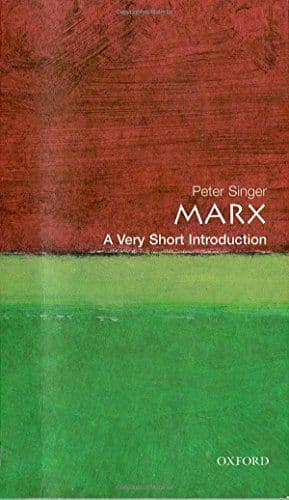
Marx: A Very Short Introduction

Singer's introduction argues that Marx's thought is unified not by economics or sociology but by a philosophical vision of human freedom. Marx's central problem, on this reading, is alienation: capitalism separates workers from their productive activity, from the products of their labor, and from each other, reducing human essence to a commodity. Singer traces this vision from Marx's Hegelian roots through the theory of alienation, historical materialism, and the critique of capital, presenting Marx as a philosopher of freedom whose critique of liberal individualism remains potent even where his economic predictions fail.
Key Insights
✦What is Singer's central interpretive claim about Marx, and what does it reject?
Singer argues that Marx's thought is unified by a single philosophical vision: a concern with human freedom, understood as liberation from alienation. The book rejects the common tendency to read Marx primarily as an economist or a social scientist. Singer presents Marx as a philosopher in the tradition of Hegel, whose critique of capitalism is ultimately a critique of a system that prevents human beings from realizing their essence through free productive activity. This framing allows Singer to treat Marx's economic theories as expressions of a deeper ethical and philosophical commitment rather than as empirical predictions subject to straightforward falsification. The interpretation is selective, but it gives the diverse body of Marx's work a coherent center.
✦How does Singer explain Marx's concept of alienation, and why does it matter for ethics?
Singer traces Marx's concept of alienation to Hegel and Feuerbach. Feuerbach argued that religion alienates human qualities by projecting them onto a deity; Marx transposed this structure onto economics, arguing that money becomes 'the alienated essence of man's labor' [citation:6]. Under capitalism, workers are separated from the products they create, from the activity of production itself, and from other human beings through competition. For Singer, this is not merely an economic observation but an ethical one: alienation represents a failure of human freedom, a condition in which people are controlled by their own creations rather than controlling them. The concept matters because it grounds Marx's critique of capitalism in a vision of what human flourishing would look like, rather than merely in inefficiency or injustice.
✦What is the textual history of this book, and how does the 2018 edition differ from the original?
The book was first published in 1980 as an Oxford University Press paperback, reissued in 1996, and first published as a Very Short Introduction in 2000 . A second, fully updated edition appeared in 2018 [citation:1][citation:7]. The 2018 edition adds new material addressing whether Marx remains relevant to the twenty-first century, including questions about inequality (eight billionaires owning as much as the bottom half of the world's population), the rise of nationalism among working-class voters, and the internet as a 'productive force' in Marxist terms [citation:7][citation:12]. The new edition also includes a chapter titled 'Is Marx still relevant?' that did not appear in the original structure. Singer's core interpretation of Marx as a philosopher of freedom remains unchanged across editions.
✦How have reviewers assessed Singer's treatment of Marx's economic theories?
Reception has been mixed on this point. The Choice review noted that Singer includes his own opinions and that many familiar with Marx will disagree with some of his interpretations, such as the claim that Marx was wrong about capitalism driving down wages and creating more severe economic crises [citation:15]. A reader review on Amazon criticized Singer for dismissing Marx's theory of surplus value and automation too quickly, arguing that Singer calls Marx's claim 'obviously wrong' without engaging with how Marx would have explained it [citation:11]. Other reviewers were more positive. One LibraryThing reviewer praised the book for avoiding oversimplification while another noted that Singer's assessment is 'insightful and fair' [citation:9]. The disagreement reflects a broader tension: Singer's philosophical focus means economic theory receives less sympathetic reconstruction.
✦How does this book relate to Singer's other Very Short Introduction on Hegel?
The two books form a natural pair. Singer published Hegel: A Very Short Introduction in 1983, three years after the Marx volume. The Marx book explicitly traces Marx's intellectual development from his Hegelian roots: the chapter 'The young Hegelian' addresses Marx's engagement with Hegel's philosophy, and the concept of alienation is presented as a transposition of Hegelian and Feuerbachian themes onto economics [citation:7]. Readers who want to understand the philosophical background that Singer assumes in the Marx book can turn to the Hegel volume for a fuller treatment of the dialectic and the master-slave relationship. Together, the two introductions show Singer's sustained engagement with German idealism and its legacy, despite his own utilitarian commitments.
✦What does Singer mean by presenting Marx as a philosopher of freedom rather than a scientist?
Singer argues that Marx's claims to have discovered 'scientific' laws of history and economics were overstated. In the book's assessment, Marx's economic theories do not constitute a scientific account of exploitation; they offer instead 'a vivid picture of an uncontrolled society in which the productive workers unconsciously create the instruments of their own oppression' [citation:9]. This picture is valuable as philosophy, social polemic, and even art, but not as predictive science. Presenting Marx as a philosopher of freedom means treating his work as a contribution to ethical and political thought—a critique of liberal individualism and a vision of unalienated existence—rather than as a failed social science. This framing allows Singer to preserve what he considers valuable in Marx while rejecting the totalizing claims that justified authoritarian communist regimes.
Wealthy Psyche is an intellectual archive. We do not host, distribute, or sell book copies — physical or digital. We provide structured knowledge to help you think better, faster.