


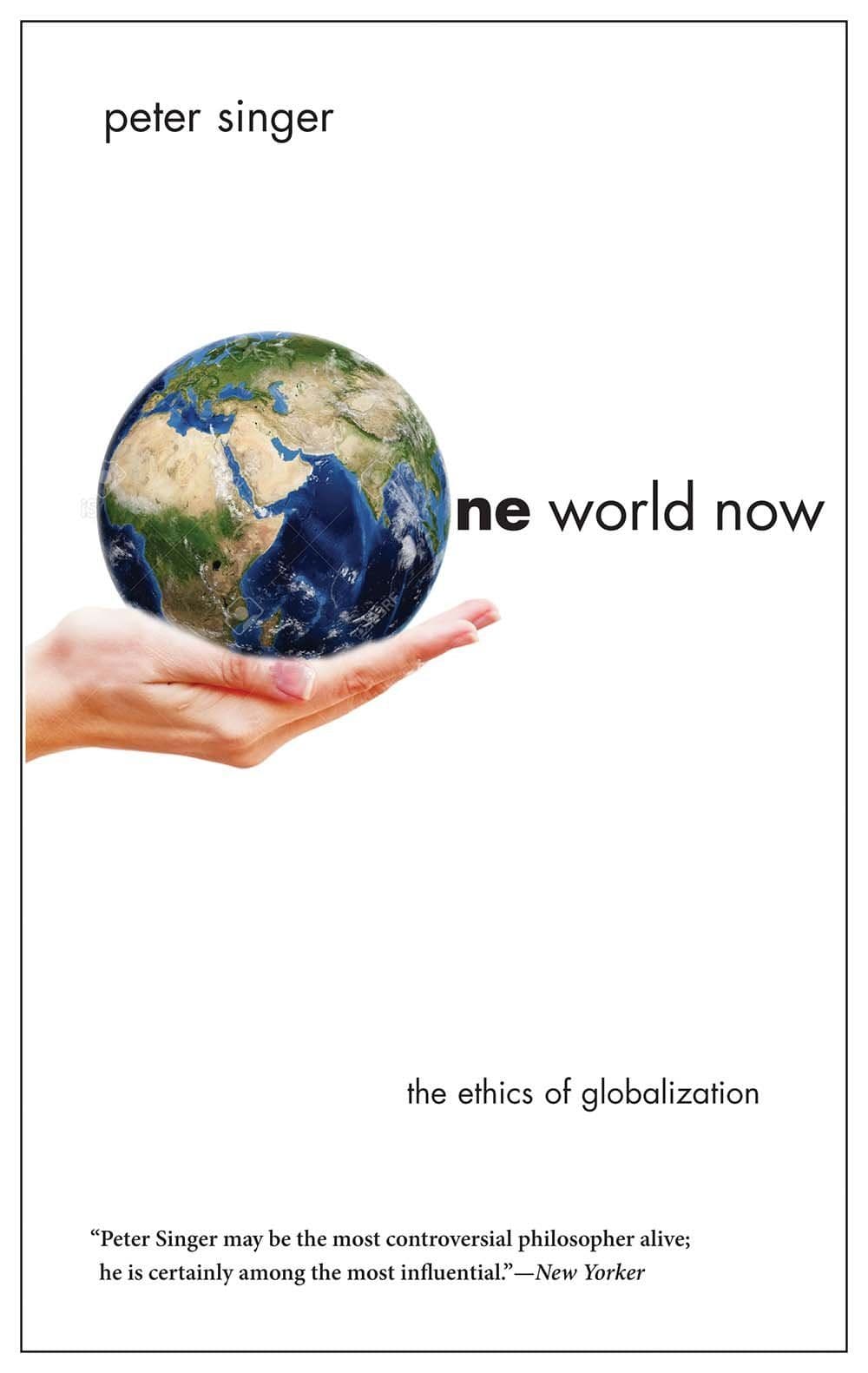
One World Now: The Ethics of Globalization

Singer argues that globalization has produced a world in which national borders no longer mark the boundaries of moral obligation. Climate change, trade rules, humanitarian intervention, and foreign aid are all treated as ethical problems that cannot be solved by states acting on narrow self-interest. The book's central mechanism is the application of a consistently utilitarian and cosmopolitan standard to each issue: the atmosphere is a shared resource to be divided fairly, sovereignty is conditional on the protection of human rights, and affluent individuals owe assistance to the global poor regardless of nationality. Singer challenges the state-centric assumptions that dominate international ethics.
Key Insights
✦What is the central argument of One World Now, and what does it reject?
Singer argues that the ethical problems created by globalization—climate change, economic integration, human rights violations, and global poverty—cannot be adequately addressed within a framework that treats nation-states as the primary moral units. The book rejects the state-centric approach that dominates international relations theory, in which each state is entitled to pursue its own interests and owes only limited obligations to outsiders. Singer's alternative is a consistently cosmopolitan and utilitarian ethic: the atmosphere is a shared resource whose benefits should be distributed equally per capita, sovereignty is conditional on a state's protection of its people, and individual affluent people have direct obligations to the global poor. The argument is pragmatic as well as moral: solving these problems requires transcending national differences.
✦What specific proposals does Singer make about climate change?
Singer treats the atmosphere's capacity to absorb greenhouse gases as a limited global resource that belongs equally to all people. He evaluates competing fairness principles—historical responsibility ('you broke it, you fix it'), the time-slice principle that holds countries responsible only for emissions after the harm was known, and simple per-capita equality—and ultimately endorses a system of tradable emissions entitlements allocated on a per-capita basis. Countries that exceed their allocation would purchase credits from countries that emit less. This framework, he argues, is fairer than the Kyoto Protocol's approach and could be acceptable to developing nations that have contributed least to historical emissions while suffering disproportionate harms. The proposal reflects his broader method: identify a shared resource, apply an egalitarian distributive principle, and design institutions to implement it.
✦How does Singer's argument about humanitarian intervention differ from traditional just-war theory?
Singer argues that humanitarian intervention is not merely permissible in cases of genocide or crimes against humanity but may be mandatory. This goes beyond traditional just-war theory, which typically treats intervention as an exception to sovereignty that must be justified by extraordinary circumstances. For Singer, sovereignty is not an absolute right but a conditional arrangement: a state that murders or cruelly neglects its own people forfeits the presumption of non-interference. He insists that only a global body like the United Nations has the moral authority to intervene, and he proposes reforms to make the UN more democratic—reducing the power of single-state vetoes in the Security Council and allowing direct popular election of representatives to the General Assembly. The argument reflects his utilitarian commitment to protecting human welfare wherever it is threatened, regardless of borders.
✦How did critics respond to the book's claim that globalization may not have helped the poor?
Singer's verdict on whether economic globalization has benefited the world's poor is deliberately cautious: he returns a Scottish verdict of 'not proven.' This disappointed critics on both sides. Free-trade advocates wanted a clear endorsement of globalization's poverty-reducing effects, while critics of globalization wanted a clear condemnation. Leif Wenar, reviewing the book in Ethics & International Affairs, noted that Singer deplores the World Trade Organization's prioritization of free trade over workers' rights, animal welfare, and environmental integrity, and demands empowerment of international institutions to ensure these values are not overwhelmed by the pursuit of efficiency [citation:18]. The cautious verdict is consistent with Singer's method: he refuses to let empirical uncertainty be resolved by ideological preference, insisting that the ethical assessment of globalization depends on evidence that is genuinely mixed.
✦How does One World Now relate to Singer's earlier work on global poverty and the expanding circle?
One World Now extends the arguments of The Expanding Circle and The Life You Can Save into the domain of global institutions and policy. The Expanding Circle (1981) argued that reason expands moral concern beyond kin and tribe; One World Now applies that framework to the specific problems of a globalized world. The Life You Can Save (2009) focused on individual donation obligations; One World Now broadens the focus to institutional reform—climate agreements, trade rules, UN reform, and humanitarian intervention. The book thus represents Singer's attempt to move from individual ethics to global political ethics, asking not only what individuals should do but what institutions should look like if cosmopolitan principles are to be realized. It is the most systematically political of his major works.
✦What changed in the 2016 edition, and why does it matter for the book's argument?
One World Now is a substantially revised edition of One World, first published in 2002 and revised in 2004 [citation:1][citation:8]. The 2016 edition integrates developments from the intervening decade, including the failure to reach a binding international agreement after Kyoto, the 2015 Paris climate accord with its non-binding pledges, the collapse of the Doha Round trade negotiations, and the emergence of the 'responsibility to protect' norm. The updated data and evidence are significant because Singer's argument is empirical as well as moral: his assessments of whether globalization has helped the poor, whether climate institutions are working, and whether humanitarian intervention can be effective all depend on facts that change over time. The 2016 edition also includes a new preface addressing these shifts, making it the most current statement of Singer's global ethics.
✦How does Singer's cosmopolitanism differ from Thomas Pogge's approach to global poverty?
Both Singer and Pogge argue that affluent people have obligations to the global poor that are not limited by national borders, but their foundations differ significantly. Singer's argument is utilitarian and consequentialist: the suffering of the global poor is a harm that can be prevented at relatively low cost to the affluent, and the failure to prevent it is therefore morally wrong. Pogge's argument, developed in World Poverty and Human Rights (2002), is rights-based and institutional: the global poor are harmed by a coercive global order that the affluent impose and uphold, and the affluent therefore owe them compensation for this harm. Pogge frames the obligation as a matter of justice owed to those wronged, not as a matter of charity or utility maximization. Singer engages with these questions in One World Now but does not adopt Pogge's rights-based framework, remaining committed to the utilitarian method that has defined his work.
Wealthy Psyche is an intellectual archive. We do not host, distribute, or sell book copies — physical or digital. We provide structured knowledge to help you think better, faster.