


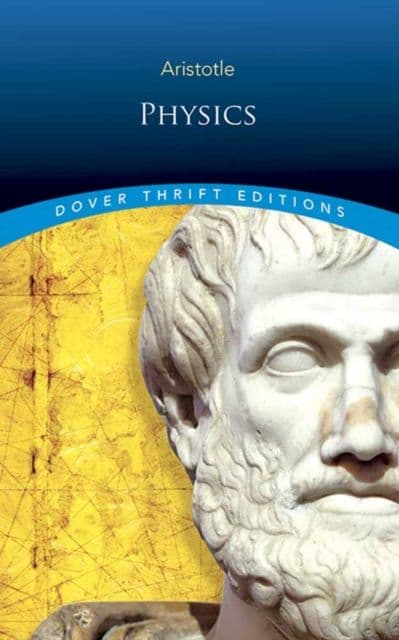
Physics (Physike Akroasis)
Aristotle's Physics is the foundational treatise on nature (physis), defined as an internal principle of change and rest in things that have it. Its central thesis is that natural change must be explained through a small set of principles: matter, form, and privation, together with the four causes (material, formal, efficient, and final). Aristotle argues against Eleatic denials of change by distinguishing potentiality from actuality, defines motion as the actuality of what exists potentially, analyzes place, void, infinity, and time, and rejects the void and actual infinity. The work culminates in an argument for an unmoved first mover as the ultimate source of eternal motion.
Key Insights
✦What is the central claim of the Physics, and what does it reject?
Aristotle claims that nature is a principle of change within things, and that change is intelligible once we distinguish what a thing is potentially from what it actually is. This rejects Parmenidean arguments that change is impossible because being cannot come from non-being. Aristotle replies that a thing comes to be from what it is not yet, a privation, not from absolute nothing. He also rejects purely materialist explanations, such as those of the atomists, arguing that form and end are as much part of the explanation of natural things as matter and chance.
✦What are the four causes, and how is final causation disputed?
In Book Two Aristotle distinguishes material, formal, efficient, and final causes, answering what a thing is made of, what it is, what initiated it, and what it is for. The status of final causation in nature has been contested. Some interpreters hold that natural teleology is built into organisms and their processes, while others, drawing on his remarks on necessity and chance, read it more modestly. Aristotle rejects Empedocles's view that apparent purpose arises by chance survival. Modern discussion often asks how his teleology relates to Darwinian explanation.
✦How does Aristotle define motion, and why is the definition famously obscure?
He defines motion as the actuality of what exists potentially, insofar as it is potential. The formula is compressed and has generated long interpretive disputes about whether it describes the process of realizing a potential or the exercise of an existing capacity. Ancient commentators such as Simplicius and Philoponus offered competing readings, and modern scholars including Aryeh Kosman and Sarah Waterlow have returned to the question. The definition matters because Aristotle uses it to make change, place, and time part of one framework.
✦What does Aristotle say about time, void, and infinity?
Book Four defines time as the number of motion with respect to before and after, which links time to change and raises the question of whether time could exist without a soul to count. Aristotle also rejects the void, arguing that motion in a vacuum would be unlimited in speed, and denies actual infinity while permitting potential infinity, as in the endless divisibility of a line. These positions set the terms of later debate, and Zeno's paradoxes are treated in Book Six as problems of continuity.
✦How is the Physics misread as a failed ancestor of modern physics?
A common oversimplification treats it as bad science superseded by Galileo and Newton. It is a work of natural philosophy that asks what nature, change, place, and time are, not a mathematical theory of motion. Another misreading is that the unmoved mover is a creator god; Aristotle's mover is a final cause of eternal motion. Scholars such as Mary Louise Gill and David Furley urge reading its arguments in their own terms and in relation to the Metaphysics and De Caelo rather than judging them by modern physics.
✦Which translations and textual points should readers know?
The Physics probably derives from lecture material and its books were arranged by later editors; Book Seven has a doubtful relationship to the rest, existing in two versions. Standard English options include Robin Waterfield's Oxford World's Classics translation, C. D. C. Reeve's Hackett translation, and the revised Oxford Translation edited by Jonathan Barnes. W. D. Ross's Greek edition with commentary remains a reference. Readers should compare how translators render key terms such as kinesis, energeia, and to ti en einai.
Wealthy Psyche is an intellectual archive. We do not host, distribute, or sell book copies — physical or digital. We provide structured knowledge to help you think better, faster.