


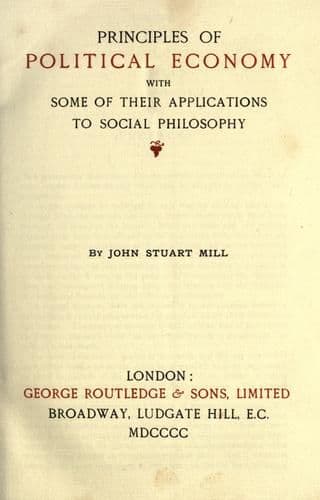
Principles of Political Economy, with Some of Their Applications to Social Philosophy
Mill's Principles is not a narrow textbook but a synthesis of classical economics and social philosophy, built around a single influential distinction: the laws of production are fixed and inexorable, while the distribution of wealth is a matter of human institution and therefore open to deliberate reform. This separation allowed Mill to defend Ricardian economic analysis while simultaneously arguing for progressive changes in property, inheritance, and land tenure. The work's central mechanism is the application of economic principles to social questions—not the derivation of abstract theory for its own sake—which is why Mill insisted on the subtitle's emphasis on social philosophy.
Key Insights
✦What is the central thesis of the Principles, and what does it reject?
The book's organizing distinction is between the laws of production, which Mill treats as physical truths dependent on the nature of matter and human psychology, and the distribution of wealth, which he insists is a matter of human will and institution. This distinction allows Mill to accept Ricardian and Malthusian economics while rejecting the fatalistic conclusion that existing inequalities are natural or inevitable. The Principles rejects the idea that political economy is a value-neutral science of wealth alone. Mill explicitly frames the work as a successor to Adam Smith's Wealth of Nations, embedding technical economics within a broader discussion of social institutions, principles, and policy[citation:2]. The book is therefore both a textbook and an argument for reform.
✦What specific concept or framework did the Principles introduce, and where is it used today?
Mill's separation of production from distribution became the most influential conceptual framework associated with the book. The claim that production is governed by inexorable laws while distribution depends solely on human institutions was taken up by later economists and social reformers, including the Fabian socialists and early welfare-state theorists. The distinction provided a respectable economic foundation for arguing that poverty and inequality were political problems rather than natural necessities. Modern scholarship, however, notes that Mill himself struggled to maintain the separation consistently; the Spectator's 1965 review of the Collected Works observed that Mill had to contradict himself on this point[citation:10]. Nonetheless, the framework shaped a century of debate about the relationship between economic law and social justice.
✦How did the Principles change across Mill's lifetime, and what do those revisions reveal?
Mill revised the Principles through seven editions between 1848 and 1871, and the changes were substantial. The third edition (1852) was particularly significant: it materially added to or recast several chapters, rewrote the chapter on property to give enlarged accounts of socialism, and incorporated the effects of the 1848–49 revolutions and the California gold discoveries[citation:4]. The second edition had already introduced new material on capital, and later editions adjusted predictions about agriculture and machinery in response to observed developments. These revisions show Mill treating the Principles as a living work rather than a fixed treatise. The standard scholarly text is the seventh edition of 1871, with notes indicating the significant changes made across the six editions Mill himself revised[citation:6][citation:11].
✦How was the Principles received outside Britain, particularly in Russia?
The Russian reception was unusually enthusiastic and politically significant. Mill's Principles became widely read among the Russian intelligentsia in the late 1850s, and the work's combination of rigorous economics with explicit attention to social institutions and reform made it attractive to readers seeking alternatives to both autocratic tradition and revolutionary radicalism. The Russian translator faced specific challenges: in the 1865 edition, 'skilled labor' was rendered as masterovye, a term with a narrower connotation than the English, and later editions refined the translation[citation:13]. The book's popularity in Russia illustrates how Mill's social-philosophical framing of economics traveled differently from the purely technical treatises of his contemporaries.
✦Did Mill's views on 'natural differences' affect his economic arguments in the Principles?
Yes, in ways that distinguish him sharply from many contemporaries. In the Principles, Mill explicitly attacked explanations of Irish economic backwardness that appealed to inherent Celtic indolence, calling this 'the most vulgar' of all modes of escaping from the consideration of social and moral influences on the human mind[citation:5]. He made the same argument about women: that their apparent inferiority resulted from education and institutional arrangements, not nature. The economist W. R. Greg criticized Mill's position in the Quarterly Review, insisting that an Irishman was 'not an average human being' and that peasant proprietorship would fail to change inherent character[citation:5]. Mill's refusal to naturalize economic outcomes is a defining feature of the Principles and connects directly to his later work on women's equality.
✦What is a common misreading of the Principles, and why does it persist?
The most persistent misreading treats the Principles as a straightforward defense of laissez-faire capitalism. Mill was indeed a classical economist, but the book's subtitle—'with some of their applications to social philosophy'—signals that he was equally concerned with institutional critique. He defended peasant proprietorship, criticized the existing distribution of land, and treated socialism as a legitimate subject for serious analysis rather than dismissal. The Spectator's review of the Collected Works noted the irony that Mill was 'the prophet of competition, progress and growth' who also yearned for a stationary state in which the struggle for wealth could cease[citation:10]. Modern readers who approach the Principles expecting a Victorian version of free-market ideology miss the work's reformist purpose and its author's ambivalence about the society he analyzed.
✦How does the Principles relate to Mill's later ethical and political works?
The Principles provides the economic and institutional background for Mill's later arguments in On Liberty and The Subjection of Women. Stephen Nathanson has argued that studying the Principles can help resolve the apparent contradiction between Mill's views in On Liberty and those in Utilitarianism, making it a key text for understanding his philosophy as a whole[citation:3]. The book's treatment of property, inheritance, and the condition of the working classes shows Mill applying utilitarian reasoning to concrete institutions rather than abstract principles. It also anticipates his later insistence that individuality and self-development require material conditions—security of person and property, access to education, freedom from extreme poverty—that the existing distribution of wealth systematically denied to many.
Wealthy Psyche is an intellectual archive. We do not host, distribute, or sell book copies — physical or digital. We provide structured knowledge to help you think better, faster.