


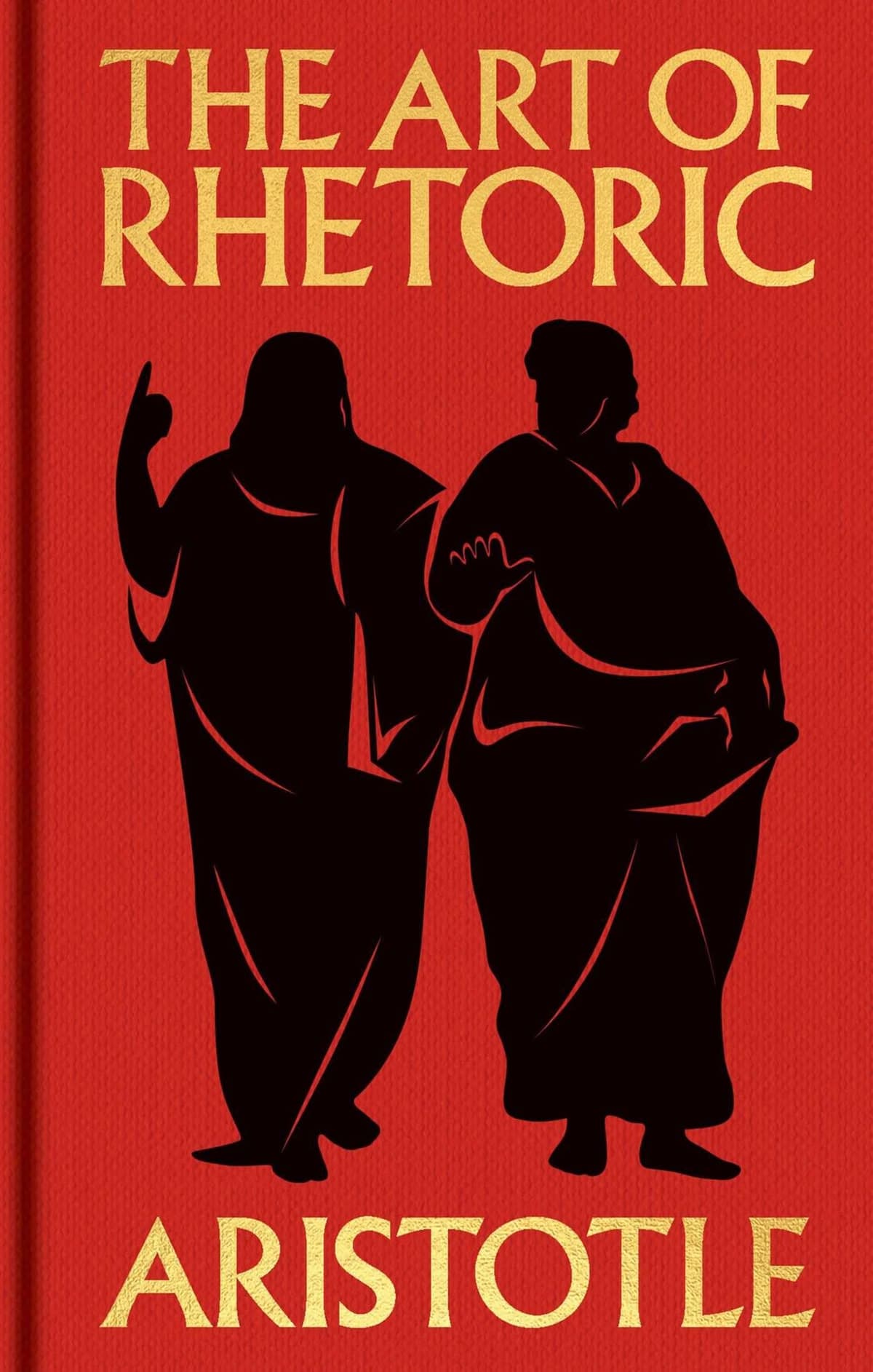
Rhetoric (Rhetorike)
Aristotle's Rhetoric defines rhetoric as the faculty of observing, in any given case, the available means of persuasion, and treats it as a systematic art rather than a bag of tricks. Its central mechanism is the analysis of three modes of proof: ethos (the speaker's perceived character), pathos (the emotions aroused in the audience), and logos (argument), with the enthymeme and the example as rhetoric's counterparts to the syllogism and induction. The work sorts speeches into deliberative, forensic, and epideictic kinds, catalogues the emotions and character types an orator must understand, and closes with style and arrangement. It presents rhetoric as the counterpart of dialectic.
Key Insights
✦What is the central claim of the Rhetoric, and what does it reject?
Aristotle claims that persuasion can be studied as a rational art, concerned with the available means of persuasion in each case, and that its core is argument rather than appeals to emotion alone. He rejects the approach of earlier handbooks, which he says concentrated on arousing the jury's feelings and on peripheral matters of litigation. He also answers Plato's charge in the Gorgias that rhetoric is a knack akin to flattery, by arguing that rhetoric has a method, is useful, and serves truth and justice because true and just things are naturally more persuasive when well presented.
✦What are ethos, pathos, and logos, and how does Aristotle treat them?
He names three technical proofs: the speaker's character as it appears in the speech, the emotional state of the audience, and the argument itself. Book One examines logos and the kinds of premises orators use, while Book Two analyzes character types and treats emotions such as anger, fear, pity, and envy, specifying the conditions that produce them, toward whom, and why. This treatment of the emotions has been influential in the history of psychology and in modern philosophy of emotion. Readers should note that the labels ethos, pathos, and logos are a later shorthand rather than a fixed Aristotelian vocabulary.
✦What is the enthymeme, and how is it disputed?
The enthymeme is the rhetorical counterpart of the syllogism, an argument from probable premises that the audience supplies in part. A traditional reading, going back to later commentators, defines it as a syllogism with a suppressed premise. Several modern scholars, including Myles Burnyeat, have argued that this reading is too narrow and does not capture Aristotle's view, which concerns arguments drawn from what is generally accepted or likely. The dispute affects how closely the Rhetoric is tied to the formal logic of the Prior Analytics.
✦How does the Rhetoric relate to dialectic and to Aristotle's ethics?
The opening sentence calls rhetoric the counterpart of dialectic, since both argue about matters that belong to no single science and both draw on common premises. Rhetorical argument draws heavily on the Topics, and its catalogues of goods, virtues, and character types depend on the ethical theory worked out in the Nicomachean Ethics. Book One's list of the goals of speakers, including the good and the advantageous, shows how rhetoric borrows from ethics and politics. Aristotle also notes that rhetoric is a kind of offshoot of both dialectic and the study of character.
✦Is the Rhetoric a single, unified work?
Its unity has long been questioned. Books One and Two develop the theory of proof and the emotions, while Book Three treats style and arrangement and may have originated as a separate lecture course. Werner Jaeger proposed that the work was composed in layers over Aristotle's career, and later scholars debated that thesis. The surviving text is probably compiled lecture material rather than a single polished treatise. Readers should keep this in mind when judging apparent tensions in its account of how rhetoric relates to ethics and truth.
✦Which translations and commentaries of the Rhetoric should readers consult?
George A. Kennedy's translation, On Rhetoric: A Theory of Civic Discourse, includes extensive notes and introductions and is a common choice for students. Robert C. Bartlett and Joe Sachs have also published translations, and the revised Oxford Translation edited by Jonathan Barnes includes W. Rhys Roberts's version. For the Greek, the commentary by E. M. Cope and J. E. Sandys remains a classic reference. Readers should compare how translators render terms such as pistis, enthymema, and eikos, which affect how persuasion and reasoning are understood.
Wealthy Psyche is an intellectual archive. We do not host, distribute, or sell book copies — physical or digital. We provide structured knowledge to help you think better, faster.