


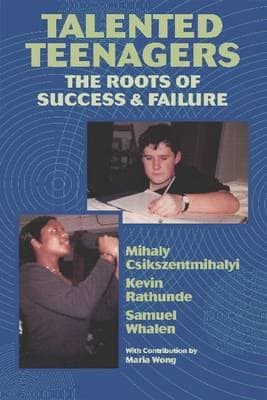
Talented Teenagers: The Roots of Success and Failure

Co-authored with Kevin Rathunde and Samuel Whalen, this book reports a five-year longitudinal study of gifted adolescents and asks why some sustain commitment to their talent while others drop out. Its central framework applies Csikszentmihalyi's flow model to talent development: teenagers persist not because they are more capable or more pressured, but because they find the experience of working in their domain intrinsically rewarding. The book examines personality traits, family interactions, schooling, and the quality of momentary experience, arguing that enjoyment of challenge—not raw ability—is the decisive factor in converting youthful promise into adult achievement.
Key Insights
✦What is the central claim of Talented Teenagers, and what does it reject?
The book's central claim is that commitment to talent during adolescence depends primarily on the quality of experience derived from working in one's domain—specifically, whether the activity produces flow. Csikszentmihalyi, Rathunde, and Whalen reject explanations that privilege raw ability, external pressure, or socioeconomic advantage alone. Their five-year longitudinal study of gifted teenagers found that those who continued to develop their talent described their work as enjoyable, even when it was difficult, while those who dropped out experienced the same activities as boring or anxiety-provoking [citation:10]. The book also rejects the assumption that talent development is a purely cognitive process; the authors deliberately set aside the cognitive dimension to examine personality, family, school, and momentary experience [citation:15]. Persistence, on this account, is a motivational and experiential phenomenon, not merely a matter of aptitude.
✦What specific framework does the book apply to talent development?
The book applies Csikszentmihalyi's flow model of optimal experience to the question of why some talented teenagers persist while others disengage. Flow occurs when challenges and skills are balanced, goals are clear, feedback is immediate, and attention is fully absorbed—conditions that make an activity intrinsically rewarding [citation:10]. The authors use this framework to interpret their data on personality traits, time use, family interactions, and schooling. Their conclusion is that talented teenagers who continue are those who learn to enjoy the hardships and challenges of their domain, turning difficult practice into flow experiences. This application extends flow theory from laboratory and leisure contexts into the developmental domain of adolescent talent, and it anticipates the argument Csikszentmihalyi would later make in Becoming Adult about the importance of intense concentration in skill-demanding activities.
✦How was the study conducted, and what makes its methodology distinctive?
The research was a five-year longitudinal study of gifted adolescents, tracking their development through high school to understand how personality, habit, and motivation sustain involvement in an area of talent [citation:15]. The authors used what Choice magazine described as a 'systematic phenomenological' approach: students made journal entries at designated times, a method derived from Csikszentmihalyi's Experience Sampling Method (ESM), alongside interviews and tests. This allowed the researchers to capture the quality of moment-to-moment experience rather than relying on retrospective self-report. The book's table of contents reflects the study's structure: chapters on what talent is, how the study was conducted, what talented teenagers are like, how they live, fields and domains, the experience of talent, family influences, schools and teachers, commitment, and cultivation throughout life [citation:3][citation:9]. The appendixes contain most tables and graphs, keeping the main narrative readable.
✦What did reviewers identify as the book's strengths and limitations?
Contemporary Psychology called it 'the most significant study of talent development to appear … [in] almost a decade,' and Howard Gardner praised it for demonstrating that well-crafted social science can illuminate the cultivation of talented youth [citation:3]. Teacher Magazine noted that its message applies to all teenagers, not just the exceptionally talented. Choice praised the book's comprehensible style and clear chapter summaries but observed that its educational implications are 'somewhat ideal' [citation:15]. The main limitation is structural: by deliberately setting aside cognitive dimensions, the study cannot address how ability differences interact with motivational ones. The book also predates the broader replication and methodological scrutiny that developmental psychology has undergone since the 1990s, and its sample, while longitudinal, is not large enough to support strong causal claims about specific family or school interventions.
✦How does this book relate to Csikszentmihalyi's other work on adolescence and flow?
Talented Teenagers sits between Csikszentmihalyi's foundational flow research and his later applied studies of adolescent development. It applies the flow model developed in Beyond Boredom and Anxiety (1975) and Flow (1990) to a new population and a new question: not what flow feels like, but how it sustains commitment to talent over time. It also extends the research program of Being Adolescent (1984, with Reed Larson), which used ESM to study the general texture of adolescent experience, by narrowing the focus to gifted teenagers and the specific problem of talent retention. The book was later followed by Becoming Adult (2000, with Barbara Schneider), which applied a similar longitudinal and experiential framework to the broader transition from school to work, examining how adolescents prepare for adult careers rather than how they sustain a specific talent [citation:1][citation:3].
✦What does the book conclude about the roles of families and schools in talent development?
The study finds that families and schools matter, but not in the ways that simple prescriptions would suggest. Families influence talent development through emotional support and by valuing the development of talent, not merely through pressure or resources; the authors' excerpt notes that how much parents value talent and how emotionally supportive they are seem important for keeping youngsters focused [citation:10]. Schools matter primarily through teachers who can pique interest and sustain engagement, and the book includes a chapter on schools, teachers, and talent development. However, the authors are cautious about drawing strong causal conclusions from their observational data, and Choice observed that the educational implications presented are 'somewhat ideal' [citation:15]. The book's emphasis is on the quality of experience in family and school settings rather than on specific structural interventions.
✦Why is this book relevant to positive psychology despite focusing on gifted adolescents?
Talented Teenagers is an early application of positive psychology's core concepts—flow, intrinsic motivation, and the quality of subjective experience—to a developmental question that had been dominated by deficit-oriented and ability-focused frameworks. By asking what makes some adolescents persist rather than what makes them fail, the book exemplifies the positive psychology commitment to studying what goes right. It also provides empirical support for the claim that enjoyment and engagement, rather than external rewards or pressures, are what sustain long-term effort. Csikszentmihalyi was a founding figure of positive psychology, and this book, published in 1993 before the field's formal institutionalization, shows the flow framework being extended from leisure and work into education and adolescent development. It won the 1994 Social Policy Book Award from the Society for Research in Adolescence, indicating recognition beyond positive psychology's immediate circle [citation:3].
Wealthy Psyche is an intellectual archive. We do not host, distribute, or sell book copies — physical or digital. We provide structured knowledge to help you think better, faster.